
Why “It Depends” Is a Real Answer, and Also a Cop-Out
At CT Pro Concrete Leveling, we lift sunken driveways, garage floors, patios, and walkways back into place across the Hartford area instead of tearing them out. Homeowners ask us how much does concrete leveling cost in Connecticut multiple times a day.
You can expect to pay anywhere from $6.51 per square foot for basic mudjacking up to $25 per square foot for complex polyurethane foam injections based on 2026 data.
Every contractor who avoids giving you a firm number says the price simply depends on the job. That standard industry response is technically true, but it leaves you entirely in the dark.
Our goal is to give you the exact details you need to estimate your own job before anyone ever visits your property. You will learn the exact math behind the quote.
Three specific measurements determine the final price of a concrete slab lift. Everything else is secondary to these core factors.
The Three Variables
These three measurements dictate the volume of material required and the exact labor needed for your specific job. High-density polyurethane foam expands up to 30 to 40 times its liquid volume, meaning material usage heavily drives the final invoice.
Our team looks closely at these three exact factors when calculating your quote.
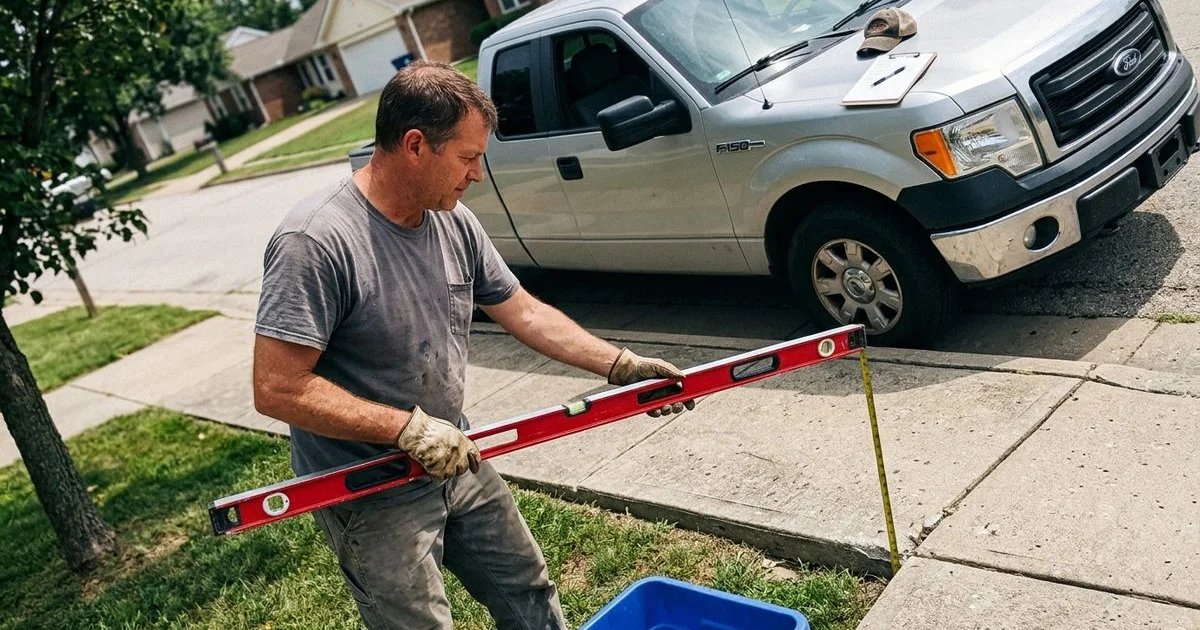
- Square footage of the area being lifted: The size of the actually settled sections sets the baseline for the project scope. Sectional lifting is the standard approach for older residential properties in the Hartford ring towns. On most driveways, only part of the run needs treating. This is the variable people expect most, yet it matters the least for the final price.
- Lift height: This measures how far the slab has dropped from where it should logically sit. This variable is far more important than the surface area. A two-inch drop across a section needs roughly double the material of a one-inch drop across that same area because polyurethane material is sold by the pound.
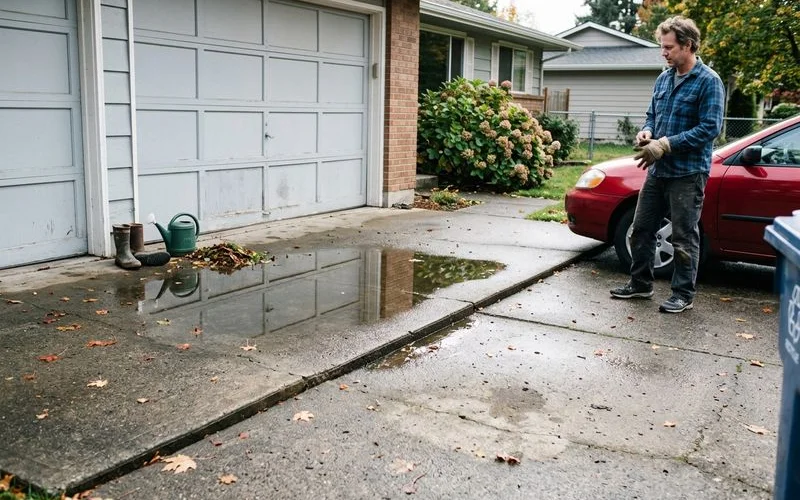
- Void volume beneath the slab: The cavity under a settled slab is the biggest cost factor, and it is entirely invisible from the surface. Water erodes soil irregularly over the years. A slab that dropped an inch might hide a cavity three inches deep in certain places and nothing at all in others.
Why Flat Per-Slab Rates Hide Too Much
A flat per-slab rate is structurally dishonest because it ignores the hidden void volume that dictates the actual material cost. You will see companies advertise a fixed price per slab or per square foot to make their quotes look simple.
This attractive pricing model fails to account for the realities of soil erosion. Take two 400-square-foot driveway sections in a town like Glastonbury, both dropped an inch and a half.
One slab sits over a shallow, even cavity. The other sits over a deep, washed-out channel where a downspout has been discharging water for fifteen years.
“A single per-foot rate covering both scenarios means the company is either overcharging the first customer or losing money on the second.”
Contractors do not stay in business by habitually losing money on large voids.
Our per-project quoting method relies on a measured survey to ensure the final number reflects your specific slab. This approach protects you from subsidizing someone else’s massive concrete cavity.
Secondary Factors
These secondary details move the final figure less, but they require itemized pricing rather than getting hidden in a round number. Every specific property feature adds a layer of time and material requirements to the job.
We calculate these secondary factors based on the unique layout of your home.
- Slab type: Interior work requires specialized dust control and contents clearing. Pool decks need controlled, incremental lifting near fragile fiberglass or gunite shells. Stamped surfaces demand planned port placement and color-matched patching for the injection holes.
- Access and staging: Parking our rig directly near the slab means no premium access fees. Running hoses a long distance or carrying staged equipment off-site adds a specific line item to your quote.
- Pitch correction: Restoring proper water drainage is a more demanding lift than simply raising a slab back to a flush level. This requires aiming for a specific target profile to shed water away from your foundation.
- Joint sealing on completion: This cheap, optional service is always worth doing. High-quality caulking keeps surface water out of the stabilized base you just paid to fix.
- Cure time requirements: Polyurethane foam cures in about 15 to 30 minutes, allowing immediate use of the driveway. Traditional mudjacking requires hours or even days to dry completely, which impacts project staging.
What It Costs Against Replacement
The slab lifting price Connecticut homeowners pay runs roughly 50% to 70% less than a full tear-out and replacement job. The financial gap between lifting and replacing widens significantly as the size of your concrete slab increases.
Replacement pricing scales directly with area. Demolition, disposal, wooden forms, fresh concrete delivery, and finishing labor all multiply by the square footage. In 2026, Connecticut homeowners pay an average of $5.83 per square foot just for the demolition and removal of an old slab before new concrete even arrives.
Lifting pricing relies heavily on lift height and void volume, which do not scale linearly with the surface area.
Practically, a small front stoop lift saves a modest amount of money compared to rebuilding it from scratch. A long approach driveway or a large backyard patio saves an amount that generally settles the decision immediately. Lifting versus replacing works through the non-cost factors too, including yard disruption, landscaping damage, and expected service life.
| What you are comparing | Priced by | Scales with slab size? | Connecticut 2026 Impact |
|---|---|---|---|
| Concrete lifting | Lift height + void volume | Weakly | $5 to $25 per sq. ft. |
| Tear-out and repour | Total Area | Directly | $15.50+ per sq. ft. total |
| Days without access | The method used | 1 day vs 7+ days | Zero downtime with foam |
| Landscaping restoration | Heavy equipment damage | $0 vs heavy costs | No bobcats on your lawn |
What the Free Inspection Includes
Our free inspection provides a real, measured survey of your property rather than a high-pressure sales visit. There is absolutely no obligation to book a repair.
We follow a strict evaluation process on every property:
- Acoustic void mapping: We sound the slab across its entire area with a steel rod to map the underground cavity. This acoustic test reveals the hidden voids caused by local freeze-thaw cycles.
- Precision drop measurement: Our team measures the surface drop against fixed reference points. A garage slab, a door threshold, or the street edge serves as the perfect target level.
- Structural integrity check: We inspect the condition of the concrete itself to establish whether it is a viable lifting candidate. Severely crumbled slabs cannot hold the immense pressure of a heavy lift.
- Root cause analysis: We trace what is feeding water underneath the area. Fixing the underlying drainage problem dictates whether the repair holds long-term.
You will receive a written quote covering the exact scope, the measurements it is based on, and the total price.
That price is the final price. The quote does not move once work starts unless you ask for something different or we uncover drastically different underground conditions. If that happens, we stop all work, explain the new findings, and agree on a plan before continuing.
If our honest recommendation is a full replacement rather than lifting, we put that in writing at no charge. We do this even though it costs us the job, because your safety comes first.
Getting a Real Number
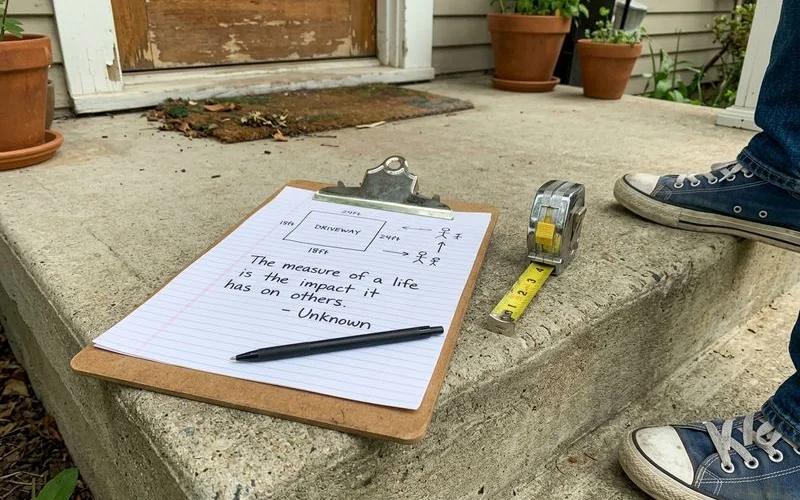
You can narrow down the concrete lifting cost CT estimate yourself before calling a professional. Measure the settled area with a tape measure, lay a straightedge across the joint to gauge the drop, and tap the slab with a hammer to note where it sounds hollow.
Those three simple observations cover most of the baseline data we need to quote a job.
Take five minutes to book your free inspection and our team will measure your concrete with specialized tools like a laser level and steel sounding rod.
If you want the service-specific detail first, driveway leveling covers the most common job in this area.