
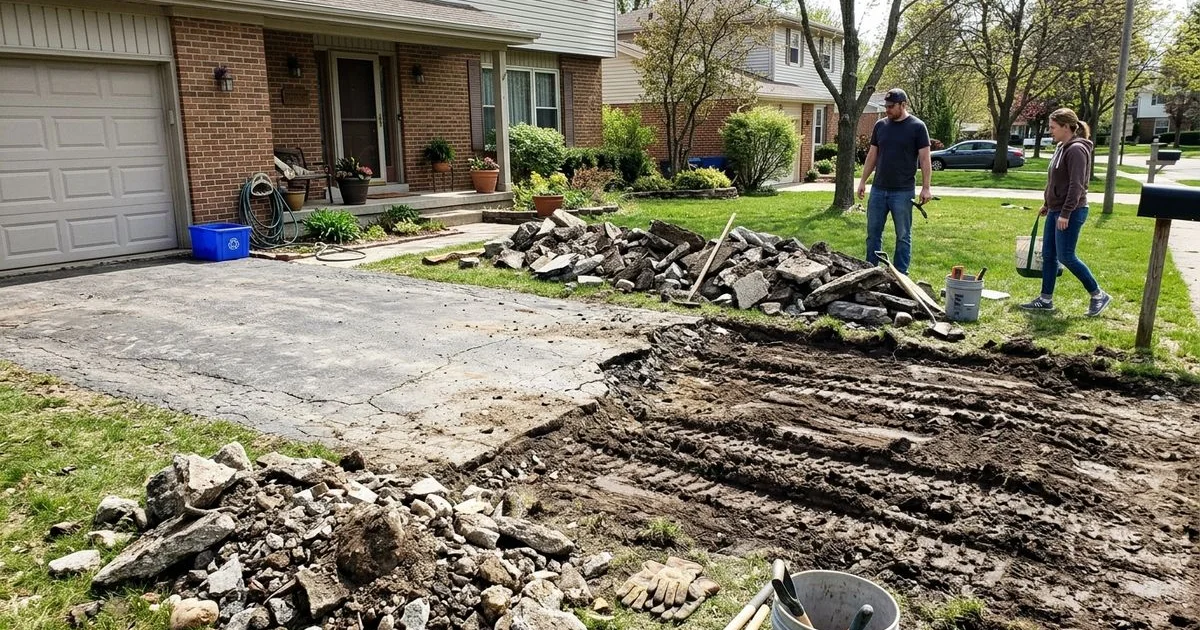
We know the sinking feeling you get when you discover your concrete slab is cracking and settling.
The immediate reaction for most Hartford County homeowners is assuming the whole thing needs to be ripped out and rebuilt. Our team frequently talks to folks who already have a massive replacement estimate in hand.
So, let’s look at the data comparing these methods, explain what the numbers are actually telling us, and explore a few practical ways to respond. We want to give you a clear roadmap before you sign that expensive contract. If you are researching concrete leveling vs replacement for your home, this guide will help you decide between a simple driveway leveling and a massive repour.
The Real Competitor Is the Tear-Out Quote
We find that most people calling us aren’t just comparing concrete companies. The real decision is between fixing the existing slab or paying for a complete tear-out, solving the classic repair or replace concrete dilemma. Our goal here is to argue against that expensive replacement quote, while pointing out exactly when a tear-out is actually the right call. Recent 2026 data from Angi shows that pouring a new slab costs anywhere from $8 to $15 per square foot in our region. We can typically save homeowners 50% to 80% of that cost by lifting the concrete instead.
Both options result in a safe, flat surface. Our polyurethane foam injection method fills the voids underneath and brings the slab back to grade perfectly. What differs is the path you take to get there, the price you pay, and the state of your property when the trucks drive away.
We want you to consider four specific factors before making your choice:
- The total out-of-pocket expense.
- The hidden costs of demolition.
- The massive difference in curing times.
- The risk to your existing landscaping.
These details usually settle the concrete lifting vs tear out debate immediately.
Cost: The Gap Widens With Size
We base replacement prices purely on the total area, because demolition, dumping, and fresh concrete all scale strictly with square footage. Demolition requires heavy equipment, and landfill disposal fees add up quickly for thick slabs. Our lifting service is priced on the lift height and the total void volume underneath. If you are asking yourself, is concrete lifting worth it, this pricing model produces a counterintuitive result where the bigger your slab, the bigger the savings. We might save you a modest amount on a small front stoop.
A long approach driveway or a massive patio replacement, however, costs thousands, making lifting the obvious choice. Our exact numbers vary based on three main variables, which you can read about in this guide on what leveling costs in Connecticut. The high-density foam expanding up to 20 times its original volume requires less raw material, keeping your final bill incredibly low.
Disruption: Hours Against a Week
We always warn homeowners that replacing a driveway is a sequence of disruptive events taking weeks to finalize. A typical tear-out project brings three major headaches to your daily life:
- Extended wait times: It takes 28 to 30 days for new concrete to fully cure, and at least seven days before you can carefully drive on it.
- Heavy equipment traffic: Skid steers and dump trucks block access and create noise.
- Complete loss of use: Your property remains completely inaccessible during the demolition and pouring phases.
Our crews prefer a much faster approach, parking a specialized rig at the curb and running hoses directly to the slab. The entire foam lifting process wraps up in just a few hours. We use a specialized high-density polyurethane foam that reaches load-bearing strength in just 15 to 30 minutes. Most driveways are ready for standard vehicle traffic the exact same day. Our team knows this speed is a massive advantage for a busy household with two cars and limited on-street parking. For commercial sites, skipping a month of curing time is usually the only detail that matters.
What Happens to Everything Around the Slab
We frequently point out the hidden landscaping costs that never appear on a standard replacement quote. Reaching a sunken driveway or patio requires a clear path for a skid steer or heavy excavator. Our competitors often leave behind rutted lawns, crushed edging, and compacted flower beds after hauling dumpsters across the grass.
The Hidden Expense: Repairing this secondary machinery damage easily adds $500 to $1,000 in topsoil, sod, and labor to your final bill.
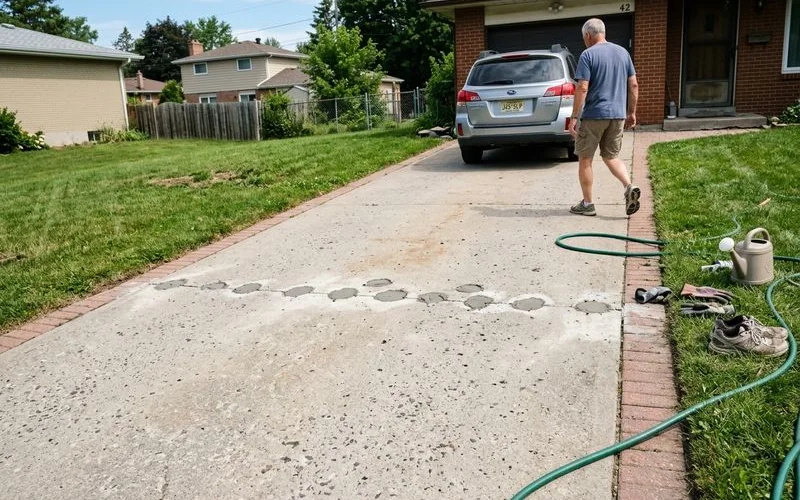
We complete the entire lifting process from the top of the existing slab without any excavation. There is absolutely zero demolition debris to haul away and no heavy machinery tearing up the yard. Our only footprint consists of 5/8-inch ports, which are roughly the size of a dime, drilled directly into the concrete. These small injection holes get patched smoothly with non-shrink grout. We find this to be the winning argument for homeowners who have spent fifteen years perfecting their landscaping. Preserving mature planting beds is often more valuable than the concrete itself.
Service Life and Appearance
We guarantee that a properly executed lift holds firm when the underlying void is completely filled. The high-density polyurethane foam boasts a compressive strength of up to 100 PSI, capable of supporting 14,000 pounds per square foot. Our injected material is chemically inert, meaning it never breaks down or washes away over time. The only factor that can undo this stability is the same uncontrolled water runoff that created the first cavity. We always tell you exactly what drainage issues to correct alongside the repair work.
The Problem With Repouring on Old Dirt
A new pour has its own massive dependency on the base material beneath it. We see fresh slabs fail rapidly when laid over the same poorly compacted fill that caused the initial settlement. The original concrete actually has decades of gradual soil consolidation behind it, making it a stronger foundation. Our process helps you keep the concrete you already have, preserving the exact same color, weathering, and finish as the rest of your property. A new section poured against old flatwork rarely matches and generally looks like a glaring patch job for years.
Side by Side
We created this quick comparison to highlight the stark contrast between these two methods. The numbers clearly show why preservation is gaining so much traction across Connecticut. Our team uses these exact benchmarks when evaluating every property. Review this side-by-side breakdown to see how the timelines and impacts differ.
| Factor | Tear out and repour | Polyurethane Foam Lifting |
|---|---|---|
| Average Cost per Sq. Ft. | $8 to $15+ (plus demolition) | 50% to 80% less than repouring |
| Time out of use | 28-day full cure (7 days no driving) | 15 to 30 minutes for 90% rigidity |
| Landscaping Damage | Requires skid steers and excavators | Completely untouched |
| Debris & Haulage | Heavy dumpsters required | Zero waste generated |
| Existing finish | Destroyed | Preserved perfectly |
| Fixes the void beneath | Only with proper soil re-compaction | Yes, the expanding foam creates the lift |
| Works on decorative concrete | Unique patterns cannot be matched | 5/8-inch ports hidden in grout lines |
| Right answer for failing concrete | Yes | No |
When Replacement Genuinely Wins
We always inspect your property thoroughly, and we will tell you upfront if a replacement is actually required rather than just taking your money. There are three specific situations where lifting simply will not work.
1. The Concrete Has Reached the End of Its Service Life
We cannot save a slab when it is actively spalling across the surface, showing exposed aggregate, or suffering from crumbling edges. This indicates the actual concrete material is failing from freeze-thaw damage or heavy de-icing salts, not the ground below it. Our support underneath does not magically restore a concrete matrix that is coming apart at the surface.
2. The Slab Has Broken Into Too Many Pieces
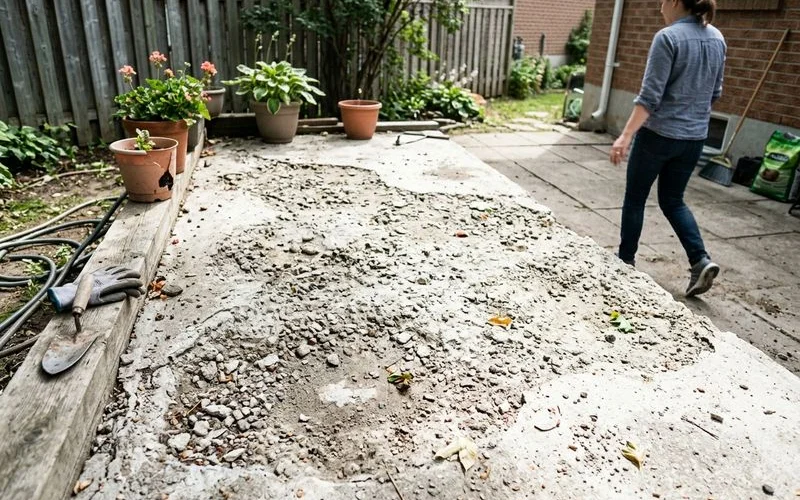
Lifting relies on raising large, structurally sound sections as single units. We cannot successfully raise a slab once it has fractured into tiny fragments that move independently. There is nothing coherent left to lift when a driveway resembles a jigsaw puzzle.
3. The Layout Is Wrong, Not Just the Level
Our crew steps back from the job if you want the driveway wider, the patio a different shape, or the walkway on a completely different line. You are completely rebuilding at that point, and leveling is no longer the relevant service. We find that outside of these three cases, most flatwork across Hartford County is structurally sound concrete sitting on shifted soil. That specific settlement issue is exactly what polyurethane lifting exists to solve.
Getting the Answer for Your Own Slab
The choice comes down to the actual condition of the concrete and the ground under it, and nobody can settle that from a photo.
If you’re weighing the two options on a driveway specifically, the driveway-specific comparison covers the numbers in that context.
An on-site inspection measures the drop, sounds the slab for voids and puts the recommendation in writing. The inspection and the written quote are free, and you get the honest answer either way, including when replacement is the better buy.