
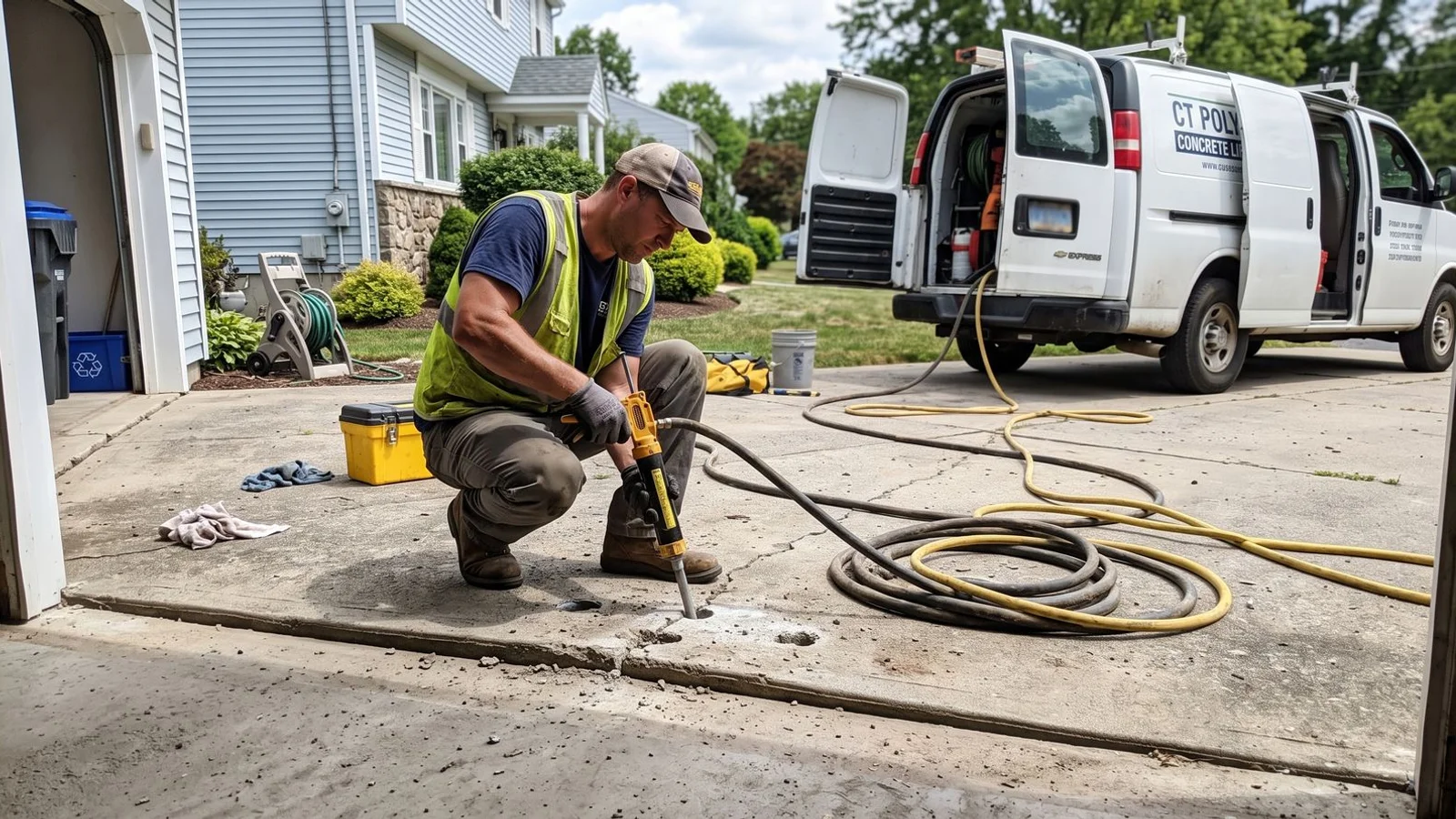
Sunken Driveway Lifted Back to Level, Usually the Same Day
Lifting settled driveway slabs, dropped aprons and sections that have tipped back toward the house.
- CT registered & insured
- Free written quote
- Same-Day Use on Most Jobs
-
CT HIC Registered
CT Dept. of Consumer Protection
-
Fully Insured
General liability cover
-
Same-Day Use on Most Jobs
Foam cures in 15-30 min
-
Free Written Quote
On-site inspection, no charge
What Is Driveway Leveling & Repair?
Have you noticed a nasty crack forming right where your driveway meets the garage? Professional Driveway Leveling & Repair might be exactly what you need.
A settled driveway is almost never a concrete problem. It is actually a base problem caused by failing soil.
Once the ground under the slab consolidates or washes out, the concrete has nothing to sit on and drops into the empty void.
The crack you are looking at did not cause the drop; it simply followed gravity after the dirt washed away.
Driveway leveling puts the support back right where it belongs. Here at CT Pro Concrete Leveling, our team injects an expanding, high-density polyurethane foam through dime-sized ports to fill the cavity beneath the slab.
This closed-cell polymer lifts the concrete back to its original grade in controlled increments while a technician watches a level. The material reaches a load-bearing strength of up to 10,000 pounds per square foot in just 15 to 30 minutes.
Because the foam cures so quickly, most driveways in Hartford County can handle a parked car again the very same day. Let us walk you through exactly how this repair process works and why it saves so much hassle.
Why Connecticut Driveways Settle
Connecticut soil goes through a lot of stress throughout the year. The local frost line sits at 42 inches deep, and standard structural footings have to reach below it.
Your driveway sits well above that depth, so it takes the full punishment of more than 70 freeze-thaw cycles every single winter. Add the uncompacted backfill that most flatwork was originally poured over, and you have a recipe for trouble.
Here are the main culprits that ruin local concrete bases:
- Heavy Annual Rainfall: Hartford County sees nearly 50 inches of precipitation annually, which aggressively washes out fine soil particles.
- Harsh Winter Cycles: Constant freezing and thawing expands moisture in the soil, lifting and dropping the slab until voids form.
- Poor Initial Compaction: Transition slabs near garages usually sit on loose foundation backfill that naturally compresses over time.
- Buried Tree Roots: Large suburban trees constantly seek moisture, and their growing root systems easily heave unreinforced concrete upward.
That is the mechanism behind nearly every driveway we lift between West Hartford and Southington. A simple surface-only fix like patching a crack or resurfacing a low spot just leaves the void exactly where it was.
Sunken Driveway Problems We Fix
Every sunken concrete issue presents a different challenge for a homeowner. Our team sees four specific failure patterns pop up across suburban neighborhoods over and over.
These issues usually start small before turning into expensive safety hazards.
The Apron at the Garage Door Has Dropped
This is the single most common driveway failure you will see in residential areas. The transition slab at the garage usually sits on foundation backfill, which is the least compacted ground anywhere on the property.
It drops before the rest of the driveway shows any signs of wear. The heavy weight of daily vehicle traffic accelerates this sinking process.
The apron acts as a warning sign; if it sinks, water will eventually run right into your garage.
What you notice is a step down from the garage floor, creating a sharp lip that catches a snowplow blade. Our technicians often see this lead to foundation water damage that costs $5,000 or more to repair if left ignored.
Catching it early saves you from dealing with flooded tools or structural rot.
Water Runs Toward the House Instead of Away
A few degrees of lost pitch is all it takes to cause a major headache. Once a driveway tilts, roof runoff and surface water head straight for the foundation backfill instead of draining to the street.
Pooling water easily penetrates poured concrete foundations and encourages black mold growth. In winter, that same low spot turns into a dangerous sheet of black ice across the exact section you need to walk on.
We make sure to re-establish the proper downward slope to keep your property safe and dry. Fixing the pitch permanently redirects rainfall back into the local storm drains.
A Stepped Joint Between Sections
When one slab drops and its neighbor stays put, you get a sharp vertical offset at the joint. It catches toes, trips up guests, and snags a plow blade every December.
The Americans with Disabilities Act defines any vertical change of just 1/4 inch as a legitimate trip hazard. The gap grows a little further each winter as the cavity underneath opens up, and it will not stabilize on its own.
| Vertical Offset Size | Safety Impact & Required Action |
|---|---|
| Under 1/4 inch | Generally safe, monitor for further dropping. |
| 1/4 inch to 1/2 inch | Official ADA trip hazard requiring a beveled repair. |
| Over 1/2 inch | Severe safety hazard requiring lifting or full replacement. |
Liability claims from a slip and fall can be financially devastating for a homeowner. Leveling the joint eliminates the hazard completely without the heavy noise of a jackhammer.
The Slab Sounds Hollow
Tap a settled section with a heavy stick, and it rings quite differently compared to a fully supported one. That distinct hollow sound confirms there is a cavity hiding below the surface.
It is the absolute ideal time to act before gravity takes over. Filling a void under a slab that is still level costs roughly 70% less than lifting one that has already cracked and dropped into the hole.
Our preventative maintenance injections can save you from a complete replacement down the road. Catching a hollow spot early keeps your concrete intact for decades.
How the Lift Works on a Driveway
The repair process is completely straightforward and minimally invasive. We start by sounding the slab and measuring the exact drop against fixed reference points like the garage slab, the street edge, or a walkway.
That assessment gives a target level and tells the crew roughly how much cavity hides down there. The specific injection port pattern is carefully planned before anything gets drilled.
Spacing matters heavily during a lift. Too few holes make the lift uneven, while too many marks up the driveway for no structural benefit.
Here is the step-by-step breakdown of how the lifting process happens:
- Precision Drilling: The team drills holes measuring just 5/8 of an inch, which is roughly the diameter of a penny.
- Void Filling: High-density polyurethane foam injects into the cavity first to create a solid base.
- Controlled Lifting: Once the void is packed tight, the pressure slowly raises the slab in monitored increments.
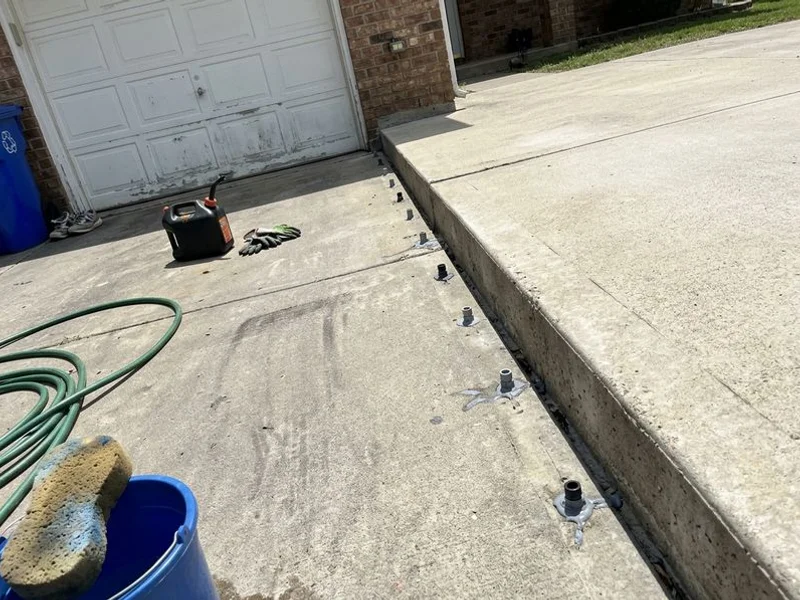
- Finishing Touches: The small ports get patched with cement, the site gets swept clean, and the area is ready for use.
Rushing a lift is exactly how slabs crack, so the process never gets rushed. The foam achieves 90% of its ultimate compressive strength within just 15 minutes of injection.
For a typical residential job in Hartford County, that whole sequence takes only a few hours.
Driveway Leveling & Repair vs Replacement: When We Say Replace
A lift on a failing slab is simply not worth your money. We would rather tell you the truth at the free inspection than take a job that will fail next year.
Replacement becomes the better call when the concrete itself has reached the end of its structural service life. Heavy surface spalling, exposed aggregate stones, or crumbling edges mean the material is severely compromised.
A slab broken into dozens of small pieces has nothing left to lift as a single unit. It simply lacks the structural integrity required to hold the polyurethane pressure.
| Repair Method | Average Hartford Cost | Best Used For |
|---|---|---|
| Polyurethane Leveling | $3 to $5 per square foot | Sunken but structurally sound slabs. |
| Full Replacement | $10 to $15 per square foot | Severely cracked, crumbling, or spalling concrete. |
The honest version is that most driveways in this area are not actually in that terrible condition. They consist of perfectly sound concrete sitting on ground that gave way underneath.
That exact scenario is what professional Driveway Leveling & Repair services were designed to fix. You will always get the answer either way in writing, at no charge, before you have committed to anything.
Give the office a call today to schedule a free evaluation of your property. We look forward to helping you restore your concrete safely.
How Much Does Driveway Leveling Cost?
There's no honest flat rate for a driveway lift. Two 400 square foot driveways can differ several times over in material once you measure how much cavity is actually under them. Here is what sets the number.
Apron Section
The transition slab at the garage door, lifted back flush.
Smallest job
- Single dropped section
- Usually a short visit
- Re-pitched so water leaves the garage
Partial Driveway
Two to four settled sections lifted back to a set target level.
Most common
- Sectional lift, no need to treat the whole driveway
- Void filled beneath each lifted section
- Drainage corrected where the slab has tipped
- Vehicle back on it the same day
Full Driveway
The whole run leveled, usually with joint sealing on completion.
Largest scope
- Whole driveway brought to a single target level
- Complete void fill and stabilization
- Joint sealing recommended to protect the work
- Still a fraction of tear-out and repour
What Moves the Number on Your Quote
- Square footage of the sections that have to be lifted
- Lift height: how far the slab has dropped away from grade
- Void volume beneath the slab, sounded and measured on site
- Whether the pitch has to be corrected as well as the level restored
- Access and staging distance for the injection rig
- Joint and crack sealing if you want the water kept out afterwards
Custom per-project quote based on square footage, lift height and void volume.
The inspection and the quote are free, and the quote is the price.
Why Choose Us for Driveway Leveling?
A Berlin-based crew, a method built for Connecticut ground, and a written recommendation you can hold us to.
Vehicle Load, Same Day
High-density polyurethane reaches load-bearing strength within 15-30 minutes of injection. Mudjacking slurry needs 24 to 72 hours before it will carry a car.
Pitch, Not Just Level
A driveway that has tipped back toward the house is a drainage problem before it's a cosmetic one. We set the fall so water leaves the foundation again.
Your Landscaping Survives
No excavator, no demolition, no material stockpiles on the lawn. Everything works from the slab surface, and the only marks left are patched ports.
Sectional Where It Makes Sense
There's no rule that says the whole driveway has to be treated. If three sections have dropped and the rest is sound, we lift three sections.
Snowplow-Ready Joints
A stepped joint is what catches a plow blade every winter. Bringing sections back flush removes the snag as well as the trip hazard.
We Say When to Replace
A driveway that's spalling, crumbling or broken into small pieces has reached the end of its service life. You get that answer in writing, free.
Our Driveway Leveling Process, Step by Step
Most residential jobs are a few hours on site from arrival to cleanup.
Free Inspection
We sound the slab for voids, measure the drop against the garage slab and the street, and write down what it needs.
Mark and Drill
A planned pattern of 5/8-inch ports goes through the settled sections, spaced to spread the lift evenly.
Fill and Lift
Expanding polyurethane fills the cavity first, then raises the slab in monitored increments while we watch the level.
Patch and Drive
Ports patched, site swept, foam at load-bearing strength in 15-30 minutes. Most driveways take a car before we leave.
Want a real number for your driveway leveling?
Free on-site inspection, free written quote, and an honest answer on lifting versus replacing.
Driveway Leveling: What the Job Looks Like
Click any image to enlarge.
Before and After a Lift
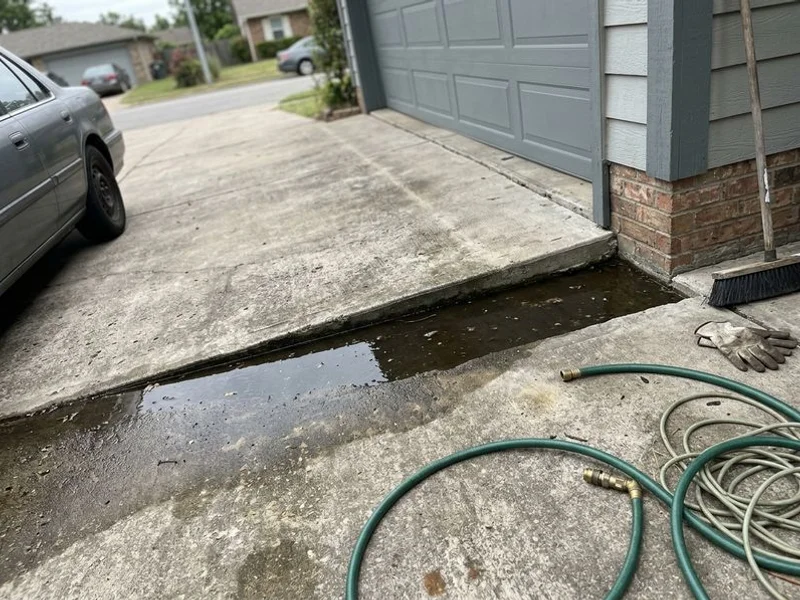
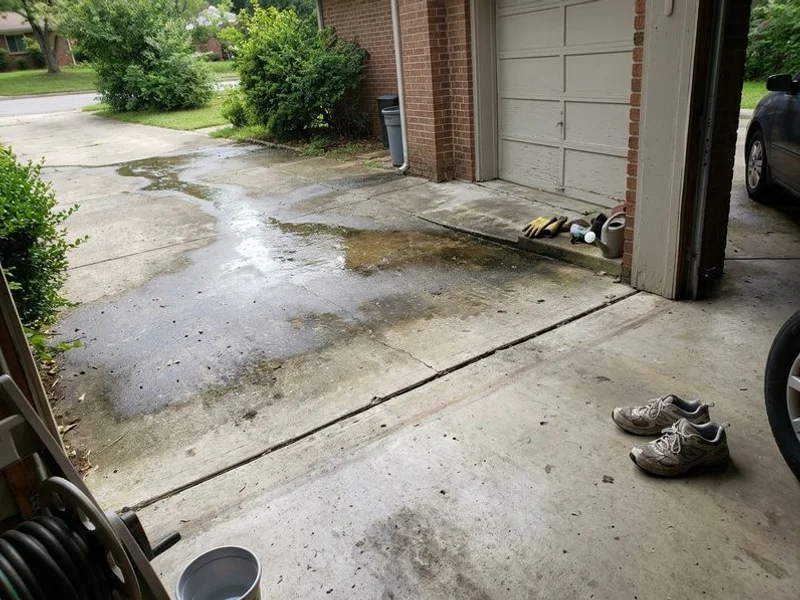
Driveway Leveling: the same slab, lifted back to grade
Lifting Your Driveway vs Tearing It Out
| Factor | Tear-Out & Repour | Polyurethane Lifting |
|---|---|---|
| Days without vehicle access | 7+ days including cure | Same day in most cases |
| Holes left in the surface | Entire slab removed | 5/8-inch ports, patched |
| Landscaping and edging | Access damage, often replaced | Untouched |
| Debris and disposal | Dumpster on the property | None |
| Fixes the void underneath | Only if the base is re-compacted | Yes, filling the cavity is the job |
| Cost | Full replacement pricing | A fraction of tear-out |
Get a Ballpark Before Anyone Comes Out
No email required to see a number. They run on the same inputs we measure on site, so you can budget against the range before booking the free inspection.
Concrete Leveling Cost Estimator
Estimate the cost of lifting your slab from its size, how far it has dropped, and where it sits on the property.
Open calculatorLift or Replace? Cost & Downtime Comparison
Compare lifting your slab against tearing it out and repouring: price, days out of use, and what happens to your landscaping.
Open calculatorDriveway Leveling: Questions We Get Asked
How much does driveway leveling cost in Connecticut?
It's quoted per project on square footage, lift height and void volume, because those three vary far more than area alone suggests. Two driveways of the same size can need several times the material if one has a much larger cavity underneath. What holds across every job is that lifting runs at a fraction of tear-out and replacement, and the wider the driveway the wider that gap gets. The on-site inspection and written quote are free, and the quote is the price.
How long before I can park on it again?
Same day on most residential driveways. Closed-cell polyurethane foam reaches vehicle load-bearing capacity within 15 to 30 minutes of injection, so we normally see a car back on the slab before we've finished loading the van. Same-day driveability is the practical difference against mudjacking, where slurry typically needs 24 to 72 hours before it will carry a load.
Will the patched holes be obvious?
They're visible on close inspection and easy to miss from standing height. The ports are 5/8 inch, roughly the diameter of a penny, against the 2 to 3 inch holes mudjacking needs. On a weathered driveway they read as maintenance rather than as a repair scar.
My driveway is cracked. Can it still be lifted?
Usually, yes. What matters is whether the sections either side of the crack are still sound and large enough to lift as units. Intact slabs with clean cracks lift well. A driveway that's spalling, crumbling or broken into many small fragments has reached the end of its service life, and we'll tell you at the inspection that replacement is the better buy.
Do you have to lift the whole driveway?
No. Sectional lifting is normal and it's usually what we recommend. A driveway is already divided by control joints and expansion joints, so individual sections lift as units. If the apron and two slabs have dropped and the rest of the run is holding its level, treating the whole driveway is money spent on nothing. The quote itemizes the sections so you can see exactly what you're paying for.
Why does the section at my garage door always go first?
Garage apron settlement happens because that slab sits on foundation backfill, ground that was excavated when the house was built and then put back, never compacted the way undisturbed soil is. It's the least supported ground on the property, which is why the transition slab drops before anything else and why it usually needs the biggest lift.
Will lifting fix the water running toward my house?
Yes, if the pitch has reversed because the slab tilted. Re-pitching by lifting is one of the most common reasons we're called to a driveway. We set the target fall so runoff leaves the foundation, then fill the cavity underneath so the corrected pitch holds rather than settling back.
Is the repair permanent?
It holds when the void gets filled as part of the job, which it does. Lifting a slab without stabilizing what's under it leaves the cause in place. The one thing that will undo it is water. If a downspout is discharging at the slab edge or the grading sends runoff under the driveway, subgrade soil erosion just starts again, so we'll tell you what to correct.
Do you work in winter?
The foam cures fast across normal working temperatures and we work year-round, but heavy snow cover and frozen ground make a proper inspection difficult. If the driveway is under snow, book the inspection for a clear day and we'll flag it if conditions affect scheduling.
How is this different from mudjacking?
Mudjacking pumps a cement slurry weighing roughly 120 lbs per cubic foot through 2 to 3 inch holes onto ground that already failed under the slab's own weight. Polyurethane weighs 2 to 6 lbs per cubic foot, goes in through 5/8-inch ports, cures in minutes rather than days, and is hydrophobic so it displaces water instead of washing out. That is the whole case for foam as a mudjacking alternative.
Still have a question?
The on-site inspection answers it properly. We look at your actual slab and put the answer in writing, and it's free either way.
Related Services
Void Filling
Filling the washed-out cavity beneath a slab and stabilizing weak subgrade so settlement stops recurring.
Garage Floors
Lifting sunken interior garage slabs, cracked and stepped sections, and floors that have thrown doors out of alignment.
Joint Sealing
Sealing control joints and cracks so surface water stops washing out the base beneath the slab.
Ready to Book Driveway Leveling?
Free on-site inspection and written quote across Hartford County. If your slab isn't a lifting candidate, we'll tell you that instead of selling you one.
- No demolition, landscaping intact
- Same-day use on most jobs
- CT registered & insured