
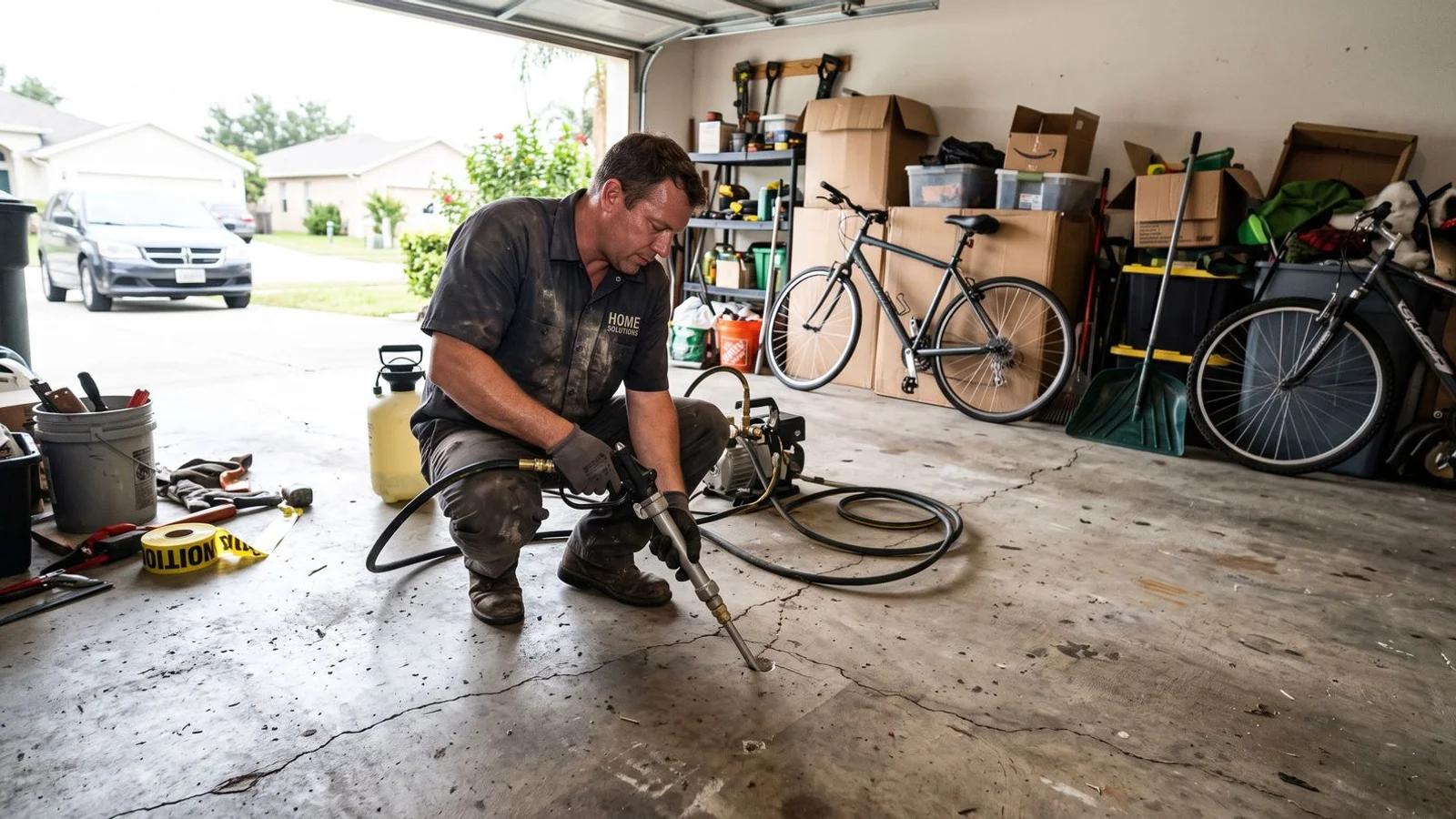
Sunken Garage Slabs Lifted, Park On It the Same Day
Lifting sunken interior garage slabs, cracked and stepped sections, and floors that have thrown doors out of alignment.
- CT registered & insured
- Free written quote
- Same-Day Use on Most Jobs
-
CT HIC Registered
CT Dept. of Consumer Protection
-
Fully Insured
General liability cover
-
Same-Day Use on Most Jobs
Foam cures in 15-30 min
-
Free Written Quote
On-site inspection, no charge
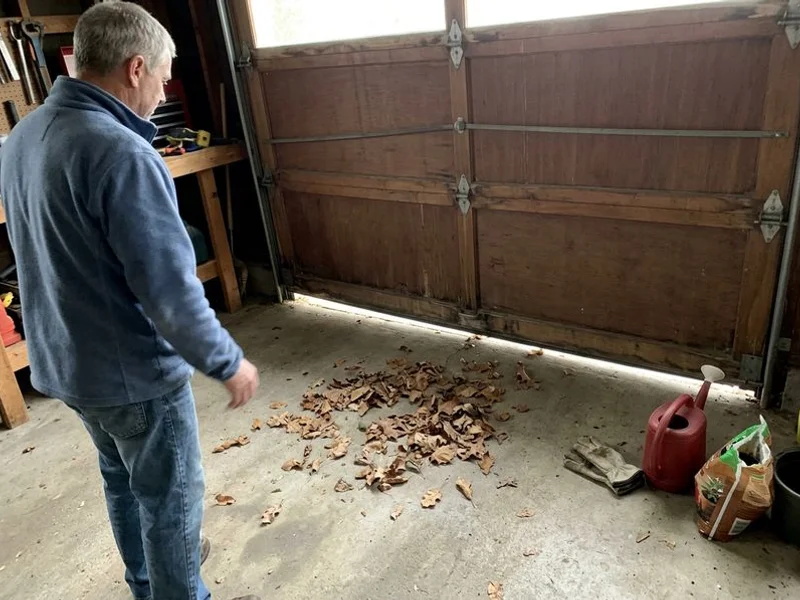
Have you noticed a frustrating gap under your closed garage door lately? We see this problem constantly throughout the older neighborhoods in the Hartford area. Garage floor leveling is the fastest way to fix that sinking concrete.
It is a simple trick that worked for me and saves a ton of money.
Our team uses a specialized foam to lift the slab back into place. You can even park your car on it the very same day. If the pavement outside has sunk down too, driveway leveling is easy to add during the exact same visit.
So, grab a cup of coffee, and let’s go through the details together.
What Is Garage Floor Leveling?
Most garage slabs sit on backfill, which is some of the least compacted ground on your property. This loose dirt settles over time and causes the heavy concrete above it to drop. You will usually notice the issue at the door first, like a threshold that no longer meets the slab.
We fix this by injecting a high-density structural polyurethane foam, similar to PolyPier or HandiFoam, through small ports in the concrete. These commercial-grade foams boast a compressive strength of up to 10,000 pounds per square foot. That means the repaired floor easily supports heavy trucks, tool chests, and workout equipment.
The benefits of using structural polyurethane foam include:
- Supporting up to 10,000 pounds per square foot of weight.
- Curing completely in just 15 to 30 minutes.
- Resisting moisture to prevent future soil erosion.
- Requiring injection holes smaller than a penny.
Our process works around your stored belongings so you do not have to empty the entire bay. The polyurethane material cures to 90 percent strength in roughly 15 minutes. This incredible curing speed means you can park your vehicle on the fresh repair the exact same day.
The Floor Is Non-Structural. That Matters.
A dipping garage floor looks like a massive foundation emergency to most people. You might panic and imagine huge repair bills. Our technicians want you to know that this specific issue is almost never a structural crisis.
A standard garage slab carries itself, but it does not carry the weight of your house. Your home foundation footings reach well below the typical 42-inch frost line required by Connecticut building codes. The garage slab sits much higher up on fill dirt that has been consolidating since the house was built.
The walls and window frames stay exactly where they were while the floor drops away from them. We consider this a simple serviceability problem rather than a foundation failure. It gets fixed in a few hours instead of requiring weeks of heavy construction.
Sinking Garage Floor Problems We Fix
Many homeowners ignore a sinking slab until it starts causing secondary issues. Our daily inspections reveal that a dropping floor creates several common headaches. These are the main symptoms that tell you it is time for a repair.
Daylight Under a Closed Door
Seeing sunlight under your closed garage door is the most reported symptom, and it is also the most misdiagnosed. Homeowners constantly adjust the door tracks or replace the rubber seal, but the gap keeps coming back. That gap is actually the exact height the floor has dropped.
Once that space opens up, it becomes a welcome mat for pests. We frequently see common Connecticut winter pests like deer mice using that exact gap to escape the cold.
Cold air also floods in, dropping the garage temperature and spiking your winter heating bills. Fixing the slab seals that entry point permanently.
A Stepped Crack Across the Bay
Sometimes a large crack forms, leaving one side of the concrete sitting lower than the other. Lay a straightedge across the break and you can easily measure the offset height. The Americans with Disabilities Act defines any vertical change of 1/4 inch or greater as a tripping hazard.
We take these uneven steps seriously because they mean the two concrete sections are moving independently over a hidden cavity. Filling the crack with store-bought caulk changes absolutely nothing about the missing dirt underneath. The floor needs to be supported from below to remove the trip hazard.
Thresholds and Service Doors Catching
The same drop that opens the main door gap pulls interior thresholds out of line. A standard two-car garage slab weighs well over 10,000 pounds, and that immense weight pulls down everything attached to it. Doors that used to swing cleanly start dragging on the floor at one end of their travel.
Our crews often see interior service door frames warped simply because the concrete below them shifted. Shaving down the bottom of your wooden door is just a temporary bandage. Lifting the heavy slab puts the entire frame back into square.
Water Coming In Over the Apron
When the asphalt or concrete apron outside pitches back toward the garage, rainwater runs inside rather than draining away. Hartford averages over 50 inches of snowfall annually. All that melting snow creates a massive amount of water pooling directly against your foundation.
That trapped water tracks under the interior slab and washes away the soil base. Our team finds that this poor drainage accelerates the washout that caused the initial drop. Fixing the pitch pushes the water away and protects the soil underneath.
What a Garage Slab Lift Looks Like on the Day
The repair process begins with a precise measurement of the entire concrete surface. We use high-precision altimeters like a ZIPLEVEL to compare the sunken slab against the threshold and the outside apron. Sounding the concrete with a heavy rod tells us exactly where the hidden cavity is located.
Only the immediate working area gets cleared out for the repair. Nearby contents are covered with plastic, dust extraction is set up at the drill, and the port pattern goes into the floor. Our technicians drill precise 5/8-inch holes spaced carefully so the concrete lifts evenly.
The polyurethane injection fills the empty cavity first. Once the space is packed tightly, the pressure begins to raise the heavy slab in small, monitored increments. Controlled lifting is exactly what stops a sound slab from cracking on the way up, so the process is never hurried.
| Step | Action | Timeframe |
|---|---|---|
| Preparation | Measuring levels and drilling 5/8-inch ports | 30 to 45 Minutes |
| Injection | Pumping foam and monitoring the slow lift | 1 to 2 Hours |
| Cleanup | Patching holes and sweeping the bay | 30 Minutes |
| Curing | Wait time before parking your vehicles | 15 Minutes |
We patch the small ports flush with the surface before sweeping the entire bay clean. On a coated or finished epoxy floor, the exact patching approach is agreed upon before a single hole gets drilled.
Garage Floor Leveling vs a New Slab: When to Replace
Lifting works wonderfully on concrete that is still structurally sound. If a garage slab is heavily delaminating, spalling across the surface, or fractured into tiny pieces, there is nothing solid left to lift. Our honest recommendation in those severe cases is a complete tear-out and repour.
Current market data for 2026 shows that a full garage floor replacement typically costs between $12 and $18 per square foot in the US. Leveling the existing floor usually costs 50 to 70 percent less than pouring new concrete. It is also worth knowing that a brand-new slab poured over the exact same poorly compacted fill dirt will eventually settle again.
If a full replacement is genuinely the right call, the soil base preparation decides whether you do the job once or twice. We provide a detailed assessment in writing during your free inspection before you spend a single dime. You will have all the hard numbers needed to make the smartest choice for your home.
How Much Does Garage Floor Leveling Cost?
Garage slabs are quoted the same way driveways are, on measured lift height and void volume, not a flat per-bay rate. What changes indoors is access and how much has to be cleared before we start.
Single Bay
One settled bay lifted back to threshold level.
Smallest scope
- Working area cleared, rest of the garage left alone
- Threshold and door alignment restored
- Vehicle back on it the same day
Double Bay
The usual residential job, a whole two-car slab brought back to level.
Most common
- Full slab leveled to a single target
- Void filled beneath the lifted area
- Doors, frames and thresholds re-aligned
- Ports patched, dust controlled during drilling
Garage + Apron
Interior slab and the driveway apron treated together in one visit.
Combined scope
- Both sides of the threshold brought back to a matched level
- Water entry at the door corrected
- One mobilization instead of two
What Moves the Number on Your Quote
- Bay count and the square footage that actually needs lifting
- Lift height measured against the threshold and surrounding grade
- Void volume beneath the slab, sounded before we quote
- How much of the garage has to be cleared for working access
- Whether the apron outside needs treating at the same time
- Finished floor coatings that need careful port patching
Custom per-project quote based on square footage, lift height and void volume.
The inspection and the quote are free, and the quote is the price.
Why Choose Us for Garage Floor Leveling?
A Berlin-based crew, a method built for Connecticut ground, and a written recommendation you can hold us to.
No Emptying the Garage
A repour means clearing everything and losing the garage for a week or more. A lift needs the working area clear and nothing else. We tell you exactly what to move at booking.
Dust Under Control
Drilling is the dusty step and it's brief. Extraction and containment handle the bulk of it, which matters more indoors than it does on a driveway.
Doors Line Up Again
The gap under a closed door is usually exactly the height the slab has dropped. Lifting the floor closes it, which is why replacing the seal first is wasted money.
Load-Bearing in Minutes
High-density polyurethane is engineered for vehicle loads and reaches strength within 15 to 30 minutes. There's no week of waiting for a slab to cure.
Non-Structural, Not a Crisis
A garage slab carries itself, not the house. We'll show you why a sinking floor almost never means the foundation is failing, and what would suggest otherwise.
Honest on Replacement
If the slab is delaminating or broken into fragments, a lift won't hold it together. You'll get that answer in writing at the free inspection.
Our Garage Floor Leveling Process, Step by Step
Most residential jobs are a few hours on site from arrival to cleanup.
Free Inspection
We check the slab against the threshold and the surrounding grade, sound it for voids and tell you exactly what needs clearing.
Clear and Protect
Only the working area gets cleared. Contents nearby are covered and dust extraction is set up before any drilling starts.
Inject and Lift
High-density polyurethane fills the cavity and raises the slab in monitored increments back to threshold level.
Patch and Park
Ports patched flush, floor swept, foam at full load-bearing strength in minutes. Park on it the same day.
Want a real number for your garage floor leveling?
Free on-site inspection, free written quote, and an honest answer on lifting versus replacing.
Garage Floor Leveling: What the Job Looks Like
Click any image to enlarge.
Before and After a Lift
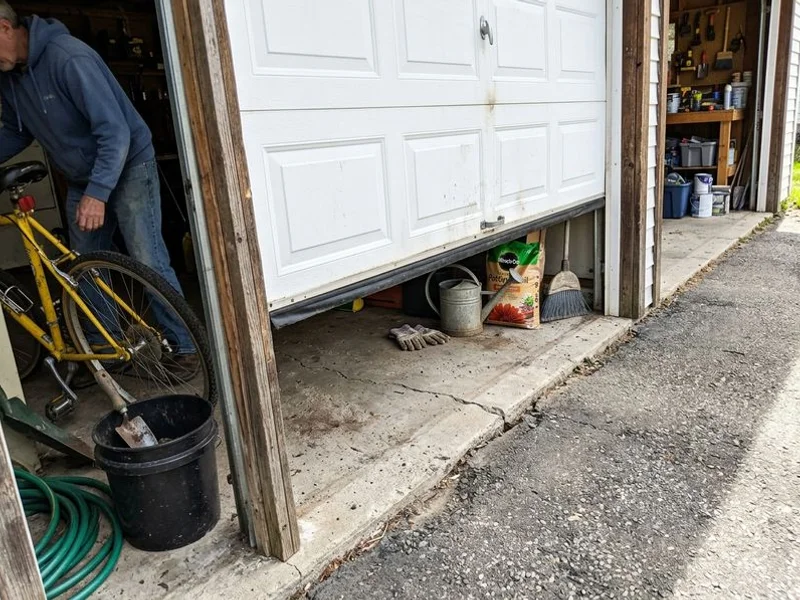
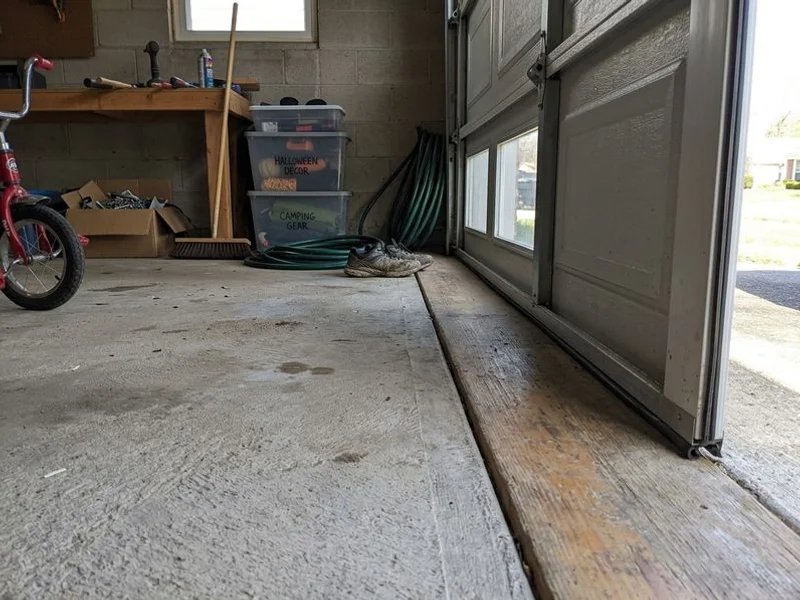
Garage Floor Leveling: the same slab, lifted back to grade
Lifting a Garage Slab vs Pouring a New One
| Factor | Break Out & Repour | Polyurethane Lifting |
|---|---|---|
| Garage out of service | A week or more | Same day |
| Contents to be moved | Everything, completely emptied | Working area only |
| Demolition dust and debris | Hauled out through the property | Drilling dust, extracted |
| Threshold and door alignment | Reset to the new pour | Restored to original level |
| Base compaction | Only if re-compacted properly | Void filled as part of the lift |
| Cost | Full replacement pricing | A fraction of tear-out |
Get a Ballpark Before Anyone Comes Out
No email required to see a number. They run on the same inputs we measure on site, so you can budget against the range before booking the free inspection.
Garage Floor Leveling: Questions We Get Asked
Does a sinking garage floor mean my foundation is failing?
Almost never. A garage slab is slab-on-grade, a non-structural floor poured over backfill that carries itself rather than the house. Your footings sit below Connecticut's 42-inch frost line and the slab sits well above it, so the two move independently. That's exactly why the floor can drop while the walls, frames and openings stay where they were. Door frame misalignment inside the garage follows the floor, not the structure. If we see stair-step cracking in block work or out-of-plumb frames upstairs, we'll tell you that's a different question and point you to a structural opinion.
Can I park on it the same day?
Yes, in the great majority of jobs. High-density polyurethane reaches its rated compressive strength within 15 to 30 minutes of injection, and it's engineered for vehicle loads. We normally see a car back in the bay before the van is packed.
How much of the garage do I need to clear?
The working area and enough room around it to move safely, usually not the whole garage. At booking we'll tell you which sections need to be empty. That's the main practical difference against a repour, which needs everything out and the space free for a week.
Why is there a gap under my closed garage door?
Because the slab dropped, not because the door is out of adjustment. A worn seal fails evenly across the width; a settled slab leaves a gap that's uneven, wider at one end than the other. The gap is usually the exact height the floor has dropped, and lifting the slab closes it.
How much dust is there really?
Drilling is the dusty part and it's short. We run extraction at the drill and contain the working area, so the dust that does get away is a fraction of what breaking out a slab produces. Nearby contents get covered before we start.
There's a crack across my garage floor. Is that serious?
It depends on whether there's a vertical step at it. A hairline shrinkage crack with both sides sitting level is cosmetic and common in the first year of a new slab. A stepped crack, where you can feel or measure an offset with a straightedge, means the sections are moving independently over a cavity. That's the one worth acting on.
Will the patched ports show on a coated or painted floor?
They're small and patched flush, and on a painted or coated floor they effectively disappear once the area is touched up. If your floor has an epoxy or polished finish, tell us at the inspection and we'll plan the port placement and patching around it before anything is drilled.
Why does the floor sink near the door?
Two reasons stack up there. It's where water tracks under the slab from the apron side, and it's where backfill consolidation is worst because that ground was excavated and put back when the house was built. It's also the part of the slab exposed to outside air, so perimeter freeze-thaw works harder on it than on the back of the garage.
Do you fix the apron outside at the same time?
Usually, and it's normally cheaper to. The apron and the interior slab share the same cause and often the same water path, so treating both in one visit saves a second mobilization. The quote itemizes them separately so you can stage it if you'd rather.
Is lifting a garage floor permanent?
It holds when the cavity gets filled, which it does as part of every lift. What would undo it is the same water that made the first void: an apron pitching inward, or a downspout discharging at the slab edge. We identify what's feeding it and tell you what to correct.
Still have a question?
The on-site inspection answers it properly. We look at your actual slab and put the answer in writing, and it's free either way.
Related Services
Driveway Leveling
Lifting settled driveway slabs, dropped aprons and sections that have tipped back toward the house.
Basement & Interior Slabs
Lifting settled basement floors, utility room slabs and interior flatwork.
Void Filling
Filling the washed-out cavity beneath a slab and stabilizing weak subgrade so settlement stops recurring.
Ready to Book Garage Floor Leveling?
Free on-site inspection and written quote across Hartford County. If your slab isn't a lifting candidate, we'll tell you that instead of selling you one.
- No demolition, landscaping intact
- Same-day use on most jobs
- CT registered & insured