
Fill the Void Under the Slab So It Stops Settling Again
Filling the washed-out cavity beneath a slab and stabilizing weak subgrade so settlement stops recurring.
- CT registered & insured
- Free written quote
- Same-Day Use on Most Jobs
-
CT HIC Registered
CT Dept. of Consumer Protection
-
Fully Insured
General liability cover
-
Same-Day Use on Most Jobs
Foam cures in 15-30 min
-
Free Written Quote
On-site inspection, no charge
Have you ever tripped over a sunken driveway panel and wondered how to fix it without a massive bill? We specialize in professional Void Filling & Slab Stabilization across the Hartford area every day at CT Pro Concrete Leveling. The secret is understanding that your concrete is perfectly fine.
It just ran out of dirt to sit on.
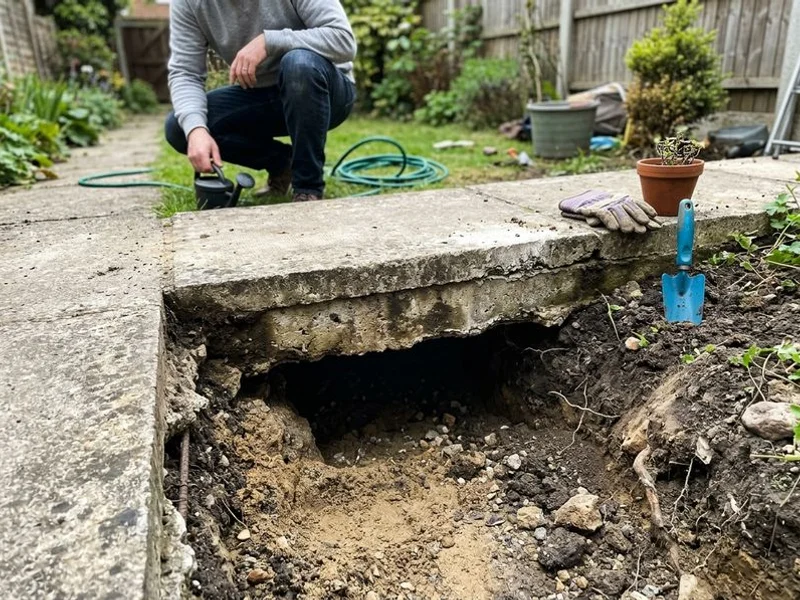
Our crew knows that every settled slab has a cavity where the supporting ground used to be. Poorly compacted backfill slowly consolidates over the years. Water easily erodes the soil right out from underneath your patio.
We watch each harsh New England winter open that hidden space a little wider. Filling that void is what makes a lift permanent.
Lifting a slab without stabilizing the soil below leaves the real problem completely untouched. Our specialized deep injection method consolidates weak subgrade rather than just bridging the gap above it.
Sometimes the slab is still perfectly level. We highly recommend filling those voids early because it is the cheapest version of this work. People often put this maintenance off for far too long.
What Is Void Filling and Slab Stabilization?
Many Hartford homeowners assume they need to replace their sinking walkways. Our experts know that full replacement is rarely the best answer. Concrete leveling costs up to 70% less than a total tear-out in 2026. This approach restores your driveway to a safe condition very quickly.
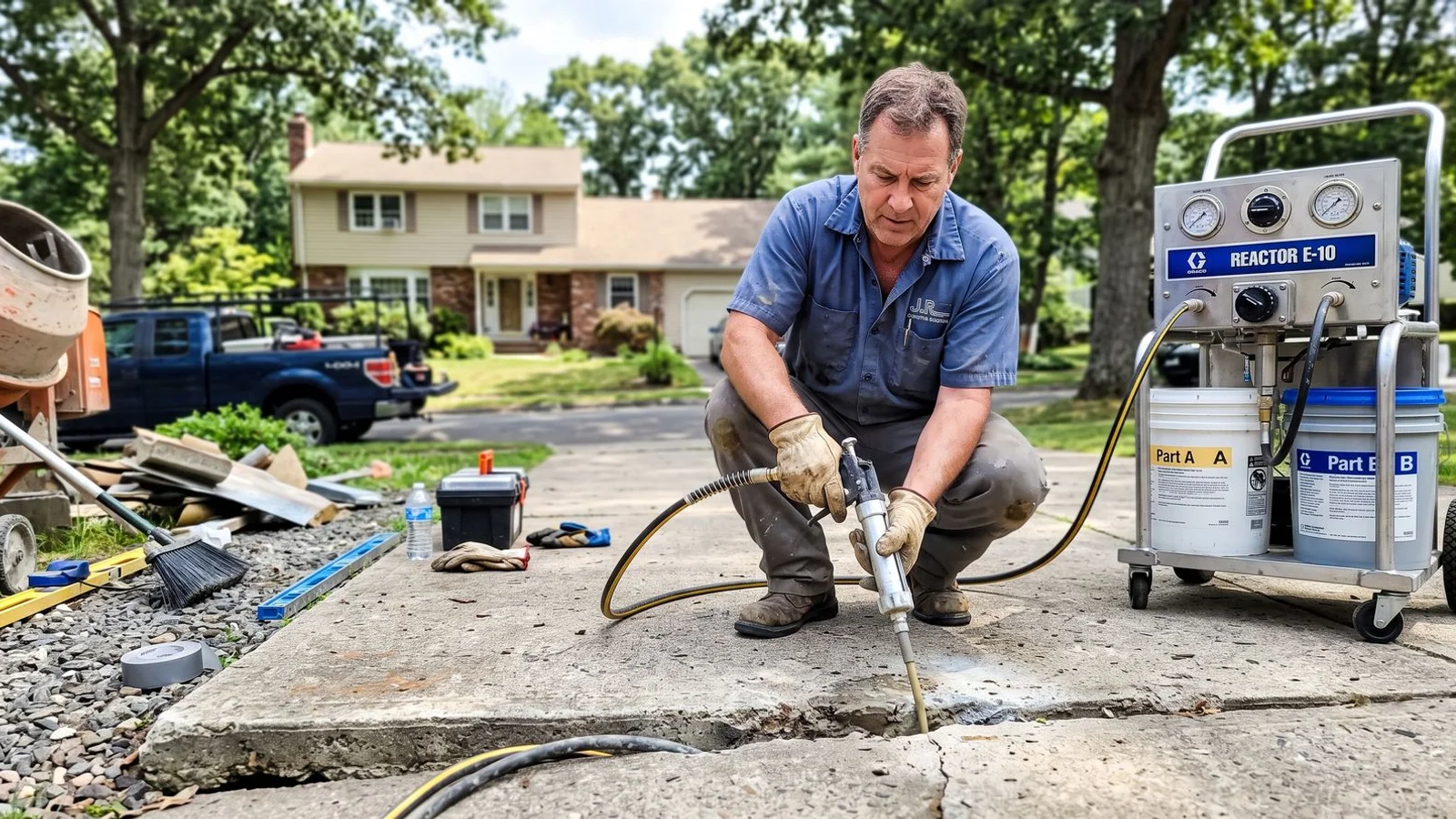
We utilize advanced polyurethane foam to solve this exact issue. The foam completely fills the empty cavity below the surface. A stabilized base ensures your heavy concrete has something solid to rest on.
Our clients appreciate seeing their property restored without messy demolition. The process tackles the root of the problem directly.
The Mechanism, Plainly
Four distinct forces empty the ground under a slab in Connecticut. We see these elements working together to destroy perfectly good concrete. Hartford’s native Windsor soil is a sandy loam that drains quickly but washes out easily. Heavy spring rainfall pulls those fine particles right out of your yard.
We routinely find downspouts dumping water directly next to sinking garage floors. Negative grading also sends surface runoff straight toward your foundation. Connecticut experiences an average of 30 to 50 freeze-thaw cycles every single winter.
We know this immense pressure from expanding ice levers the hidden cavity wider year after year. Trapped water expands by roughly 9% when it freezes solid. Dry spells in late summer then cause the soil to shrink rapidly.
Our team points out that this pulls support away from the underside of the slab even without moving water. The thick concrete above does not actually fail. It simply runs out of anything to sit on.
Sub-Slab Void Problems We Fix
You might be surprised by how many different settlement issues can be completely reversed. Our technicians evaluate everything from residential sidewalks to heavy commercial loading docks. Here is a breakdown of the specific problems you can resolve today.
A Slab That Sounds Hollow
A hollow slab rings differently when you tap it compared to the solid sections on either side. We use heavy sounding tools to locate these hidden pockets. There is no crack yet and no visible drop. The cavity exists beneath the surface, but the thick concrete is still bridging the gap.
Our advice is to act immediately when you notice a hollow sound. This is the cheapest moment in the whole lifecycle of your driveway to make a repair. Most people simply walk past the problem until the concrete physically sinks.
Settlement That Keeps Coming Back
Sometimes a slab was patched, resurfaced, or previously mudjacked but dropped down again. We frequently replace old mudjacking jobs that failed after just five years. Traditional mudjacking pumps a heavy cement slurry that weighs over 100 pounds per cubic foot. That immense weight can actually push weak soil down even further.
Our polyurethane foam offers several advantages over old methods:
- It weighs only 2 to 4 pounds per cubic foot.
- It completely resists moisture and washout.
- It cures fully in just 15 minutes.
- It prevents underlying ground from shifting.
The surface work of an old repair only addressed what you could see. The void underneath was never properly stabilized, so the sinking continued.
We guarantee the underlying ground stops shifting when we use high-density foam. Modern materials easily outlast older cement-based techniques.
Weak Subgrade Under New Construction
Contractors often place fill dirt when grading a new lot for construction. We see this soil settle for years if it was never fully compacted. The underlying issue here is not a simple washout cavity above good ground. The ground itself actually has very low bearing capacity.
Our deep injection process is specifically designed for this exact scenario. The expanding foam reaches deep down to compress and solidify the loose dirt. You get a permanent foundation without digging up your beautiful yard.
We ensure new construction slabs get the solid base they need to last. Fixing the subgrade prevents future headaches down the road.
Commercial Slabs Carrying Real Loads
Commercial spaces face extreme pressure from heavy machinery and inventory. We stabilize warehouse floor sections, loading dock approaches, and busy parking areas. A void under a commercial slab is an active load-path problem rather than just a cosmetic issue. Heavy forklifts weighing 9,000 pounds run over these unsupported gaps every single day.
“Industrial traffic demands a permanent solution, which is why structural foam is the standard for warehouse concrete leveling.”
Our structural foams cure to an incredible compressive strength of up to 100 psi. That equals roughly 14,000 pounds per square foot of holding power. This strength easily handles daily industrial traffic without breaking down.
We keep your business running smoothly with minimal downtime. Most commercial repairs finish in just a few hours.
How We Find the Void Before We Fill It
Sounding is the entire basis of providing an accurate quote. We work methodically across the slab with a heavy hammer. Listening for a change in tone marks the exact location of an unsupported section. Chalk helps map the full extent of the problem as the technician walks the surface.
Our detailed map shows exactly where the cavity is and how much material is needed. Guessing the volume produces a terrible result for the homeowner. An under-filled void leaves the slab still bridging part of a gap.
We refuse to overestimate a void because you should not pay for material that has nowhere to go. The injection process requires extreme precision to get right. Contractors drill tiny, 5/8-inch ports that are about the size of a penny.
Our highly specialized polyurethane violently expands 20 to 30 times its liquid volume once it enters the cavity. The material compacts against the surrounding ground rather than simply pooling in a puddle. The equipment controls the pressure strictly to stop short of lifting on a filling-only job.
We carefully re-sound the entire treated area after the foam sets. The hollow sections vanish completely if the job did what it was supposed to do.
| Feature | Modern Polyurethane Injection | Traditional Mudjacking |
|---|---|---|
| Material Weight | 2 to 4 lbs per cubic foot | 100+ lbs per cubic foot |
| Injection Hole Size | 5/8-inch (Penny-sized) | 1 to 2 inches |
| Cure Time | 15 to 30 minutes | 24 to 48 hours |
| Moisture Resistance | 100% Waterproof | Can wash out over time |
Filling vs Lifting: Which Do You Need?
Determining the right approach depends entirely on the current state of your concrete. We always start by checking if the panel has actually dropped below the original grade.
You will likely need a filling-only service if:
- The slab is perfectly level with the surrounding concrete.
- The surface just sounds hollow when tapped.
- There are no visible tripping hazards present.
Our filling service is the absolute cheapest version of this work you will ever be quoted. You need both filling and lifting services if the slab has already dropped. Both stages happen in a single, smooth operation.
We inject the foam material to completely fill the cavity before it starts to raise anything. A 2026 pricing average shows polyjacking costs between $5 and $10 per square foot across the US. The quote itemizes the two stages clearly so you can see exactly what you are paying for.
We will tell you plainly if the ground itself is weak and requires a different approach. Deep injection is a third scenario used for very soft soils. A reliable contractor prefers to do the job right rather than filling a cavity that will simply reform in mud below it.
Keeping the Void From Reforming
High-quality polyurethane material does not break down or degrade. Our foam acts as a permanent, waterproof barrier under your property.
The exact same water that made the first cavity is what creates a new one. Identifying the water source is a critical step during your initial inspection.
We look for these common culprits during our visit:
- Downspouts discharging directly at the slab edge.
- Poor landscaping grades sending surface water toward the house.
- Open control joints acting as a funnel into the gravel base below.
- Missing splash blocks that allow water to pool near the foundation.
The concrete slab work is completely our responsibility. Adding a simple plastic gutter extension from a local hardware store costs about $15. This twenty-minute job is something you can easily do yourself this weekend.
We strongly advise checking your gutters before the next heavy storm. Fixing the drainage is the main difference between paying for this once and paying for it again.
Proper Void Filling & Slab Stabilization protects your investment and keeps your home safe for years to come. Reach out to schedule your free inspection today.
How Much Does Void Filling & Stabilization Cost?
Void filling is priced on volume rather than area, because the whole job is about how much cavity is down there. That's why it's usually cheaper than a lift on the same slab, and why acting before the slab drops saves money.
Sub-Slab Fill
Filling the cavity under a slab that is still sitting at the right level.
Most common
- Void mapped by sounding before any injection
- Cavity filled and compacted from below
- No lift needed, the slab stays where it is
- Cheapest point to intervene
Fill + Lift
The standard job on a slab that has already dropped.
Combined scope
- Cavity filled first, then the slab raised to grade
- Both stages itemized on the quote
- Removes the cause as well as the symptom
Deep Injection
Consolidating weak subgrade below the immediate slab base.
Specialist scope
- For poorly compacted or low-bearing soils
- Injection at depth rather than directly under the slab
- Used where filling alone would not hold
What Moves the Number on Your Quote
- Estimated void volume, sounded and mapped at the inspection
- Injection depth: sub-slab fill versus deep soil consolidation
- Whether a lift is needed as well or filling alone is the job
- Access for the injection rig and staging distance
- Residential or light commercial loading requirements
- Water still active beneath the slab, which changes the approach
Custom per-project quote based on void volume and injection depth.
The inspection and the quote are free, and the quote is the price.
Why Choose Us for Void Filling & Stabilization?
A Berlin-based crew, a method built for Connecticut ground, and a written recommendation you can hold us to.
It's the Cause, Not the Symptom
Every settled slab on this site has the same root: a cavity where the supporting ground used to be. Filling it is what makes any lift permanent.
Cheaper Before It Drops
A slab that's level but sounds hollow is the ideal candidate. Filling now costs less than lifting later, and there's no cosmetic disruption at all.
Hydrophobic, Not Water-Soluble
Polyurethane displaces water rather than absorbing it. Mudjacking slurry can erode the same way the original base did, which is how a repair undoes itself.
Deep Injection Available
Where the subgrade itself is weak rather than simply washed out, injection at depth consolidates the soil instead of just filling the gap above it.
Voids Mapped, Not Guessed
Sounding the slab tells us where the cavity actually is and how far it extends. Guessing produces either an under-filled void or wasted material.
Residential and Commercial
The same method scales from a hollow-sounding garage slab to warehouse floor sections and loading approaches with real equipment loads on them.
Our Void Filling & Stabilization Process, Step by Step
Most residential jobs are a few hours on site from arrival to cleanup.
Sound the Slab
We tap across the surface listening for hollow sections and chalk the extent of the cavity before anything is drilled.
Map the Void
The marked area tells us the port pattern and gives an estimate of the volume that has to be replaced.
Fill and Compact
Polyurethane expands into the cavity, filling and compacting against the surrounding ground rather than just bridging the gap.
Verify
We re-sound the treated area to confirm the hollow sections are gone, then patch the ports.
Want a real number for your void filling & stabilization?
Free on-site inspection, free written quote, and an honest answer on lifting versus replacing.
Void Filling & Stabilization: What the Job Looks Like
Click any image to enlarge.
Void Filling vs Doing Nothing (Yet)
| Factor | Wait and See | Polyurethane Lifting |
|---|---|---|
| What happens next winter | Cavity grows with freeze-thaw | Cavity is gone |
| Cost trajectory | Rises as the void enlarges | Cheapest point to act |
| Slab surface | Will crack as it drops unsupported | Stays intact |
| Work required | Eventually a full lift | Fill only, no lift |
| Disruption | Larger job later | A few hours now |
Void Filling & Stabilization: Questions We Get Asked
How do I know if there's a void under my slab?
The everyday signs are a hollow slab sound when you tap the concrete and any sense of movement or flex underfoot. A slab sitting on solid ground rings dull and dead; one over a subterranean void sounds noticeably different. Sounding the slab properly is the first thing we do at the inspection, and it's how we map the extent before quoting anything.
My slab is level but sounds hollow. Do I need to do anything?
That's the ideal time to act. Filling a cavity under a slab that's still at the right level is cheaper than lifting one that has dropped into it, and there's no cosmetic disruption because nothing has to move. Left alone, the void grows with each freeze-thaw cycle until the slab drops.
Does void filling cost less than lifting?
Usually, because it's driven by void volume alone without the lift work on top. On a settled slab the quote itemizes both stages so you can see what each part costs. On a level slab that just sounds hollow, filling is the whole job.
Can I have the slab lifted and skip the filling?
Not really. The two aren't separable on a settled slab. The lift happens because injected material fills the cavity and then keeps going, so filling is inherently part of it. What you can skip is stabilizing weak subgrade at depth, and we'd only recommend that where the soil itself is the problem rather than the washout above it.
What is deep injection and when do I need it?
Deep injection consolidates the soil below the immediate slab base rather than filling the cavity directly under the concrete. It's the answer where the subgrade itself is weak or poorly compacted, and filling the gap above it would simply let the slab settle into softer ground again. It's a distinct scenario and we'll say plainly if it applies to you.
Will the void come back?
Not from the same cause, once it's filled. The material is chemically inert and doesn't break down. What can create a new one is the same water that made the first. Downspout discharge at the slab edge and negative grading are the two usual culprits, and we'll tell you exactly what to correct so you're not paying for this twice.
Does the foam work in wet ground?
Yes, and this is where the material choice matters most. Polyurethane is hydrophobic, so it displaces water rather than absorbing it. Mudjacking slurry in the same conditions can erode the way the original base did, which is how a repair ends up undoing itself.
Can a void form under a new slab?
It can, if the base was poorly compacted at the time or water is finding its way underneath from day one. Age isn't a requirement. We see it on properties less than a decade old, particularly on subdivisions built over imported or engineered fill.
How long does the material last?
The polyurethane itself is chemically inert and doesn't decompose. Any specific lifespan figure we quote comes from the foam manufacturer's published data and we'll cite it as theirs. This is a new business and we're not going to state a track record we don't have yet.
Do you do commercial void filling?
Yes. The same method scales to warehouse floor sections, loading approaches and parking areas, with the material specified for the actual loads present. Commercial work gets scheduled around trading and tenant hours.
Still have a question?
The on-site inspection answers it properly. We look at your actual slab and put the answer in writing, and it's free either way.
Related Services
Driveway Leveling
Lifting settled driveway slabs, dropped aprons and sections that have tipped back toward the house.
Commercial
Slab repair for retail, office and small industrial properties: entrances, walkways, loading areas and warehouse floors.
Joint Sealing
Sealing control joints and cracks so surface water stops washing out the base beneath the slab.
Ready to Book Void Filling & Stabilization?
Free on-site inspection and written quote across Hartford County. If your slab isn't a lifting candidate, we'll tell you that instead of selling you one.
- No demolition, landscaping intact
- Same-day use on most jobs
- CT registered & insured