
The Objection That Stops Interior Jobs
We see the same hesitation from homeowners across the Hartford area when dealing with a sunken basement floor. People understand the problem well enough. What stops them from booking a repair is the mental image they have of a demolition crew creating massive dust storms, moving all their belongings, and taking over the house for a week.
Those fears accurately describe a complete repour, not a targeted lift.
Basement and interior slab lifting is a genuinely low-disruption job, and here is the honest detail so you can judge it for yourself. If you are still working out whether the floor is even a lifting candidate, why basement and utility slabs settle covers the causes first. Let’s break down the exact interior concrete lifting process, look at the equipment used, and explore how to keep dust to an absolute minimum.
What Actually Happens Indoors
The actual basement floor leveling process indoors mirrors any standard outdoor concrete lift, using specialized polyurethane foam to raise the slab. We sound the concrete, mark our targets, drill small ports, inject the material, raise the floor in increments, and patch the holes. How the process works covers these steps generally.
What changes for an interior job is the setup and the care taken around your finished spaces. The heavy equipment, like our Graco proportioner rig, stays parked out in your driveway. A technician simply runs flexible, heated hoses into the basement to deliver the structural foam.
This modern polyurethane foam weighs only 2 to 4 pounds per cubic foot. That lightweight density means it will not overburden the soils beneath typical older Hartford homes.
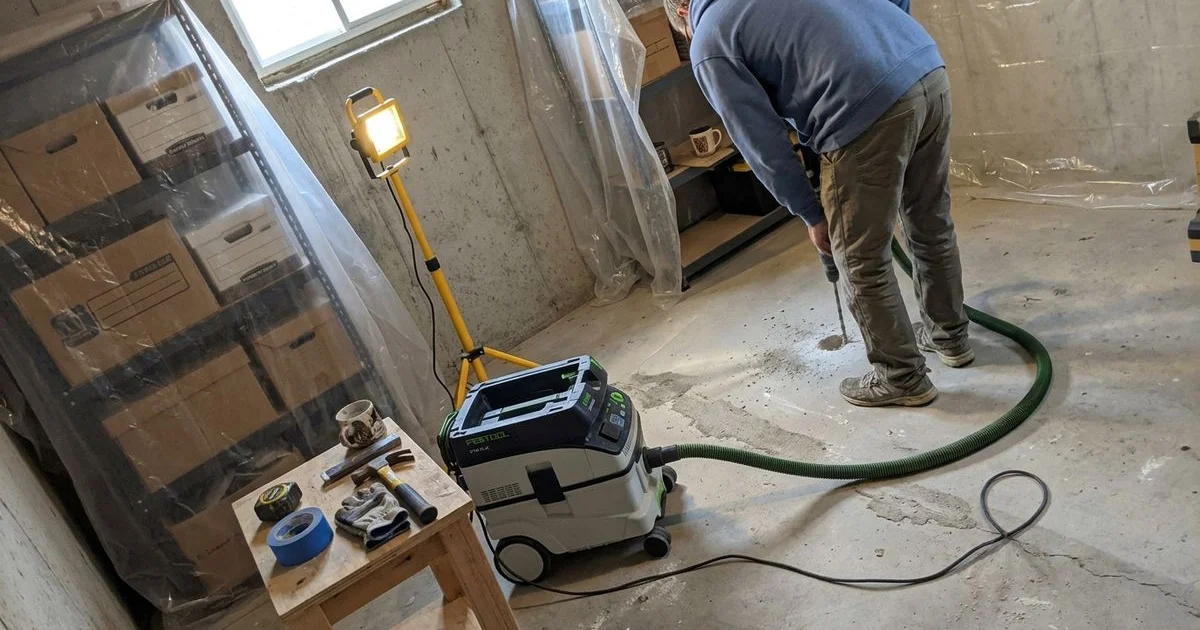
Our interior protocol also includes specific containment measures:
- Extraction rigs run directly at the drill site.
- Plastic sheeting covers nearby furniture and belongings.
- Containment zones enclose the active working area.
- Patching gets a slower, more deliberate approach to match painted or coated basement floors.
None of these steps involve breaking or removing your existing concrete.
The Dust Question, Honestly
Drilling concrete will always make some indoor concrete lifting dust. There is no version of this repair where zero dust is created.
What truly matters is the quantity of dust and the duration of the drilling. Breaking out an old slab with a jackhammer produces thick silica dust across the entire floor continuously for hours. Drilling a precise port pattern produces dust at a handful of discrete points over perhaps twenty to forty minutes.
We take specific steps to mitigate this dust practically:
- An OSHA-compliant HEPA vacuum runs right at the drill head, capturing 99.97% of respirable dust at the source.
- The working area is contained so any stray particles stay local.
- Contents within range get covered with sheeting before we start.
- Keeping the basement door closed isolates the work from the rest of your house.
After the drilling phase, the rest of the job produces essentially no dust at all. Injection is a wet chemical process, and patching requires just a small amount of mortar.
Hole Size and What They Look Like Afterwards
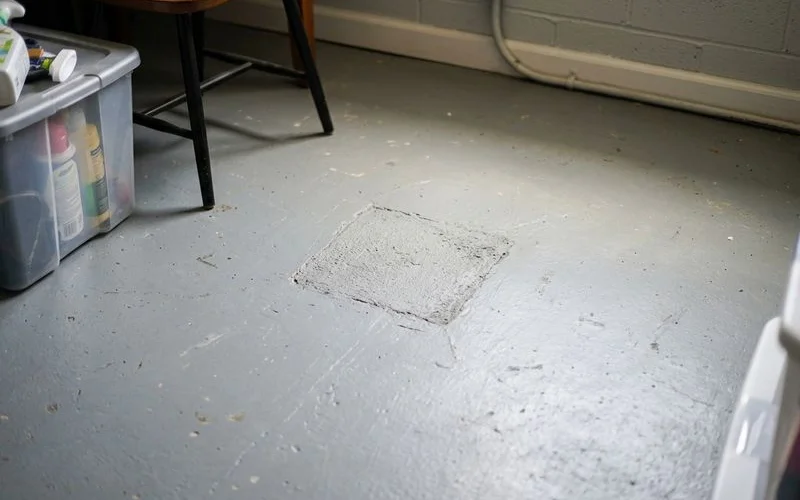
The injection ports are 5/8 of an inch, which is exactly the diameter of a standard US dime. On an interior floor, this size is small enough that the patching feels like a finishing task rather than a major repair.
Older mudjacking techniques required massive two-inch holes that looked like large craters in your floor. Our modern approach uses specialized Ardex or Quikrete mortar to completely fill the much smaller dime-sized ports.
The final appearance depends entirely on your current floor surface:
- Bare concrete: We patch the holes flush with mortar. The spots remain visible on close inspection but are easy to miss.
- Painted or sealed floors: Technicians patch the holes flush and then touch up the area. On a painted basement floor, they effectively disappear.
- Tiled floors: This requires a discussion before anything happens. Sometimes ports can go through grout lines, or a tile or two might need to come up and go back down.
- Carpet or covering: The team lifts the carpet at the edge, rolls it back over the working area, and replaces it afterwards. Ports go into the bare concrete underneath and remain completely hidden.
Whatever covering your floor has, the specific patching approach gets agreed upon at the inspection rather than being improvised on the day of the job.
What Needs Clearing
You will need to move far less than you might expect, and we provide a specific clearing list when the job is booked. Technicians only need about three to four feet of clearance to maneuver the injection hoses safely.
Heavy utility equipment like 50-gallon water heaters, HVAC furnaces, and bulky utility runs get worked around wherever possible rather than moved. Anything that genuinely has to be shifted gets flagged at the initial inspection.
| Needs moving | Usually stays |
|---|---|
| Anything sitting on the settled section | Shelving along walls outside the area |
| Freestanding storage in the working area | Wall-mounted anything |
| Furniture over the ports | Utilities and appliances, worked around |
| Rugs and floor coverings over the area | Contents at the far end of the room |
| Enough clearance to move with hoses | Everything in adjacent rooms |
You will never have to discover a surprise relocation task on the morning of the repair.
Noise and Duration
The rotary hammer drill is the only loud part of the process, and it runs for minutes at a time rather than continuously. The actual injection phase is remarkably quiet, making it difficult to hear from the next room.
For context, an industrial rotary hammer drill produces around 100 to 105 decibels of noise. That volume is roughly equivalent to a gas-powered lawnmower running right outside your window.
A typical basement or utility area job takes just a few hours on site, including setup, active work, and cleanup.
- There is no return visit required.
- There is no multi-day curing period.
- The polyurethane foam reaches 85% to 90% of its final load-bearing strength in just 15 to 30 minutes.
If you work from home, the most honest advice is to schedule important calls around the brief drilling window and otherwise carry on with your day.
Access Through the Property
Hoses run from our specialized rig outside directly to the working area indoors. On a typical basement job, this usually means routing through a bulkhead door, a walkout entrance, or taking the shortest route from the driveway.
Many standard homes in the Hartford area feature Bilco doors or direct hatchways, making this access incredibly simple. The flexible, 3/8-inch diameter heated hoses maneuver easily down stairs and around corners without damaging walls.
We will agree on the exact route at the inspection and fully protect it:
- Technicians place protective runners down on carpets.
- Heavy plastic sheeting covers finished hardwood or tile floors.
- The route only sees traffic during the initial setup and final pack-up.
Because there is no broken concrete being carried out in wheelbarrows, the foot traffic through your property remains exceptionally light.
Can You Stay in the House?
In the great majority of interior concrete lifting jobs, yes, you can absolutely stay in the house. Nobody has to leave, nothing gets shut off, and the daily rhythm of the household carries on normally.
Modern closed-cell structural polyurethane foams are completely inert once they cure. They emit no harmful Volatile Organic Compounds (VOCs) into your indoor air, ensuring a safe environment for your family and pets.
The exceptions requiring a homeowner to leave are extremely rare and highly specific. Those situations generally involve:
- Unusually large industrial-sized areas needing extended work.
- Cases where the only viable access route completely blocks a vital hallway.
- Jobs requiring major structural excavation alongside the lifting.
If any of these rare conditions apply, we will inform you clearly at the quote stage rather than springing it on you that morning.
If a dip in your basement floor has been on the to-do list for a while because you assumed it meant weeks of interior slab repair disruption, book an inspection and get the actual scope of work. It is almost always a much smaller and cleaner job than most homeowners expect.