
An Interval and a Trigger
We consistently see homeowners push driveway maintenance off until a hairline crack becomes a massive headache.
Experience shows that knowing exactly when to act is the dividing line between a quick 15-minute fix and a costly tear-out.
Our preferred high-quality polyurethane sealant typically averages a lifespan of four to six years in harsh New England climates.
That timeline drops significantly if the surface faces heavy plowing or standing water.
We are going to break down the specific regional factors accelerating this wear and walk through the exact inspection routine our crews use daily.
You can explore the mechanical process on our main Joint sealing and crack repair page.
Our goal here is to help you master the timing.
Two specific things make this maintenance actually happen: knowing exactly how often to reseal concrete joints, and knowing what to look for right now.
What Shortens Sealant Life Here
Connecticut weather is brutal on driveways.
We see joint sealant degrade much faster here than in milder climates for three specific reasons.
The local environment actively fights against the materials protecting your property.
Freeze-Thaw Movement
Our crews witness severe damage every spring because Hartford County averages 45 to 50 inches of precipitation annually.
This heavy moisture saturation causes slabs to expand and contract dramatically as temperatures fluctuate.
We find that the sealant has to stretch and compress through that wide range repeatedly.
Every single freeze cycle permanently strips away a little bit of the material’s elasticity.
Aggressive Road Salts
Our teams constantly combat the effects of liquid magnesium chloride, which the Connecticut DOT uses to pre-wet winter road salt.
This chemical mixture is fantastic for safe roads but notoriously aggressive on polyurethane bonds.
We notice that salt tracked onto a driveway accelerates degradation right at the sealant-to-concrete bond line.
That specific microscopic edge is exactly where most water infiltration failures start.
Mechanical Plow Damage
We frequently repair surfaces where a plow blade caught a slightly raised sealant bead and tore it completely out.
On driveways that get plowed aggressively, mechanical destruction usually ends a seal’s life long before natural weathering does.
Our residential data shows the average concrete sealant service life drops drastically when humid summer UV exposure finishes off whatever the winter plows left behind.
You simply have a material working exceptionally hard for its living.
The Annual Inspection
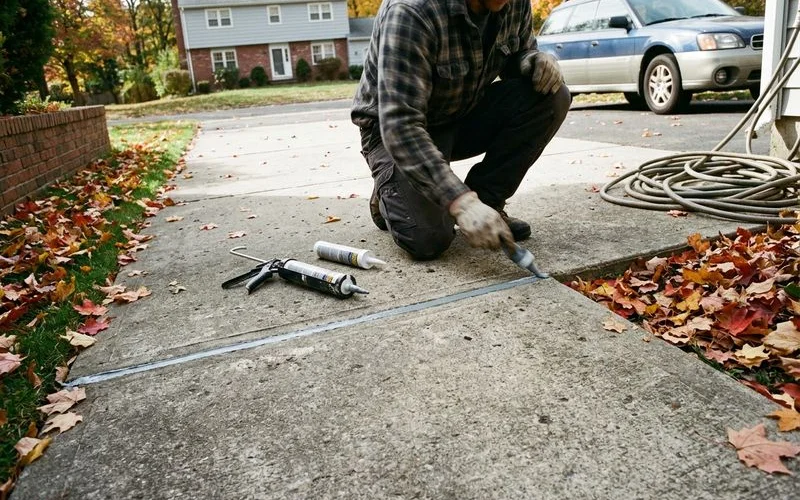
Five minutes in late summer is all you need for an effective annual inspection.
We recommend walking every joint on the driveway, patio, and walkway to look for four specific warning signs.
Identifying these early joint sealant failure signs allows you to catch minor issues before they require major concrete lifting.
Separation and Cracking
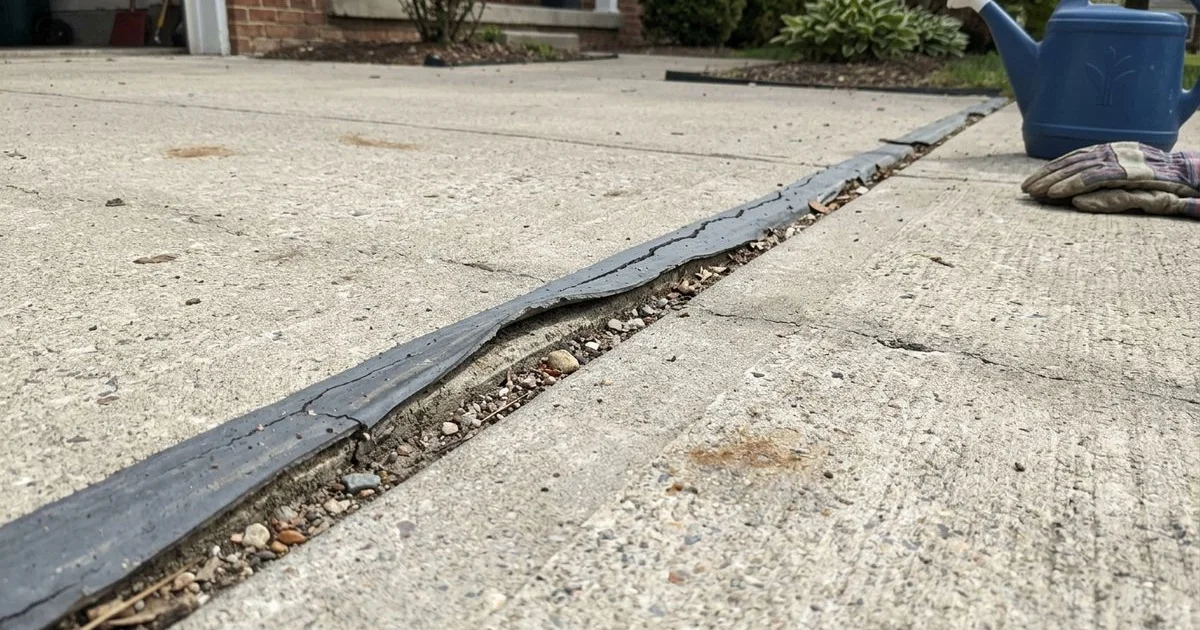
Our technicians say separation from one edge is the most common failure and the easiest to miss.
The sealant might still be sitting in the joint, looking perfectly intact from a standing height.
We suggest crouching down to see if there is a tiny gap running down one side.
Surface water goes straight past that broken seal and washes away the soil base.
Our secondary check involves looking for cracking straight through the length of the run.
Material that has lost its flexibility will eventually split right down the middle.
Adhesion Loss and Debris
We always test for a loss of adhesion in patches by pressing the bead firmly with a finger.
Where the bond remains strong, it resists the pressure, but failed sections will move independently of the concrete.
Our final red flag is debris ingress, specifically aggressive weeds like crabgrass which thrive in open Connecticut driveway cracks.
Grit packed into a joint, or vegetation sprouting out of it, means the gap has been open long enough to fill with soil.
We consider a weed-filled crack to be a joint doing absolutely no work at all.
| Inspection Finding | Recommended Action | Urgency Level |
|---|---|---|
| Sealant intact, bonded both sides | Nothing. Check again next year. | Low |
| Separated from one edge | Grind out and reseal before winter. | High |
| Cracked through its length | Reseal this season. | Medium |
| Packed with grit or weeds | Clean out and reseal. | High |
| No sealant at all | Highest-value job on the property. | Critical |
| Joint on a low spot that ponds | Seal, but lift slab to fix pitch. | High |
Why Autumn, Not Spring
The entire point of sealing is to keep water out of the base before the destructive winter freeze-thaw cycling begins.
We always tell customers exactly when to reseal driveway joints: target September, because Hartford’s average first fall frost hits between October 8 and October 20.
Completing the work in late summer guarantees three distinct advantages:
- Joints go into the coldest season tightly closed against snowmelt.
- Surface water runs safely off the slab instead of draining into the soil.
- The structural base remains dry and stable through the four harshest months.
We often see homeowners seal in April, which effectively closes the barn door after the damage is done.
Spring maintenance still benefits the following winter, but you have functionally lost an entire year of protection.
Our comprehensive guide on Why sealing prevents settlement explains the exact soil mechanics this timing is designed around.
Pair It With Other Work
Grouping repairs together is the smartest way to stretch your property maintenance budget.
We recommend two specific combinations that consistently deliver the best return on investment.
Combine With Concrete Lifting
Professional polyurethane concrete lifting usually costs 50% to 80% less than a full slab replacement.
We strongly advise sealing the joints during the exact same visit if a sunken slab is being leveled.
Paying for a single contractor mobilization costs a fraction of scheduling two separate appointments.
Our team makes this the standard recommendation on almost every single lift quote written, because it immediately protects the base that was just stabilized.
Whole-Property Approach
Driveway, patio, front walkway, and garage apron joints all degrade at similar rates.
We see this uniform aging because the original concrete was typically poured at the same time and faces the exact same weather exposure.
Servicing every surface simultaneously is significantly cheaper than paying for three separate visits over three years.
We can quickly secure the entire property perimeter in one afternoon, giving you total peace of mind before the snow flies.
When Sealing Isn’t the Answer
Two specific situations exist where caulking a gap on its own is actually the wrong call.
We always warn customers about these specific conditions:
- Ponding Water: A joint located in a low spot that constantly holds standing water will fail prematurely.
- Existing Voids: The common sandy loam soil found throughout Hartford County washes away quickly once water gets underneath a slab.
The pitch of the concrete is the actual root problem for a low spot, requiring professional lifting to restore proper drainage.
We find that if the surface has already dropped, sealing out new moisture does nothing about the massive empty void below.
The correct sequence for a sunken section is to fill the void, lift the concrete, and then seal the surface in one continuous visit.
Our schedule fills up quickly as the leaves start to turn.
If your gaps are wide open or the protective bead has completely deteriorated, book before winter.
We consider this the most cost-effective maintenance job available, especially since it carries a rigid seasonal deadline.