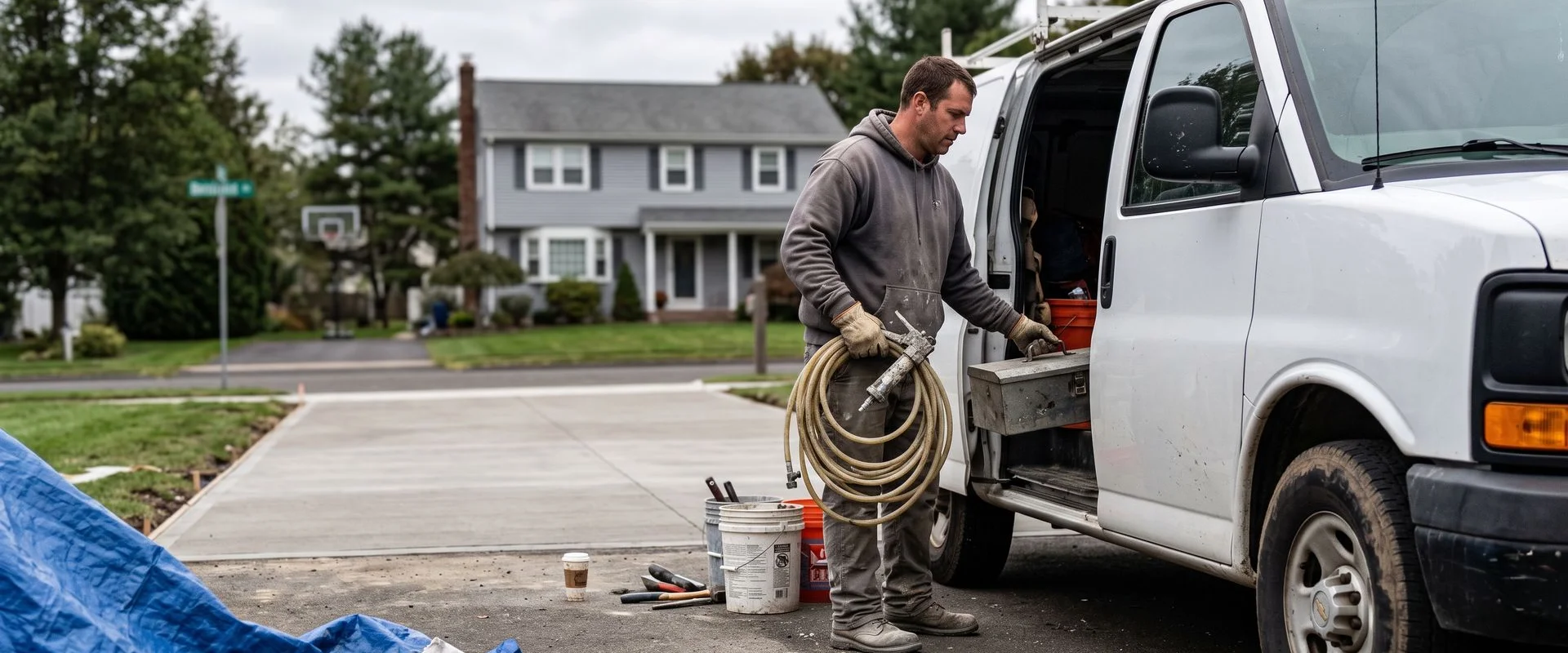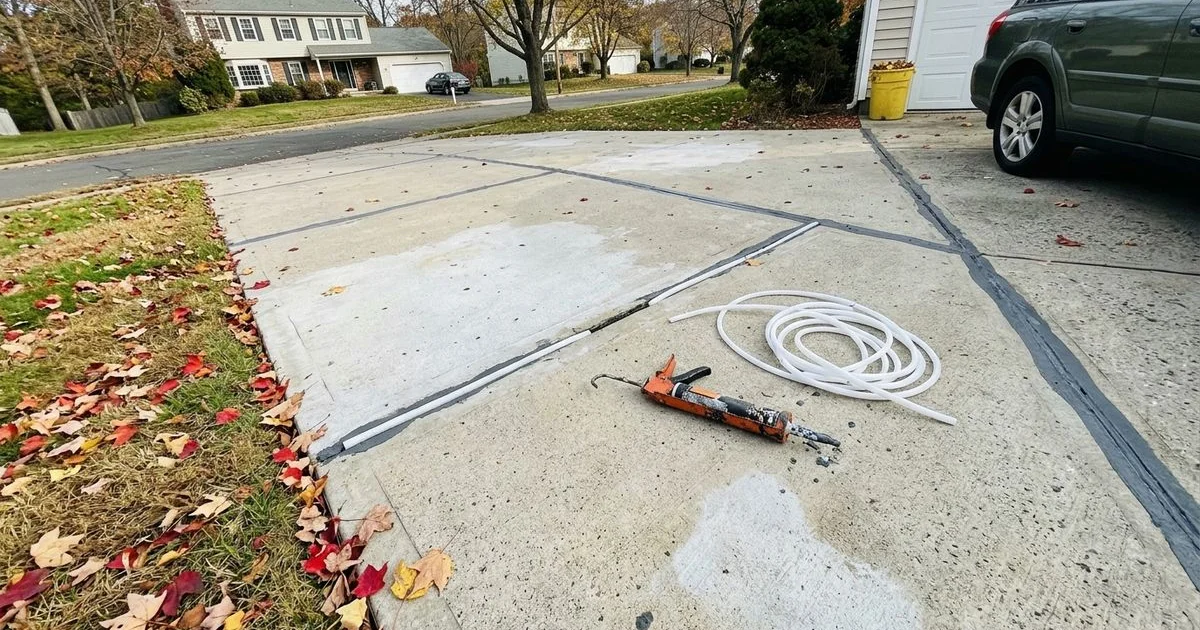
Every year around this time we get the same call in reverse order. Somebody rings in March, after the thaw, because a driveway joint has stepped over the winter and now catches a foot. The work that would have prevented it costs a fraction of the work that now fixes it, and the window for doing it closes in about eight weeks.
So: if you own concrete flatwork in Hartford County, late summer through fall is when to look at your joints. Here’s what to check and why it matters more here than it does further south.
Why Fall Is the Window
An open control joint is a funnel. Every rain sends surface water straight into the base under your slab rather than off the edge of it, and that water carries the finest material away with it. Do that for a few years and the ground under the concrete is measurably emptier than it was.
Then winter arrives and the mechanism changes gear. Water sitting in an open joint freezes, expands, and levers the joint wider. The thaw lets the slab settle further into whatever space has opened underneath. Connecticut cycles through that repeatedly between December and March, which is why flatwork here fails faster than the same concrete would in a milder climate.
Sealing in fall closes the route before the cycling starts. Sealing in January closes it after the water is already in the base, which is a lot less useful.
The Five-Minute Inspection
Walk your driveway, patio and front walkway and look at every joint line. You’re checking four things.
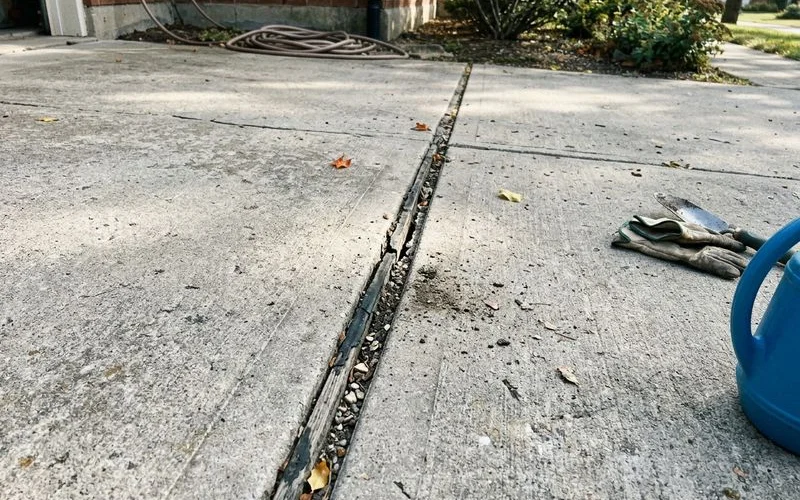
Has the sealant separated from one edge? This is the most common failure and the easiest to miss. The sealant is still sitting in the joint, so from standing height it looks fine. Crouch down and you’ll see a gap running down one side. Water goes straight past it.
Is the sealant cracked through its length? Old sealant loses flexibility. Once it can’t stretch with the slab’s seasonal movement, it splits.
Is the joint packed with grit or growing weeds? Debris in a joint holds moisture against the concrete and stops the joint closing when the slab expands in summer. Weeds coming out of a driveway joint mean it’s been open a long time.
Is there a joint with no sealant in it at all? Plenty of driveways were never sealed. If yours has open control joints and you’re in Connecticut, that’s the highest-value maintenance job available to you.
The one to prioritize
A joint that ponds water is worse than a joint that drains. If a section of your driveway holds a puddle on the joint line after rain, that’s the one to deal with first — and it’s usually a sign the slab has already started to tilt.
What Proper Sealing Involves
Preparation is most of the job, and it’s why DIY reseals so often need doing again the following year.
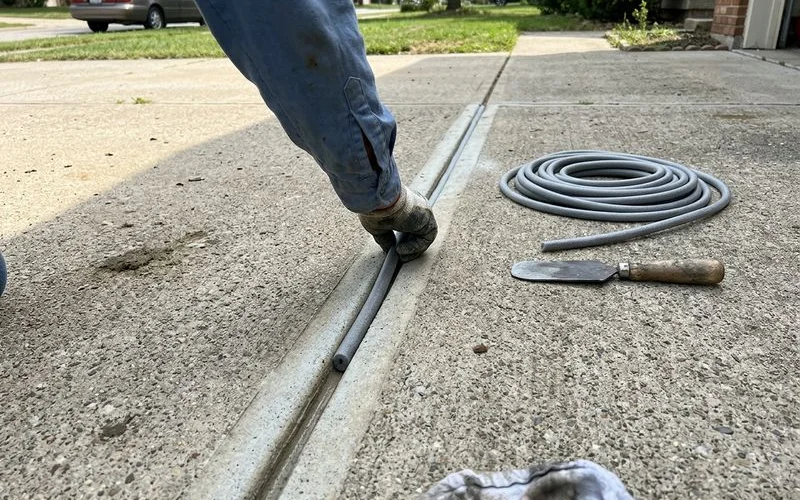
Old failed sealant has to be ground out rather than painted over. The joint faces need cleaning back to sound concrete so the new sealant has something to bond to. Then closed-cell backer rod goes in at the right depth — this is the step people skip, and it matters because the rod sets the sealant’s depth-to-width ratio so it can stretch and compress rather than tear. Sealant packed straight into a deep joint has the wrong geometry and fails early.
Finally the sealant itself: a flexible elastomeric product chosen to stay flexible through Connecticut’s freeze-thaw range and to handle road salt, tooled flush in the joint line.
Can You Do This Yourself?
Yes, honestly. The materials are available to anyone and the technique isn’t difficult.
What we’d say is that the preparation is the job. Grind out the old sealant properly, clean the joint faces, get the correct backer rod in at the correct depth, tool the finish — do those and a DIY reseal will hold as well as ours. Run a bead of caulk into a dirty joint over the old failed sealant and it’ll lose adhesion within a season.
Where it’s worth calling someone is when there’s a lot of linear footage, when the joints need serious grinding out, or when the slab has already started to move and sealing alone won’t be enough.
| What you’re looking at | What it needs |
|---|---|
| Joints sealed and intact | Nothing. Check again next fall |
| Sealant separated from one edge | Grind out and reseal before winter |
| Open joints, slab still level | Seal now — cheapest preventive spend there is |
| Slab sounds hollow underfoot | Void filling first, then seal |
| Joint has stepped, one side lower | Lifting first, then seal in the same visit |
If the Slab Has Already Moved
Sealing is preventive. It closes the route water uses to wash out the base. If your slab has already dropped, the cavity is already there and sealing on its own won’t bring the concrete back up.
In that case the sequence runs the other way: fill the void, lift the slab back to grade, and then seal the joints in the same visit so surface water stays out of the base you’ve just stabilized. Doing both in one mobilization costs less than two separate trips, which is why joint sealing appears on almost every driveway quote we write.
Book It Before the Leaves Are Down
There’s no urgency dressed up here — this is genuinely just a seasonal timing thing. Joints sealed in September go into winter closed. Joints left open take four months of freeze-thaw working on the base underneath them, and the bill for that arrives in spring.
Want your joints looked at before the first freeze? — Concrete joint sealing and crack repair
Claude
Founder & Concrete Lifting Specialist
Claude is the founder of CT Pro Concrete Leveling and runs the crew out of Berlin, Connecticut. He specializes in polyurethane slab lifting and sub-slab void filling across Hartford County, and does every on-site inspection himself.
CT Home Improvement Contractor Registration (CT DCP) · Foam Manufacturer Certified Installer