
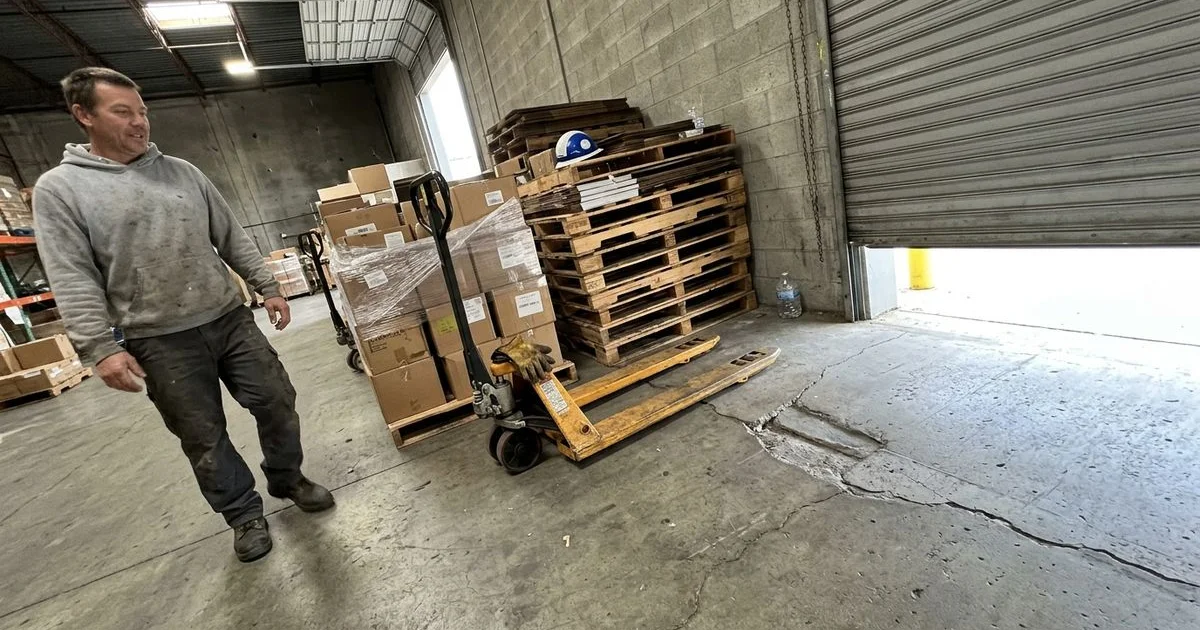
We hear the same frustration from Hartford facility managers all the time. A small dip in the slab suddenly turns into a massive repair bill for a forklift mast.
This is exactly where warehouse floor leveling proves its value. We see this constantly as the team at CT Pro Concrete Leveling, lifting sunken concrete back into place across the Hartford area instead of tearing it out.
Those minor bumps are actually serious hazards hiding in plain sight. We recommend tackling these issues early to prevent costly downtime.
Commercial concrete leveling addresses these infrastructure flaws before they cause accidents. Let’s look at the data, what it is actually telling us, and explore a few practical ways to respond.
An Equipment Problem Before It’s a Concrete Problem
Nobody in a warehouse raises a settled slab just because it looks bad. The issue usually surfaces because a pallet jack gets stuck or a forklift operator flags a jarring bump at a specific joint.
We know that a dock plate failing to sit flat will stop a loading sequence entirely. Infrastructure problems get noticed entirely through their impact on daily operations.
OSHA data from 2025 shows that forklift tip-overs account for roughly 25 percent of all forklift accidents. Uneven surfaces and small slab dips are leading triggers for these dangerous events.
Our teams often spot these subtle hazards long before a major incident occurs. You can spot the early warning signs by simply watching how equipment moves across the floor.
Watch for these operational red flags:
- Forklifts visibly slowing down at specific joints
- Unusual tire wear on your daily handling equipment
- Operators complaining about back strain from jarring impacts
What a Dip Does to Handling Equipment
Every bump takes a hidden toll on your machinery. A forklift crossing a stepped joint takes a massive impact through the mast during every single pass.
We have seen this repetitive shock loading destroy expensive hydraulics and mast components very quickly. A standard mast chain replacement easily costs between $700 and $1,200 in 2026.
That repair cost does not even factor in the lost productivity while the machine sits in the shop. A forklift floor dip is a fast track to inflated maintenance budgets.
| Forklift Component | Impact of Uneven Floors | Estimated Repair Cost (2026) |
|---|---|---|
| Mast Chains & Bearings | Repetitive shock loading | $700 to $1,200 |
| Polyurethane Tires | Chunking from stepped joints | $400 to $800 per set |
| Hydraulic Cylinders | Premature seal failure | $900 to $1,800 |
We calculate that avoiding just one of these repairs covers the cost of fixing the floor. Operators naturally reduce their travel speed for a known bad joint, which slows down your throughput.
Load instability becomes a genuine safety event when a jolt hits a machine carrying a high load, not just a productivity issue. Manual and powered pallet jacks have tiny hard wheels and virtually zero ground clearance.
Our crews have seen pallet jacks stopped completely by a dip that a larger forklift barely registers.
Racking on a Settled Slab
This issue demands separate attention because the consequences extend far beyond basic driving hazards. Racking transfers massive point loads through its baseplates directly into the concrete floor.
We must emphasize that this works perfectly on a properly supported slab. A problem arises when those point loads rest over a cavity, forcing the concrete to bridge an empty gap.
The Rack Manufacturers Institute explicitly states that pallet racking must not exceed an out-of-plumb tolerance of 1/2 inch for every 10 feet of height. Racking leaning beyond this strict limit loses its structural rating and becomes a collapse risk.
Our structural assessments often reveal that a settled floor easily pushes racks past this safety threshold. Industrial floor repair ct services can restore this balance quickly.
Two critical things happen when a floor drops beneath a loaded rack. The slab becomes highly susceptible to cracking under that concentrated pressure, and the steel framing twists.
If you have racking bases sitting on a section of floor that sounds hollow, you need to address it immediately.
“Ignoring a hollow-sounding slab under heavy pallet racking is a gamble that risks both your inventory and your personnel.”
Dock and Approach Settlement
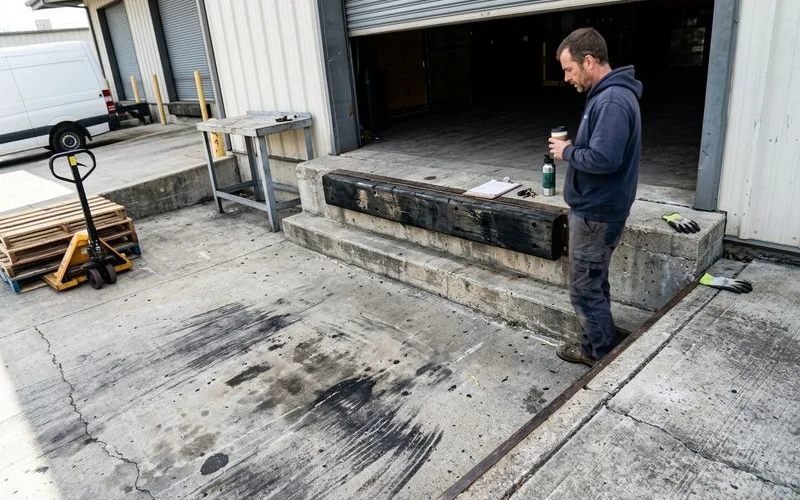
The apron outside a loading dock settles for the exact same reason a residential garage apron does. The concrete sits on backfill against the building line, which is usually the least compacted ground on the entire site.
We see the stakes are much higher in a commercial setting. A dropped approach slab means a massive, 80,000-pound loaded trailer sits at the wrong height relative to the dock leveler.
Dock plates rely on a specific engagement angle to safely bridge the gap into the trailer bed. A severe loading dock settlement issue creates a steep incline that snags pallet jacks and damages product.
Our technicians also look for drainage problems in these sunken areas. Water that used to run away from the building now flows backward and seeps under the door.
This section carries the heaviest wheel loads on the entire property, accelerating the degradation of the slab.
| Symptom | Operational impact |
|---|---|
| Dipped joint mid-floor | Equipment shock loading, reduced travel speed |
| Hollow slab under racking | Point-load risk, racking out of plumb |
| Settled dock approach | Dock plate angle, trailer height mismatch |
| Water entering at the dock door | Wet floor at the busiest point of the site |
| Ponding in a yard or parking area | Ice hazard, surface degradation |
Why a Repour Rarely Works in an Operating Facility
The arithmetic on a commercial warehouse floor looks vastly different from a residential driveway project. Breaking out a floor section requires loud, messy demolition inside an operating building.
We know this process creates substantial dust that coats your inventory and forces debris out through your active doors. The crew then has to handle base preparation, forming, pouring, and waiting for the cure before anything drives on it.
A standard concrete repour requires at least 7 days to cure enough to handle heavy forklift traffic. That is not just a scheduling inconvenience for most facilities, it is a complete shutdown of operations.
Our high-density polyurethane foam offers a massive operational advantage here. A foam lift is completed in small sections, stays completely quiet after the initial drilling, and produces a fraction of the dust.
The foam injection reaches 95 percent load-bearing strength in just 15 to 30 minutes. You get that critical floor area back into service during the exact same shift.
Industry data from 2026 shows that foam lifting is often 400 percent cheaper than replacement when you factor in the cost of facility downtime.
Key benefits of avoiding a repour:
- Zero days of lost facility throughput
- No heavy demolition equipment inside the building
- Elimination of concrete dust settling on products
How Sectional Work Runs
The first step is always walking the site to scope the project against your daily operations. We want to know which specific bays can be released, where inbound deliveries land, and when the floor hits peak traffic.
This consultation yields a highly detailed, phased action plan. The strategy includes specific sections, a tight sequence, and a clear access arrangement to keep your business moving.
Our crews drill precise, 5/8-inch holes that are barely larger than a penny to inject the material. The lifting process stays contained within a small footprint of cones and safety barriers.
We complete the lift and immediately move the equipment to the next zone. The rest of your commercial floor keeps running smoothly throughout the entire process.
Scheduling around operations covers the timing side in detail, including after-hours and weekend work.
Typical Sectional Workflow:
- Traffic flow analysis
- Strategic hole placement
- Rapid foam injection
- Immediate area return
Fixing the Cause, Not Just the Level
A void underneath a commercial slab is usually being fed by something easily identifiable. The culprit is often a broken downspout, a yard graded backward facing the building, or a dock area where water collects beneath the apron.
We frequently see issues with poorly compacted fill dirt around older warehouse structures in the Hartford region. Rainwater easily washes out the fine silt from this loose soil, creating massive hidden cavities.
Common water sources feeding slab voids:
- Broken downspouts discharging near the foundation
- Yard grading that traps water against the building
- Poorly maintained dock drain systems
Lifting a slab without fixing the drainage gives you a repair with a ticking countdown on it. Slab stabilization covers the void-filling side of the equation thoroughly.
Our site assessment includes identifying the exact water path so we can tell you precisely what needs correcting. The evaluation is completely free for commercial sites.
It is highly valuable to have this assessment even if you are not ready to book the repair today. Finding out which sections of concrete sound hollow tells you exactly where your next operational headache is going to appear.
Protecting your equipment and your team starts with a stable foundation. We encourage every facility manager to take a slow walk through their building and listen to the floor traffic.
That clanking forklift might be telling you it is time for professional warehouse floor leveling.
Reach out to our team today to schedule your free commercial site assessment. We will help you secure your concrete and get your operations running smoothly again.