
Compliance Changes the Timeline, Not the Repair
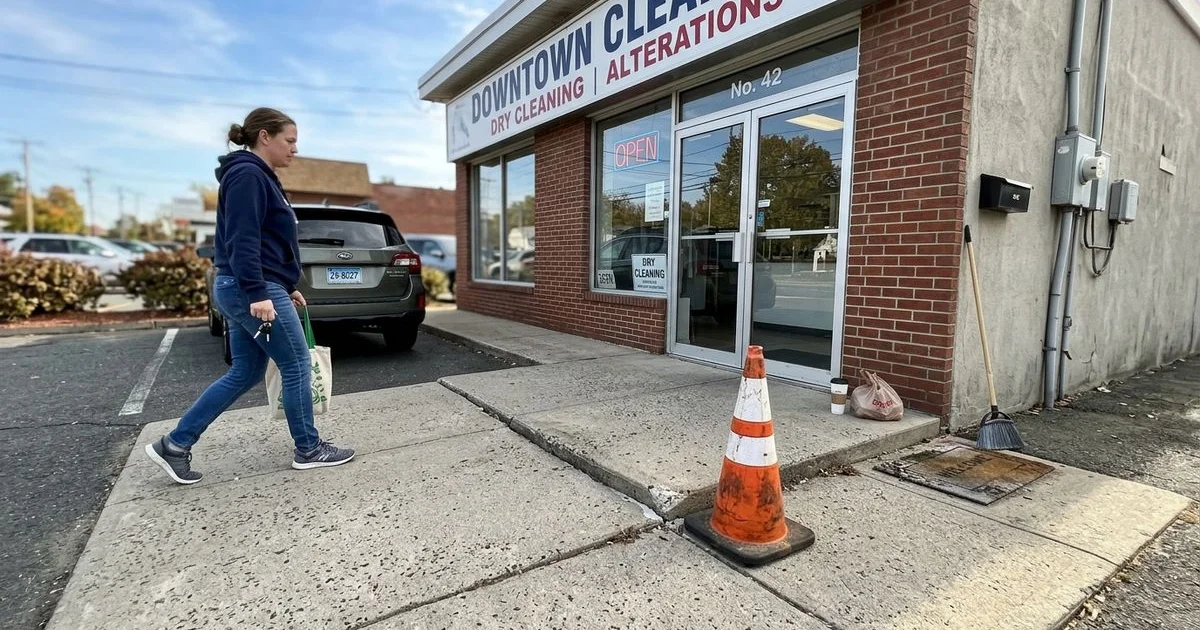
You know how a small bump in a residential sidewalk is usually just an annoyance. On an accessible commercial route, that same bump instantly becomes an ada trip hazard concrete compliance issue.
Our crews fix these exact problems across the Hartford area every week. A single stepped joint suddenly carries a strict deadline and serious financial risk.
Under current 2026 guidelines, a property owner faces maximum civil penalties of over $118,000 for a first-time ADA Title III violation.
That harsh reality completely changes how you should approach the repair.
Commercial concrete leveling makes perfect sense for these tight timelines for three key reasons:
- The process requires no heavy demolition.
- Your accessible route remains intact during the fix.
- It corrects the trip hazard in a few hours, keeping your entrances open.
We are going to break down exactly where these offsets form, what the actual legal limits are, and how you can resolve a citation quickly. The next steps will show you why modern lifting methods beat traditional grinding for long-term compliance.
This page describes how these situations typically get handled in practice. It isn’t legal advice, and the specific requirements applying to your property are a question for a qualified accessibility consultant or your legal adviser.
Where Concrete Settlement Creates the Problem
Accessible routes must remain continuous and reasonably free of any abrupt changes in level. Concrete settlement produces the exact type of vertical shift that triggers an ADA violation.
Our region deals with intense freeze-thaw cycles every winter. That freezing weather causes the soil beneath Connecticut properties to expand and contract, which washes out the base material and leaves concrete slabs unsupported.
These soil voids cause sudden drops in the concrete surface. The specific locations that come up most often include:
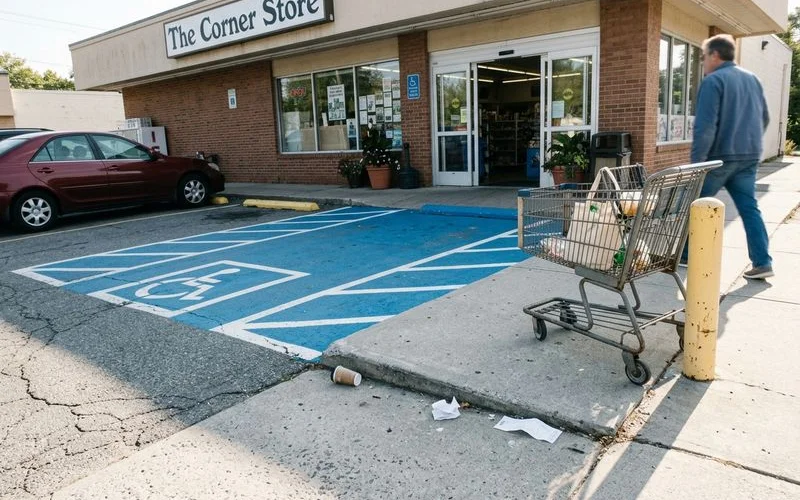
- The path from accessible parking to the building entrance.
- The entrance apron and threshold approach itself.
- Walkways connecting building entrances across a site.
- Ramp landings and the transitions at either end.
- Routes between separate buildings on the same property.
Any of those areas can develop an ada vertical offset concrete defect very quickly. One slab drops relative to the neighboring section, and you suddenly have a dangerous obstacle.
The Offset Itself
Vertical changes in level on an accessible route are treated as a severe safety risk. The 2010 ADA Standards, which remain strictly enforced in 2026, set the maximum allowable vertical change at just 1/4 inch.
Anything between 1/4 inch and 1/2 inch requires precise beveling at a 1:2 slope. If the offset exceeds 1/2 inch, the law demands a completely new ramp treatment to restore safe access.
“A vertical displacement of more than 1/4 inch significantly increases the risk of a trip and fall incident, especially for individuals using mobility aids.”
We advise property managers to skip guessing and measure the drop accurately. A trip hazard over 1/4 inch is no small issue, considering sidewalk falls generate over 300,000 emergency room visits across the United States annually.
Rather than quoting a threshold from memory, grab a straightedge and a standard rule. You need to document the exact height and have it assessed by a qualified professional against current commercial walkway compliance CT standards.
Once the offset exceeds what the code permits, your remediation question becomes an immediate priority.
Documenting a Known Hazard
This documentation phase is where the compliance question and the financial liability question directly converge. Many commercial property managers get caught completely off guard when a small defect turns into a massive legal headache.
Our experience working with Hartford property owners shows that knowledge equals responsibility. Once a hazard is identified in a survey, a tenant complaint, or a formal accessibility audit, a permanent record exists proving you knew about the danger.
From that exact moment, the only thing that matters is what you did and how quickly you acted. Sidewalk-related falls generate average liability settlements ranging from $30,000 to $120,000 for property owners nationwide.
Courts typically evaluate your response based on two positions:
- Documented and remediated: A clear record showing the defect was identified, assessed, scheduled, and corrected with dated before-and-after photographic evidence. This creates a highly defensible legal position.
- Documented and left: A record showing the defect was identified and nothing happened. That is the absolute worst position because you hold the liability knowledge without showing any mitigation effort.
The Owner liability exposure guide covers the broader liability picture on shared and public routes in greater detail.
Remediation Options Compared
Choosing the right repair method depends entirely on the size of the drop and the stability of the soil underneath. Property managers must balance the immediate compliance need with the long-term budget.
We strongly recommend comparing the core repair methods based on how permanently they solve the underlying soil problem.
| Repair Option | Best Suited For | Key Limitations & Drawbacks | Expected Lifespan | Time Per Area |
|---|---|---|---|---|
| Bevelling / Grinding | Minor offsets under 1/2 inch on a stable slab | Fails to address the underlying soil cavity. The offset returns quickly if the slab keeps sinking. | 3 to 7 years | Hours |
| Foam Lifting (Polyjacking) | Most settlement cases requiring a lift of 1/2 inch or more | Not effective for crumbling, deteriorated concrete or extreme tree root heave. | 10+ years | Hours, same-day reopening |
| Sectional Replacement | Severely failed, cracked, or fragmented concrete panels | The entire area must be closed for days. Extensive base preparation is absolutely critical. | 20 to 30 years | Days |
| Offset Ramping | Locations where a level change simply cannot be eliminated | Strict space and design requirements often limit installation options near doorways. | Varies by material | Varies |
The foam lifting option is overwhelmingly chosen for compliance work for a very specific reason. It successfully addresses the root cause of the settlement while fitting perfectly inside a tight remediation window.
Grinding a lip off a slab that is still settling only gives you a compliant measurement for a few months. That same joint will likely produce a non-compliant step within two winters, long after you have certified the initial remediation.
A Realistic Timeline
For a single entrance walkway with a settled section, the process moves much faster than a full replacement. You can typically expect the entire compliance issue to be resolved within a week.
Our scheduling process prioritizes keeping your commercial property accessible to customers. Here is a realistic timeline for a standard repair:
- Site assessment: This includes a site visit, sounding the slabs, measuring every offset on the route, and providing a written scope. This is free and usually happens within a week of the inquiry.
- Flexible scheduling: The work is arranged around your trading or tenant hours. Overnight and weekend work is standard practice in the industry, and scheduling slab work around tenant hours covers how that gets coordinated on an occupied site.
- The physical work: Lifting a settled slab is typically a matter of just a few hours per designated area.
- Immediate reopening: You can reopen the walkway during the exact same shift. High-density polyurethane foam reaches 90% load-bearing strength in just 15 to 30 minutes.
- Thorough documentation: You receive dated before-and-after condition photographs provided directly for your compliance files.
For a multi-building site or a sprawling retail parking area, phasing extends the calendar slightly. However, no single area is ever out of use for a prolonged period.
What to Do This Week If You’ve Been Flagged
You must immediately measure and photograph every vertical offset on the affected route, not just the specific one that was cited. Remediating a single slab while leaving its neighbors untouched is only a partial answer that leaves you exposed to further liability.
Our experts recommend taking these three exact steps to protect your property:
- Document the entire run: If one concrete joint has stepped, others on the same exact run have likely dropped as well.
- Schedule a professional assessment: You need a qualified expert to evaluate the whole route.
- Understand the growth factor: The guide on What makes a lip dangerous clearly explains why these offsets grow over time rather than stabilizing.
That growth factor is critical when you are deciding whether to permanently fix a route today or repeatedly pay for temporary grinding services.
We provide a free site assessment that produces a detailed written scope covering your full property. If you have a strict legal deadline looming, mention it during the initial call.
Our team will tell you honestly whether that timeframe is achievable and outline exactly what it takes to restore full compliance. You can secure your property and protect your business before the fines multiply.