
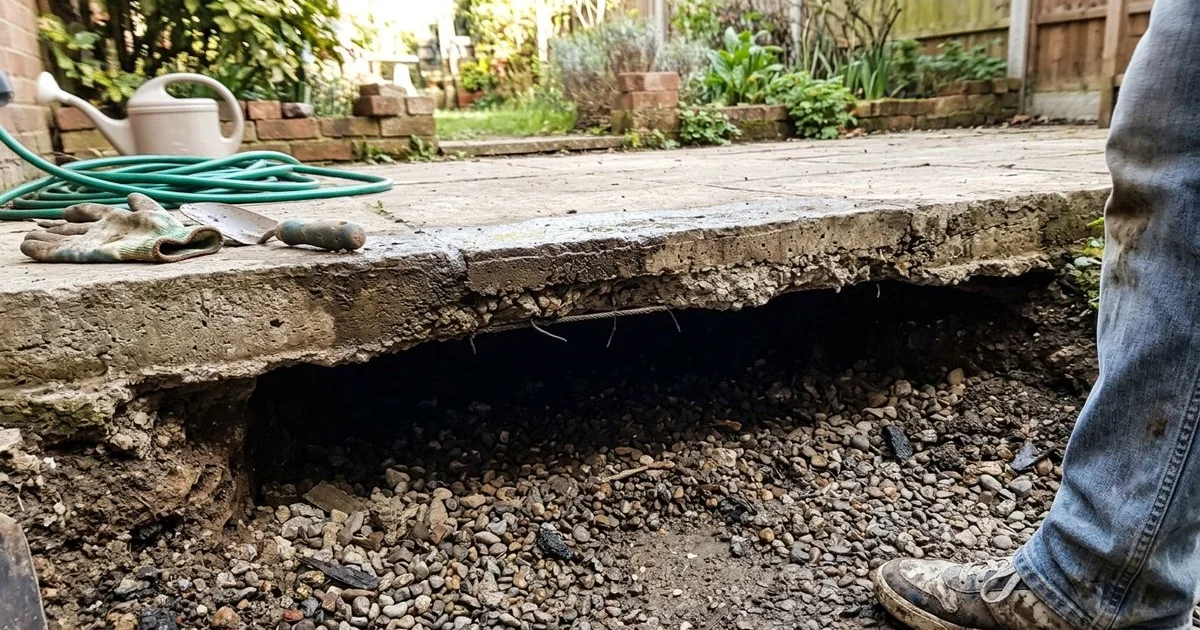
We constantly see the same frustrating issue creating voids under concrete slab structures across the Hartford ring towns. Driveways, garage floors, patios, walkways, basement floors, and warehouse floors all share similar symptoms. The real problem is simply that the ground supporting the concrete has vanished.
Understanding how that happens tells you two very useful things: whether your slab is a candidate for void filling and stabilization, and what you must change to stop it from recurring.
Four distinct processes create these cavities. These forces usually run together to wash away your base. We are going to break down the exact sub slab void causes and then explore practical ways to respond.
One Mechanism Behind Every Settled Slab
The single mechanism behind every settled slab is the complete disappearance of the supporting soil underneath. Ground that was previously holding the concrete up simply washes away or compacts over time. We see this structural failure play out across local neighborhoods every single week. All of these different slabs display the exact same sinking symptoms.
Understanding the root cause provides essential information for homeowners. You will quickly learn if your property qualifies for a quick lift or if you need a total replacement. Our crew focuses on diagnosing the exact environmental forces destroying your base. Data from recent local property inspections shows exactly how to fix this damage permanently.
One: Backfill Consolidating Under Its Own Weight
Backfill consolidates because builders excavate ground for a foundation and return the loose dirt without packing it to its original density. The soil then slowly compresses under its own weight for decades. We often test this soil and find it fails the Standard Proctor compaction test, meaning it contains too much air and empty space. That loose dirt sits around the perimeter of your home and settles continuously.
This natural compression explains why failures cluster so predictably. Garage aprons, front stoops, patio edges, and the section of driveway nearest your foundation all sit on ground disturbed during construction. Undisturbed soil twenty feet from the house completely avoids this problem. Our technicians regularly see newly built homes in Glastonbury or Avon experience 10% to 20% backfill drop within the first five years.
To help you visualize this, here are the most common areas affected by backfill settling:
- Garage Aprons: The strip of concrete meeting your garage floor.
- Front Stoops: Porch steps leaning heavily toward the front door.
- Driveway Perimeters: The top section of pavement right near the foundation.
- Patio Edges: Backyard slabs pulling away from the siding.
Two: Water Eroding Fines
Water erodes the fine particles packed between larger soil chunks, leaving the remaining dirt loose and highly compressible. The Hartford area averages around 50 inches of rainfall annually, which creates a massive volume of water flowing through the ground. We see this runoff act like a microscopic river underneath your concrete. It picks up the finest silt and carries it into drains or out of slope faces. Larger rocks stay behind, but the actual structural support vanishes entirely.
Our property inspections usually reveal very obvious water paths once you know where to look. Common culprits feeding water under your slab include:
- Unsealed Control Joints: Acting as direct channels for rain to bypass the concrete.
- Negative Grading: Slopes delivering surface runoff to the exact same spot storm after storm.
- Poor Downspout Placement: Gutters discharging rain directly onto the slab edge.
You can read exactly what to correct in our detailed guide on Downspouts and washout. A simple rigid PVC downspout extension buried at least ten feet away from the foundation solves a majority of these drainage issues. We highly recommend avoiding cheap corrugated plastic pipes because they easily crack during winter freezes.
Three: Freeze-Thaw Enlarging the Cavity
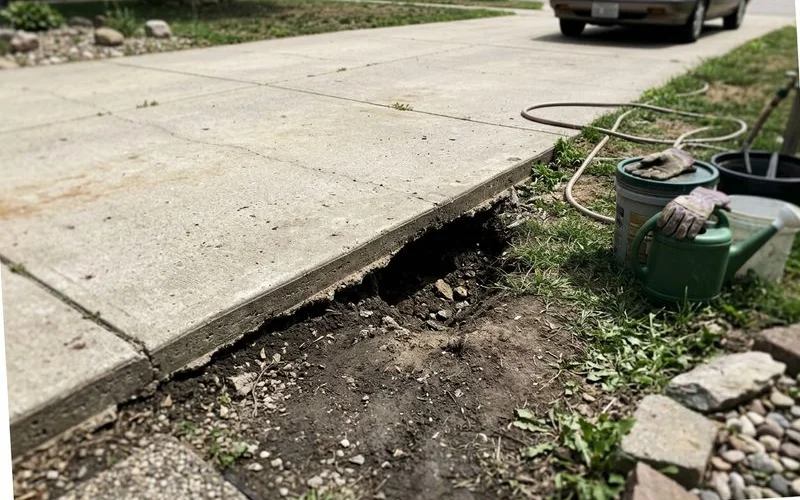
Freeze-thaw cycles enlarge existing cavities because trapped water expands by roughly nine percent when temperatures drop below freezing. This expansion pushes upward against the concrete and outward against the soil, completely reorganizing the dirt structure. We deal with this specific accelerant constantly in Connecticut. This cycle explains why local flatwork fails much faster than concrete poured in milder southern climates. The spring thaw lets the ground settle back down loosely.
Meltwater then carries even more fine particles away as it drains. Our local frost line sits at 42 inches deep. Everything above that specific depth freezes and thaws repeatedly between December and March. Building codes require footings to reach below this line, but residential flatwork never does.
You can find the full explanation in our resource on Connecticut’s frost line. Every single winter cycle enlarges an existing cavity under concrete slightly. Over twenty seasons, those slight changes add up to massive sinkholes. We regularly measure gaps larger than four inches hidden just beneath seemingly intact driveways.
Here is a simple timeline of how winter weather destroys your base:
| Season | Soil Condition | Concrete Impact |
|---|---|---|
| Fall | Water pools in small existing gaps | No visible change |
| Winter | Water freezes and expands by 9% | Upward pressure weakens slab |
| Spring | Ice melts and ground settles loosely | Meltwater washes away more dirt |
| Summer | Soil dries and shrinks away | Cavity reaches its maximum size |
Four: Soil Shrinkage in Dry Spells
Soil shrinkage opens gaps beneath concrete during extended dry spells, particularly in clay-bearing earth. Fine-grained soils physically contract as they lose moisture during the hot summer months. We see this frequently in the Connecticut River Valley, where clay pockets are common. The ground literally pulls away from the underside of the concrete. This movement opens a dangerous void that did not exist during the wet spring season.
Rain eventually returns and causes the soil to swell again. Our experience shows that the dirt rarely expands fully or uniformly back to its original shape. This shrinkage rarely causes a complete slab failure on its own. Combined with the other three natural forces, it plays a major role in property damage.
We created a quick summary of how these four processes break down your foundation over time:
| Process | What it does | Where it shows |
|---|---|---|
| Backfill consolidation | Ground settles under its own weight | Aprons, stoops, slabs near foundations |
| Water eroding fines | Removes the material that gives soil density | Downspout discharge points, joint lines |
| Freeze-thaw | Loosens and enlarges existing cavities | Everywhere above 42 inches, every winter |
| Soil shrinkage | Contracts away from the slab underside | Clay soils, extended dry spells |
How the Slab Behaves Over a Void
Concrete bridging a cavity behaves like a plank over a ditch, which forces the material to bend and places the underside in extreme tension. Standard residential concrete boasts a compressive strength of around 4,000 PSI, meaning it handles heavy weight pressing straight down perfectly well. We know that its tensile strength is only about 400 PSI. The concrete simply cannot handle the stretching force caused by bending over an empty space.
The slab will hold its shape for a while. You get a hollow concrete slab that sounds completely empty but has not visibly dropped yet. Our technicians consider this the ideal moment to intervene, though very few homeowners catch it early. Eventually, the weight of a vehicle or even heavy snow exceeds what the unsupported span can carry.
The slab violently cracks along the exact line where the soil support ends. Those broken sections then plunge downward into the empty cavity. We usually get the phone call right after this happens. By then, you have an empty hole to fill and a heavy slab to lift back into place.
That surface crack is a direct consequence rather than the root cause. It distinctly marks the outer edge of the hidden void.
The Tensile Strength Problem
Your driveway was never designed to act as a bridge. We explain this to customers by comparing concrete to glass. Both materials can support immense weight when resting on a solid, flat surface. Neither material can survive bending without snapping in half.
How to Find Voids Under Concrete Slab Yourself
You can find a void yourself by systematically tapping the concrete with a hammer and listening for a hollow echo. Homeowners do not need any expensive diagnostic equipment to locate these dangerous pockets. We teach our customers two foolproof testing methods that take less than five minutes.
Sounding With a Hammer or Golf Ball
Tap methodically across the slab with a standard framing hammer or a heavy masonry hammer. Supported concrete always rings dull and dead. Concrete sitting over a cavity sounds distinctly hollow. We also recommend the pro-trick of bouncing a regular golf ball across the surface. The ball will produce a sharp clicking noise on solid ground and a deep, thudding sound over an empty pocket. Work in a grid pattern and mark the exact spots where the acoustics change.
Testing Movement Underfoot
Walk or shift your weight heavily onto suspect sections. A slab bridging a cavity sometimes flexes perceptibly under your boots. Our crew sometimes sees the concrete rock back and forth slightly between two support points. Finding a hollow area on a slab that has not visibly dropped yet gives you a massive advantage.
Filling an empty pocket beneath a perfectly level slab is the absolute cheapest form of maintenance. This proactive approach requires no heavy lifting and creates zero cosmetic disruption. We utilize high-density polyurethane foam to fill these spaces, which stops the settlement entirely before a crack ever forms.
Stopping It Recurring
You stop the problem from recurring by filling the existing empty space and permanently redirecting the water source that originally washed the dirt away. The high-density polyurethane foam used to fill a cavity is chemically inert, meaning it never breaks down or washes away like soil. We know that the same bad drainage will happily wash away the remaining dirt around the repair if left unchecked. A truly durable fix always requires a two-part approach.
First, you must inject material to stabilize the foundation. Next, you must cut off the specific water path that caused the erosion. Our team considers simple maintenance tasks like installing a splash block or sealing control joints mandatory. A small regrade at the slab edge to promote positive drainage is another incredibly cheap fix.
These minor weekend projects represent the difference between paying for a repair once and paying for it twice. According to recent 2026 local pricing data, polyurethane foam leveling costs 50% to 80% less than a complete tear-out. We often see homeowners spend $800 to level a driveway that would cost $4,000 to completely replace. Protecting that investment with a twenty-dollar downspout extension just makes financial sense.
The free on-site inspection includes sounding the slab and identifying exactly what is feeding water underneath. This critical information decides both the repair method and the preventative strategy. Give your local concrete experts a call today to schedule an evaluation before those hidden voids under concrete slab structures turn into expensive cracks.