
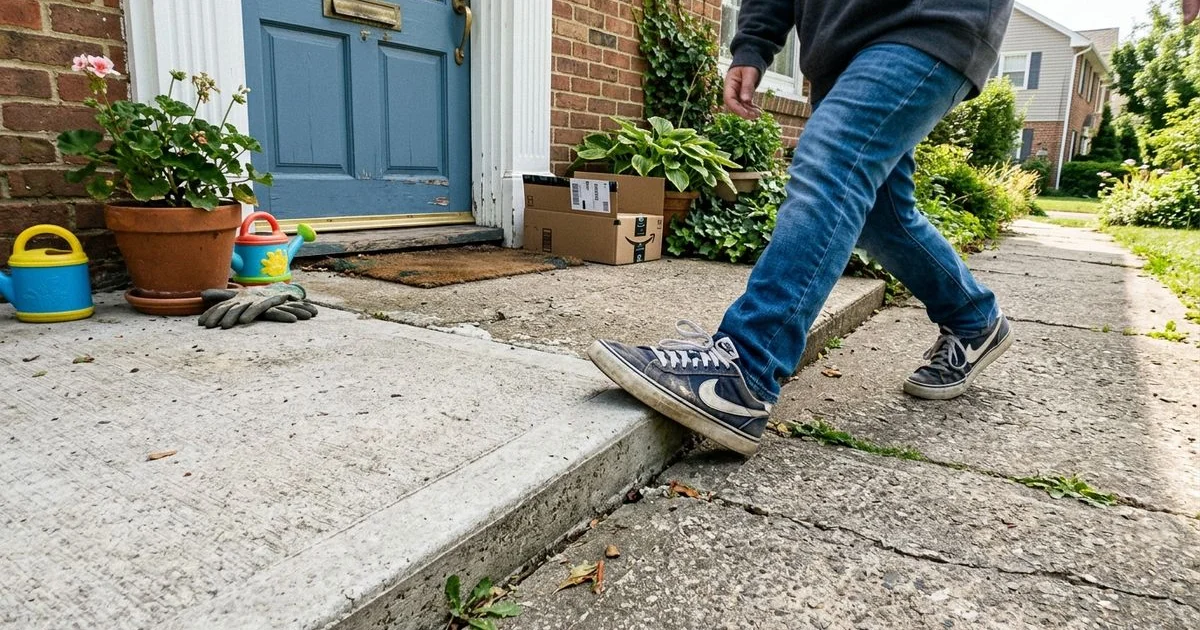
The Question Behind This Page
Most people looking at an uneven concrete walkway trip hazard want to know if it is actually dangerous enough to fix. Here is the straight answer.
Any lip you can feel under your shoe is a real hazard.
That is not the answer most Hartford homeowners hope to hear, but it is the truth.
Toes Catch on Very Little
The honest threshold for a tripping hazard concrete issue is surprisingly tiny. The Americans with Disabilities Act (ADA) officially flags any vertical change of just 1/4 inch or more as a hazard.
The mental image of a trip is usually a dramatic step you notice from ten feet away. Tripping does not actually work like that.
A normal walking gait clears the ground by a tiny margin during the swing phase. This clearance drops significantly toward the end of a stride.
People are especially vulnerable to these small offsets when they are:
- Tired after a long day of work
- Carrying items from the car
- Looking at their phones instead of the path
- Walking in poor lighting
Offsets well below the point where a slab looks obviously broken are easily enough to catch a toe. If you can feel it underfoot while walking normally, other people will definitely find it too.
Walkway leveling exists for exactly this category of defect.
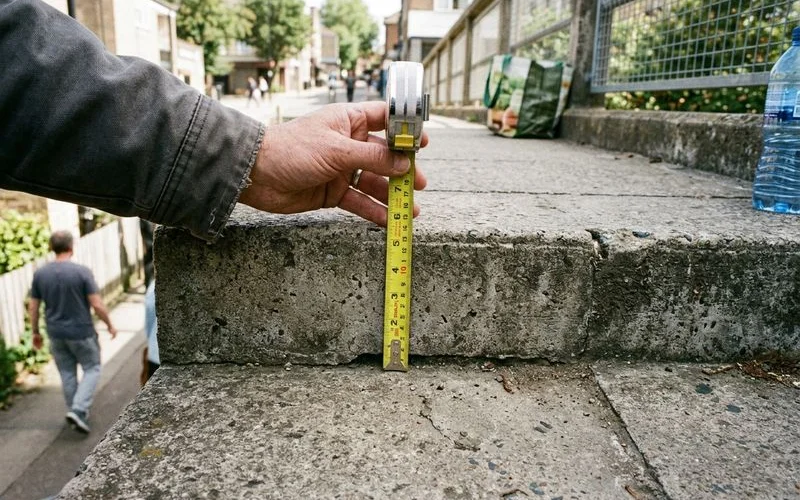
The Conditions That Make a Small Lip Worse
The same offset becomes a completely different hazard depending on the weather and lighting conditions. An exact walkway lip height might be safe at noon but dangerous at midnight.
We see this play out constantly across older Hartford neighborhoods. A lip is easy to spot in daylight because it casts a clear shadow line.
Under a porch light at an oblique angle, that visual cue disappears entirely.
Four Seasonal Hazards to Watch
- Darkness: Unlit paths remove all depth perception.
- Wet surfaces: Rain removes the shadow contrast and adds a slipping threat to the trip.
- Leaf cover: In a classic Connecticut autumn, a stepped joint vanishes under leaves for weeks. Those leaves compact into a smooth surface that hides the drop completely.
- Snow and ice: Hartford averages roughly 40 inches of snow a year. This creates the exact same visibility problem for four months, but with a much harder landing on solid ice.
Someone arriving with a delivery cannot look at the path closely. They also cannot easily put a hand out to catch a fall.
Most incidents on private property combine two or three of these elements. The lip that looks perfectly fine in July is exactly the one that catches a delivery driver in November.
It Grows Every Winter
This defect will get worse every single year, which completely changes the calculation about waiting to fix it. Settlement is not a one-time event that simply stops.
The cavity under your low slab enlarges with each seasonal freeze-thaw cycle. Surface water gets in, freezes overnight, levers the space wider, and then thaws.
Our crews repair the damage this causes every spring. Central Connecticut runs that cycle roughly 40 to 50 times between December and March.
The slab drops slightly further into the expanded cavity every time. A lip you decide to live with this year will be measurably bigger next year.
It does not stabilize because nothing in this mechanical process is self-limiting. The cheapest possible moment to deal with a stepped joint is the moment you first notice it.
| Time from noticing | Typical state | Fix | Estimated Impact |
|---|---|---|---|
| Now | Small offset, sound slabs | Short lift, or grinding if very minor | Lowest cost, takes hours |
| A few winters on | Larger offset, cavity grown | Full lift, more material needed | Higher material cost |
| Longer | Slab jolted repeatedly, often cracked | Lift if sound; replacement if not | Significant project |
| After an incident | Same repair, plus everything else | Repair cost is now the small number | Medical and legal stress |
Who Carries the Risk
On private residential property, the financial exposure for a visitor injured by a hazard generally sits squarely with the homeowner. You hold the direct liability for maintaining a safe path to your door.
The legal position gets materially worse if the hazard was previously known. A defect you noticed, or that a neighbor mentioned to you, makes for a much harder situation in court than an issue that genuinely appeared without warning.
For rental and multi-family properties, this uneven sidewalk danger is even sharper. Common walkways and shared entries remain the direct responsibility of the property owner.
According to 2024 data from the Insurance Information Institute, the average payout for a bodily injury claim related to a slip and fall on residential property exceeds $30,000.
There are simply more people crossing these paths more often. Liability on rental property covers these specific commercial situations in detail.
The comparison between risk and repair is not close in either case. A professional walkway lift is just a few hours of work at a modest cost.
A trip-and-fall claim involves immediate medical expenses and potentially massive legal costs. It also guarantees years of expensive impacts to your insurance premiums.
Lift the Run, Not the Slab
Lifting the entire run of concrete is the only way to permanently fix multiple stepped joints without creating new ones. Doing it piecemeal usually just shifts the problem to the next slab over.
One technical point will save you a lot of money and confusion. If a path has several joints that have each stepped a little, lifting a single slab flush relocates the pressure.
We see this mistake from untrained contractors constantly. You make one joint level but leave the rest, creating a brand new discrepancy where the newly lifted slab now sits awkwardly proud of the next one in the sequence.
Walkways must be scoped as complete runs to avoid this.
The Professional Scoping Process
- The inspection measures every offset along the entire path.
- We set one target level for the whole run.
- The final price is calculated based on that comprehensive fix.
- Our team injects high-density polyurethane foam to achieve that exact target.
It sounds like a lot more work upfront. This approach actually costs less in the long run than paying a crew for three separate visits over three years.
Grinding or Lifting?
For a genuinely minor offset on a sound path, grinding the lip off is cheaper and entirely reasonable. It physically removes the tripping point.
This method stops being appropriate when the concrete slab is still settling. You end up grinding the symptom off a surface that will simply sink and step again next winter.
Grinding also becomes a bad idea when the offset is larger than half an inch. Standard residential walkways are only four inches thick, so removing a heavy layer weakens the remaining concrete and exposes the porous inner aggregate to salt and ice.
| Feature | Edge Grinding | Polyurethane Foam Lifting |
|---|---|---|
| Best For | Minor offsets (under 1/2 inch) | Active settlement, larger offsets |
| Visual Result | Exposed aggregate, scarred surface | Original surface texture maintained |
| Structural Impact | Thins and weakens the slab edge | Supports and stabilizes the slab |
We do not sell grinding services, which is precisely why our opinion on it is highly objective. Grinding versus lifting works through exactly where that functional line sits.
If you have a lip you keep noticing, a free on-site inspection measures every offset on the run. The technician will also sound the slabs for hidden cavities underneath.
That assessment tells you definitively whether you are looking at a simple grind, a foam lift, or something you can genuinely leave for another season. Reach out to schedule a visit so you know exactly what your property needs.