
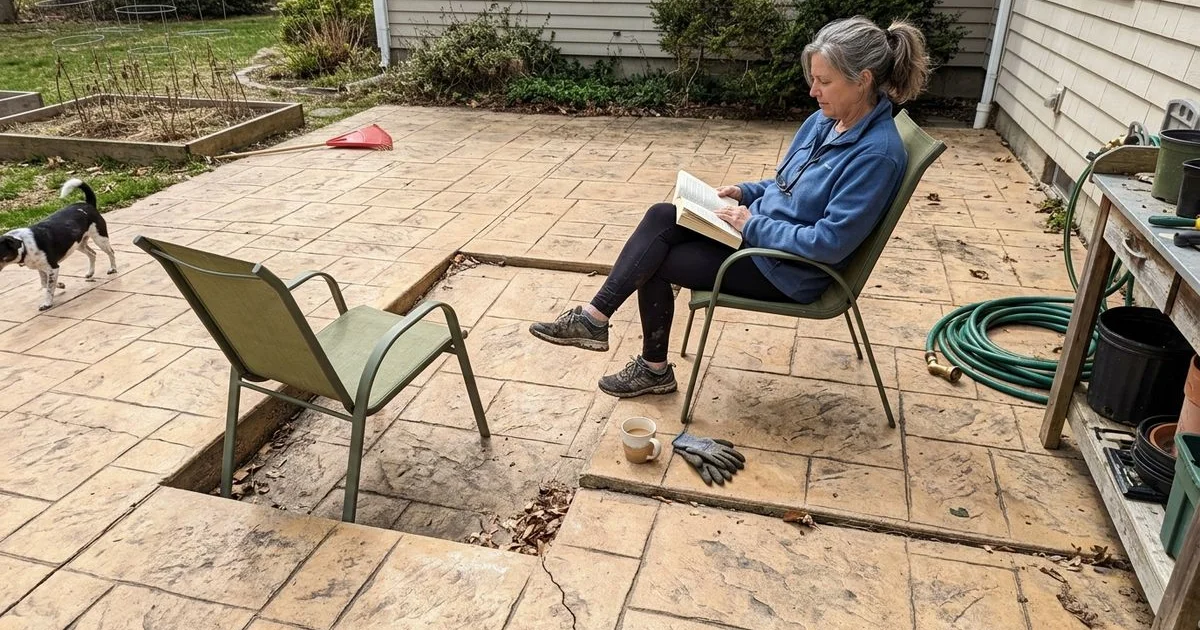
Many Hartford-area homeowners notice their beautiful outdoor spaces sinking after a few brutal freeze-thaw cycles. We see this frustration constantly, as costly investments slowly become uneven trip hazards.
Can stamped concrete be leveled successfully?
Our team has proven that the answer is a resounding yes across Connecticut, saving folks from the massive expense of a full tear-out. Let’s look at the data, what it actually means for your property, and how to fix the issue without tearing everything out.
The Short Answer, Then the Reason
Yes, you can absolutely raise settled patterned surfaces. And of everything we lift, decorative flatwork has the strongest case for repair.
The reason is not highly technical. Decorative concrete lifting works the same way plain concrete leveling does.
It is the same slab-over-a-cavity problem. Our patio and pool deck leveling service handles it with the exact same polyurethane method.
The Key Difference: What changes significantly is the alternative.
On a plain driveway, a replacement gives you a brand-new driveway. On a stamped patio, replacement gives you something that completely fails to match the patio you originally had.
Why a Repour Can’t Reproduce What You’ve Got
Stamped concrete gets its unique appearance from three specific elements applied at the time of the pour. The contractor uses a specific stamp mat pattern, a base color worked into the mix, and a release agent that creates the secondary color variation.
Reproducing all three on a new pour next to concrete that has weathered for a decade is exceptionally difficult. People rarely anticipate this mismatch.
We consistently see homeowners shocked by the obvious difference. Mat patterns get discontinued by manufacturers over time. Color formulations from brands like Brickform or Euclid change their chemical makeup.
Even where the exact products remain available, new surfaces do not look like ten-year-old concrete.
Here are the specific reasons a fresh pour stands out:
- Stronger Base Tones: The fresh color hardener is much richer than a sun-faded surface.
- Crisper Release Variation: The antiquing release agent has not worn down from years of rain and foot traffic.
- Lack of Weathering: The new surface lacks the natural, settled-in look created by harsh Connecticut seasons.
- UV Damage Mismatch: Years of direct sunlight permanently alter the original tint.
The result reads as an obvious patch. You might not notice it instantly, but you will see it every time you look at the joint.
Where the Ports Go
This is the entire technique for stamped patio repair, and it is simpler than it sounds.
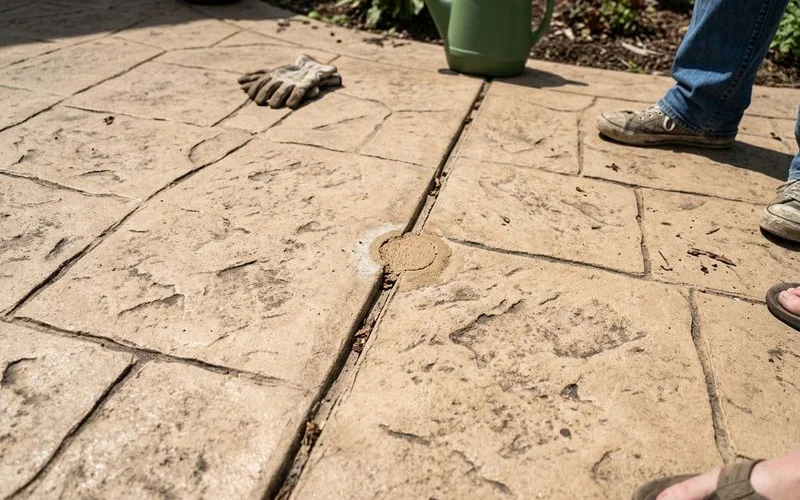
A patterned surface already has numerous visual breaks built into the design. Grout lines, pattern joints, and the edges where one element meets another all create natural hiding spots. Those are places the eye already expects a discontinuity.
Pro Tip: The success of colored concrete leveling relies heavily on the technician’s eye for geometry. Placing ports in the busiest intersections of the stamp pattern yields the most invisible results.
Our technicians place the injection ports directly in these lines. A small, 5/8-inch hole in the middle of a smooth panel would be highly noticeable. That exact same dime-sized hole inside a grout line virtually disappears into a pattern already full of lines.
Planning that pattern takes slightly longer than working on a standard driveway. We have to work around the design rather than laying a straightforward grid. It is the main reason decorative work takes a little more time on site.
Patching and Color Matching
The ports get filled flush and then carefully color-matched to the surrounding surface. On integrally colored slabs, this means matching the primary body color. On surfaces with a release-agent secondary tone, the patch gets worked to sit within that variation rather than reading as a dull, flat spot.
Nobody should claim a patch is completely invisible. Under close inspection on a bright afternoon, you can find them. The honest framing is that they remain far less visible than any full-replacement alternative.
They are considerably less visible than the massive 2-inch holes traditional mudjacking would leave behind. Polyurethane foam only requires a 5/8-inch opening, which makes a world of difference for the final look.
If the surface is sealed, resealing the treated area afterwards blends the finish beautifully. We often recommend using a quality product like a high-gloss Gem-Seal to even out any difference in sheen.
| Option | What happens to the finish | Cost Impact |
|---|---|---|
| Polyurethane Lifting | Original surface kept; discreet 5/8-inch color-matched ports | A small fraction of replacement |
| Traditional Mudjacking | Original surface kept; massive 2-inch patches, very hard to hide | Often slightly lower upfront, but risky long-term |
| Repour the settled section | New pattern and bright color placed right beside the old faded slab | High, and the mismatch shows permanently |
| Replace the whole patio | Consistent appearance, but it is a completely new patio | Highest ($12 to $25 per square foot locally) |
What to Tell Us at the Inspection
Four specific details change our approach to your project. Let the inspector know about these factors right away.
Surface Treatments and Sealers
Explain exactly what sits on the surface. We need to know about any applied coatings, such as:
- Clear acrylic sealers
- Acid stains
- Integral body colors
- Dry-shake color hardeners
This information dictates the repair plan. It affects both the port placement strategy and the patching material used.
The Original Contractor Details
Share when the patio was poured and by whom. If the original local contractor is still operating, the color formulation might be traceable. This occasionally makes matching the exact tint straightforward rather than an approximation.
Our team can sometimes source the exact release agent used initially. This saves significant time and improves the final aesthetic.
Resealing History
Tell the inspector if the slab has been resealed recently.
Maintenance Note: Multiple sealer coats physically change the surface sheen over time.
The patch material has to be worked carefully to sit within that specific level of gloss.
High-Visibility Areas
Point out where you least want to see a port. If there is a section you look at every single day from the kitchen window, say so immediately. Port placement has some flexibility, so technicians can easily avoid your direct line of sight.
The Decision Usually Makes Itself
Most owners of decorative flatwork who understand the matching problem quickly change their mindset. They stop weighing cost against cost and start weighing the desire to keep what they have against having something completely different.
Once framed that way, the choice is rarely close. Our Lifting versus replacing guide covers the general comparison in detail. On stamped and colored work, the preservation argument tends to settle the debate before the price argument is even reached, and the same reasoning applies to a settled and tilting patio slab whether or not the surface is decorative.
The Bottom Line: A replacement gives you a new patio. Leveling gives you your patio back, stabilized and safe.
To put it in perspective, Hartford-area stamped concrete replacement costs anywhere from $12 to $25 per square foot. Leveling saves you thousands of dollars while protecting the custom look you already love.
When It’s Still Not Worth Lifting
The same structural limits apply as on plain, standard concrete. If the core of the slab is failing, there is simply nothing sound left to lift. No amount of pattern preservation changes that physical reality.
Here are the clear signs a slab requires full replacement:
- Widespread surface spalling or flaking.
- The top color layer is actively delaminating from the base.
- The slab has shattered into multiple small, jagged pieces.
This happens far less often on decorative work than on plain flatwork. A custom stamped patio is usually a newer and better-finished slab than a fifty-year-old suburban driveway.
But severe damage still happens, especially with heavy salt use during Connecticut winters. We will tell you the honest truth at the free inspection rather than after you sign a contract.
Got a stamped patio with a settled section? Book a free look and our specialists will assess both the concrete condition and the optimal port placement before you decide anything.