
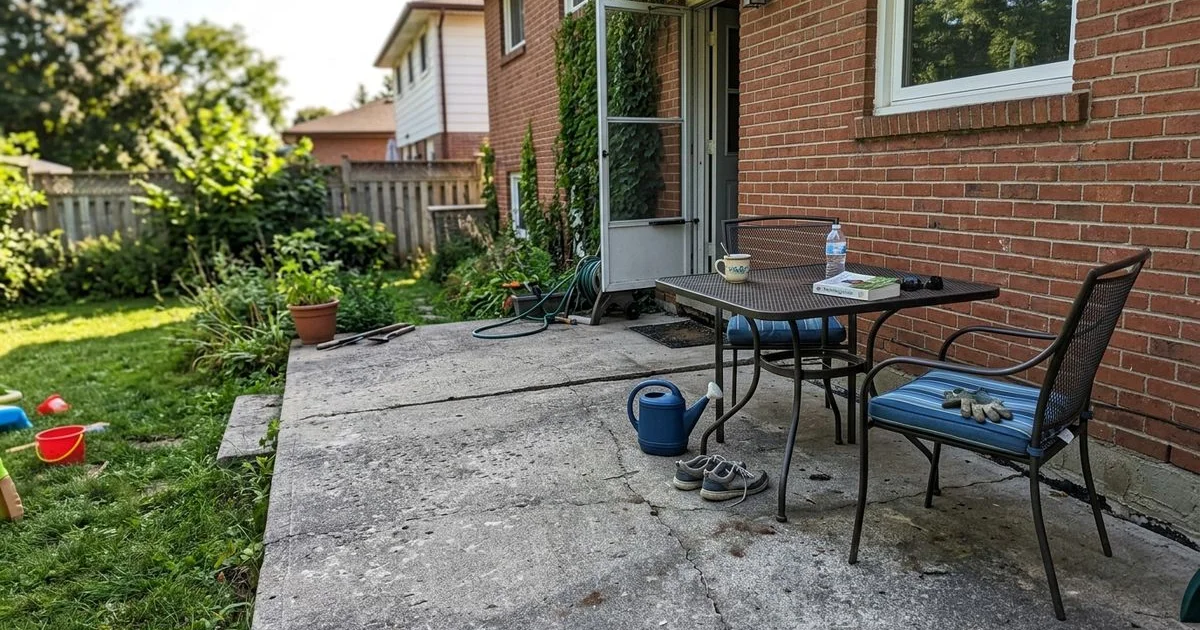
Many property owners assume a heavy concrete slab is a permanent, immovable fixture. We see this issue constantly at CT Pro Concrete Leveling, where we lift sunken concrete back into place across the Hartford area instead of tearing it out. That specific structural mismatch is exactly why patio and porch leveling is a vital service for local homeowners. Our crews point to the 2026 building codes, specifically the rule for Connecticut’s frost line, to explain the settling mechanism in full. The following sections will break down the main reasons this happens and walk through the exact solutions to protect your property. If the settled surface is a pool surround rather than a patio, lifting a pool deck without damage covers the extra care that job needs.
No Footing, No Anchor
Here is the structural fact that explains why is my patio sinking: your concrete has absolutely nothing anchoring it into the deep earth. We know that residential homes sit on structural footings that reach deep below the surface. The 2026 Connecticut State Building Code requires these footings to extend at least 42 inches below grade to escape freezing soil. Our crews frequently explain that your patio simply sits on backfill, which is the loose dirt tossed back against the wall after the foundation was poured.
This backfill zone is usually a 4-to-6-foot wedge of loosely packed earth. We find that the house stays firmly put while the patio is forced to ride the constant expansion and contraction of that shallow topsoil.
That unanchored movement forces the concrete to shift and drop over the years.
Our leveling service exists specifically to correct this inevitable winter damage.
Why It Tilts Rather Than Dropping Evenly
Settlement across a patio tilting toward house is almost never uniform because the underlying soil density varies drastically. We constantly observe that the backfill closest to your foundation is the least compacted ground on your entire property. Standard Proctor compaction tests require commercial sites to reach 95 percent density, but residential backfill is rarely tamped to that level. Our local experience shows this dirt retains up to 20 percent more air voids than the untouched, ancient soil at the outer edge of your yard.
Here are the specific soil conditions driving this uneven drop:
- The Foundation Trench: A 4-foot wide zone of disturbed earth hugs your home.
- The Compaction Gap: Residential builders rarely reach the high density required for commercial builds.
- The Outer Stability: Soil past the patio’s far edge has been settling since the glaciers receded.
We see the slab rotate inward rather than dropping straight down. This simple geometric tilt instantly turns a harmless cosmetic crack into a severe water management problem. Our repair process treats that backward pitch as the primary danger.
Roof Runoff Does the Excavating
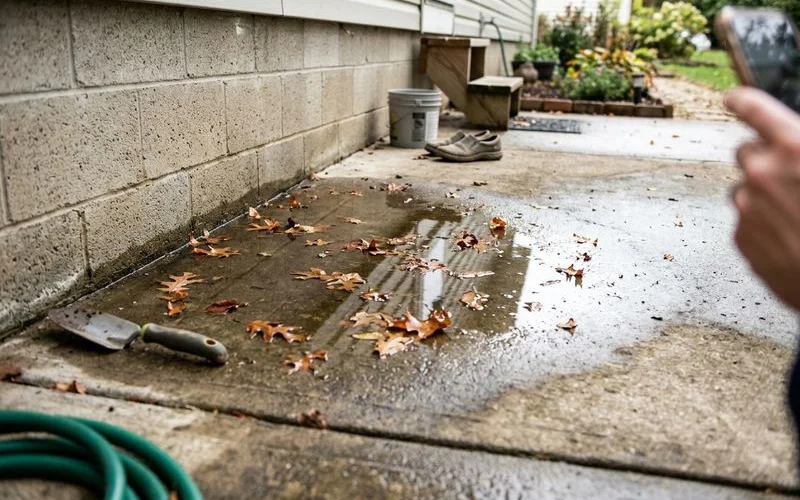
Winter weather loosens the ground beneath your concrete, but concentrated roof runoff physically washes it away. We track this issue back to downspouts discharging massive volumes of water directly onto the slab edge. One inch of rain falling on a standard 1,000-square-foot roof sheds roughly 600 gallons of water. Our inspections often reveal all that water dumping just two feet from the house, blasting right into the vulnerable joint.
This endless cycle of water carries the fine sand and silt away as it drains into the yard. We consider this a slow, invisible excavation project happening right underneath your outdoor living space.
A single one-inch rainstorm on a typical Hartford roof can dump over 600 gallons of water into a poorly placed downspout, acting like a power washer against your patio’s base.
Our team warns that if a downspout empties near a sunken corner, you have undoubtedly found the culprit. The heavy concrete eventually just slumps down into the empty cavity left behind.
The Consequence Nobody Plans For
Once the concrete pitches backward, a cascade of expensive secondary damage begins. We immediately look for three specific threats that follow this reversed drainage.
- Water sits against the foundation wall. Saturated ground creates hydrostatic pressure, which forces moisture into the structure.
- Our repair quotes show a stark reality. We frequently see Hartford homeowners paying $800 to $1,300 to fix a single foundation crack caused by this pressure.
- Ice forms all winter. Hartford averages 108 freezing nights a year, turning that low spot into a dangerous daily hazard.
- Our observations confirm rapid acceleration. We know water finds the joints, erodes the base, and creates a deeper tilt that catches even more rain.
The comprehensive guide on water draining toward the house covers the full drainage picture. We always check these hidden symptoms against the visible signs on the surface.
| What you notice | What’s underneath |
|---|---|
| Puddle standing beside the house | Slab has rotated inward |
| Gap opening between patio and wall | Slab has dropped away from a fixed structure |
| Basement wall damp on the patio side | Saturated backfill from redirected runoff |
| Ice in the same spot every winter | Low point holding water |
| Furniture rocking on the slab | Uneven settlement across the surface |
| Hollow sound near the house edge | Cavity present under the inner edge |
What About Porches?
A concrete porch sinking causes the exact same structural concerns but behaves differently due to its shape. We treat a front stoop as a smaller, thicker block sitting on the same loose backfill. The home rests on deep footings while the heavy precast or poured steps float independently. Our lifting crews watch the gap at the joint widen because the entire block tips outward as a single unit.
A solid three-step precast concrete porch can easily weigh over a thousand pounds. We utilize high-density polyurethane foam because it can support upwards of 4,000 pounds per square foot, easily handling that massive weight.
| Feature | 4-Inch Patio Slab | Solid Concrete Porch |
|---|---|---|
| Settling Behavior | Flexes and cracks internally | Tips or leans as one whole unit |
| Weight Profile | Spread wide over a large area | Concentrated heavy block (1,000+ lbs) |
| Lifting Result | Restores surface pitch for drainage | Closes the vertical wall gap instantly |
This material lifts the porch as one cohesive piece rather than fighting internal flex and cracks. Our fast injection process raises the structure and tightly closes that ugly separation gap along the siding.
Decorative Surfaces Change the Decision Entirely
If your patio features stamped, colored, or stained patterns, tearing it out is rarely the smart financial choice. We know that the lift-or-replace debate is largely settled by the massive cost of decorative concrete. Replacing a stamped concrete patio in Connecticut currently averages between $12 and $25 per square foot. Our team points out that an original color blend faded by five years of UV light simply cannot be matched by a new pour.
Any new replacement section will clash awkwardly with the older flatwork on your property. We save the existing surface by drilling tiny, dime-sized ports directly into the grout lines or pattern joints.
The financial reality of replacing stamped surfaces includes several hidden expenses:
- Demolition Fees: Tearing out heavy decorative slabs adds thousands to the bill.
- The Color Match Problem: Sun-faded pigments cannot be accurately replicated by fresh mix.
- Extended Cure Times: A new slab requires weeks to fully cure before taking heavy furniture.
Our custom color-matched patching ensures the preservation argument easily beats the high cost of replacement.
What to Check Right Now
Go out after the next heavy rainstorm and perform a basic visual inspection of where the water flows. We highly recommend trying the “Golf Ball Test” if the slope is hard to see with the naked eye. Place a standard golf ball two feet from the wall; if it rolls backward and hits your siding, the pitch is negative. Our experts also suggest tapping the concrete near the door with a broom handle.
A sharp, high-pitched ping indicates solid contact with the earth below. We listen closely for a hollow, echoing thud, which proves a severe cavity has already washed out underneath.
Taking the Next Step
Finding both pooling water and a hollow sound means you need a straightforward re-pitch before the concrete cracks. Our free on-site inspection measures the fall against fixed points, sounds the cavity, and stops the damage at the source.
Protect Your Foundation Today
Ignoring a settling patio slab only invites expensive water damage into your basement. We have seen too many homeowners pay for costly structural wall repairs because they ignored a tilting slab. Addressing the pitch now saves your foundation and restores your outdoor living space.
Our local experts are ready to evaluate your property and provide a precise, permanent solution. Contact CT Pro Concrete Leveling today to schedule your free on-site inspection.