
The Worry That Stops People Calling
A settled pool deck is a common problem that makes many homeowners anxious.
At CT Pro Concrete Leveling, we often speak with customers who are terrified to fix their sinking concrete. That hesitation makes perfect sense when a new inground pool in Connecticut costs between $35,000 and $65,000 based on 2026 local pricing.
Our team understands why the mental image of pumping expanding foam next to that expensive shell keeps people from calling.
The truth is that concrete pool deck lifting is handled very differently from a standard driveway repair. We use specialized, low-pressure polyurethane foam to ensure absolute safety for the structure.
While Pool deck leveling is routine work, it requires a much slower, careful pace. Our goal is to explain exactly how this process protects your backyard investment and provides the exact pool deck leveling CT homeowners need.
Why Pool Surrounds Settle in the First Place
Pool surrounds sink because the soil underneath fails to support the heavy concrete. We see two main culprits causing this failure across the Hartford area. These issues often combine to create dangerous tripping hazards right at the water’s edge.
- Backfill around the shell. When a pool goes in, a large hole is excavated and the shell is set into it. The space between the shell and the excavation walls is then backfilled. That backfill is the least compacted ground on the property, and the deck is poured directly over it.
- Deck drain washout. Pool surrounds handle a lot of water, including splash-out, rain, backwash, and hose water. Hartford received over 22 inches of rain in the spring and summer of 2025 alone, contributing heavily to soil erosion. Deck drains and the joint between the deck and coping carry that water down into the backfill. This constant water flow carries the fine soil particles away.
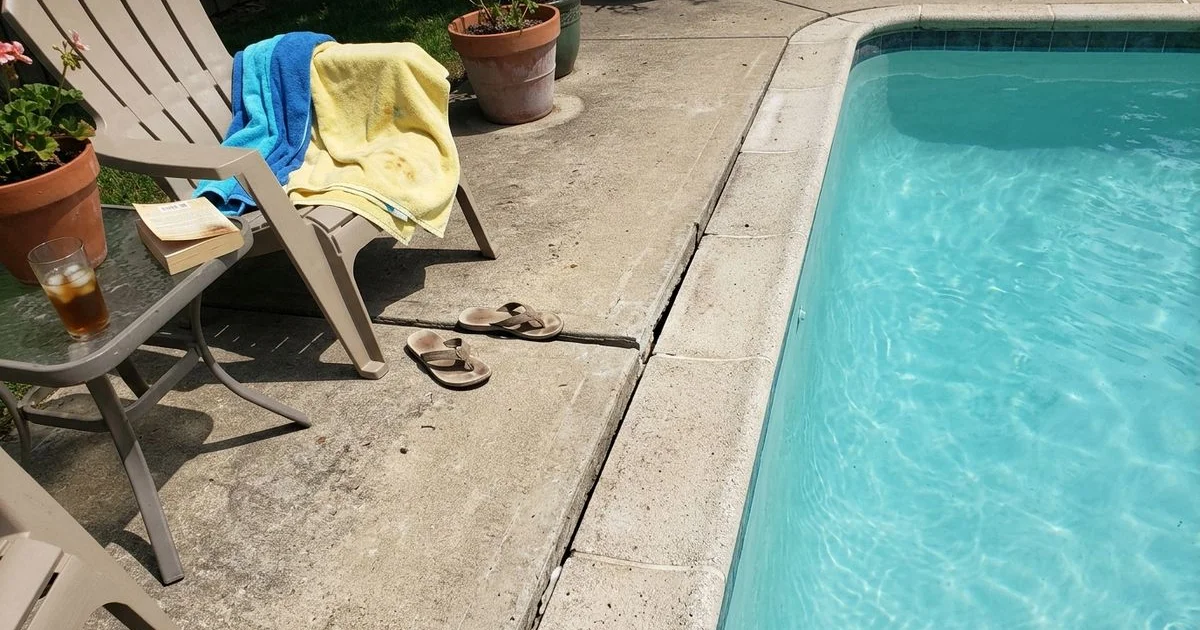
Our technicians usually find that the section of deck nearest the coping drops first. This settlement leaves a dangerous step at the pool edge on a surface that is frequently wet and walked on barefoot.
What We Do Before Drilling Anything
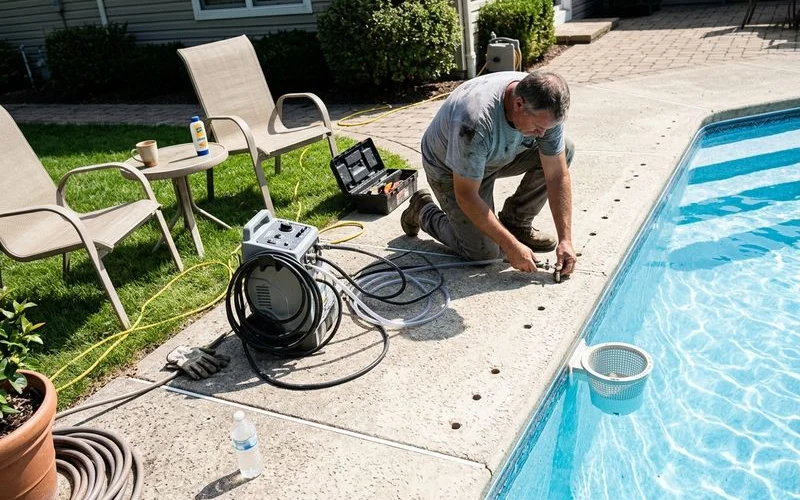
Before a single drill bit touches the concrete, a comprehensive underground assessment must happen. We spend more time inspecting a pool surround than we do on a standard driveway project. The primary goal is finding where the loose shell backfill ends and the consolidated virgin ground begins.
Our crew must map this out because injecting foam into loose backfill behaves differently than injecting into solid ground. Next, the location of the skimmer line and return pipes must be identified. We know these critical lines typically sit just 18 to 24 inches below the surface.
Using the free “Call Before You Dig” service in Connecticut is a mandatory step for public utilities, but private pool plumbing requires manual onsite location. Our inspection also documents any existing movement or damage to the coping and tile line before starting. Having the original 2026 installation drawings makes this mapping process much faster. We can still figure out the plumbing layout safely if you do not have those blueprints.
Controlled Incremental Lifting
The lifting process relies on small, highly controlled movements to prevent damage to the pool wall. We work port to port with a level on the slab, similar to a driveway repair, but using much tighter increments. High-density polyurethane foam expands slowly and cures to 90 percent strength in about 15 minutes.
Our technicians watch the slab and the coping line closely during every single injection. A section that rises in one pass on a driveway will take several measured passes here. We use this slow lift rate as a built-in safety mechanism. Building pressure in unwanted areas is much easier to detect and stop when the material goes in slowly.
| Consideration | How it’s handled |
|---|---|
| Pool shell proximity | Small monitored increments, pressure watched throughout |
| Coping and tile line | Checked at each stage, condition documented beforehand |
| Skimmer and return lines | Located at inspection, port pattern planned around them |
| Deck drains | Identified and avoided; drainage function checked afterwards |
| Water level | Stays as it is; no draining required |
| Decorative finish | Ports in grout lines, patched and color-matched |
Coping and Tile
The coping and tile line sit below the deck and attach to the pool shell, making them highly vulnerable to pressure. We pay special attention to these elements because they are much more brittle than the concrete deck. Both pieces attach directly to the shell rather than the floating slab.
Our concern is that when the deck settles, the coping stays stationary, which creates a gap or a tripping step. Replacing damaged pool tile and coping easily costs $25 to $40 per linear foot today. We aim to bring the deck back up to close the joint smoothly without forcing horizontal pressure against those fragile tiles.
Any indication that the deck is bearing heavily against the coping as it rises is a clear signal to stop. Our incremental lifting approach is specifically designed to catch that exact friction early.
Decorative Pool Decks
Decorative pool decks require strategic drilling in grout lines to preserve the expensive custom finish. We strongly advocate for repairing rather than replacing these high-end stamped, stained, or textured surfaces. Pouring new stamped concrete in Connecticut currently costs between $13 and $18 per square foot based on 2026 market rates.
Our team knows that matching original patterns and faded colors on a full replacement is nearly impossible. A new section of plain concrete poured next to an aged decorative surround looks like an obvious, ugly patch job. We place the injection ports directly into the grout lines and pattern joints, then carefully patch and color-match them.
The guide on Decorative concrete covers these specific visual repair techniques in detail.
Scheduling Around the Season
The ideal time for sunken pool deck repair is during the shoulder seasons of spring or autumn when the pool is closed. We highly recommend scheduling this work when the area is completely clear of patio furniture, heavy covers, and swimmers. Connecticut pools typically close in late September or October before the first freezing temperatures arrive.
Our practical advice is to book the repair the moment you notice pool surround settling. A minor trip hazard spotted in September turns into a very comfortable and fast autumn repair job. We want to avoid interrupting your July swimming schedule for a maintenance project that could have been done earlier.
If a step has formed at the coping or a section of the slab is holding standing water, arrange an inspection to get a clear assessment. Our specialists will evaluate the site and tell you frankly if the repair is better left until after closing.