
Two Problems That Look the Same From Ten Feet
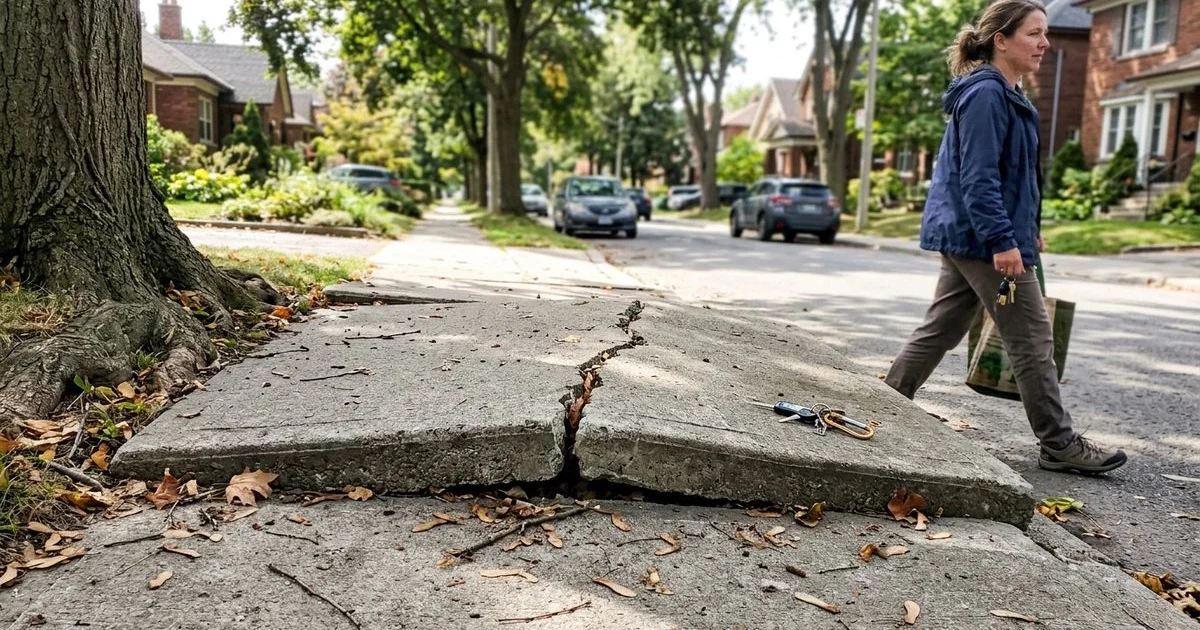
Our team frequently inspects walkways with a single raised slab that creates a dangerous tripping hazard. The Americans with Disabilities Act defines any vertical change over 1/4 inch as an official trip hazard, making this a serious liability. Property owners confuse the root causes of these uneven spots constantly.
We find that this problem usually stems from either soil settlement underneath the concrete or tree roots lifting concrete walkway sections from below.
Walkway leveling effectively corrects settlement, but it simply does not work on root heave. The exact identification methods and repair options are broken down below to help you make an informed decision. This knowledge empowers you to choose the most cost-effective solution.
Settlement Versus Heave
We see soil settlement occur when the dirt washes away and leaves an empty cavity, causing the concrete to sink. Sinking slabs typically sit noticeably lower than their neighboring sections because the ground beneath them has eroded over time. Structural foam injection easily fills this empty void and lifts the concrete back to a level position.
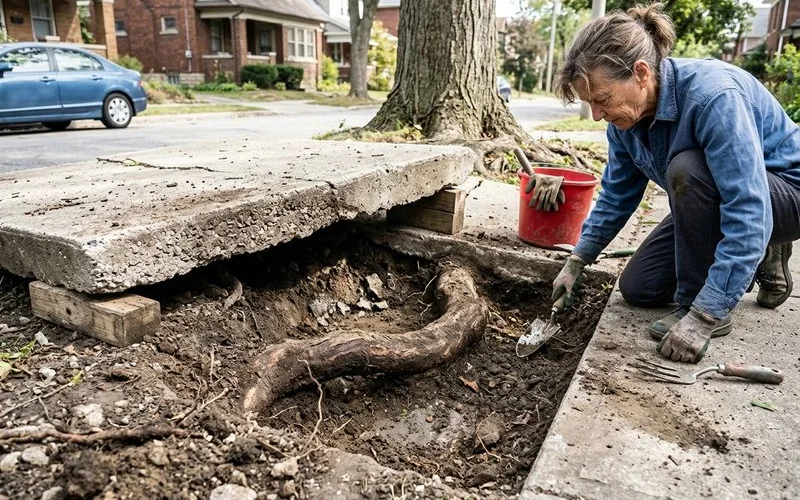
Our experts face a completely different mechanical challenge when dealing with root heave. A mature tree root exerts immense hydrostatic pressure as it grows in diameter beneath the hardscape. A typical 5-by-5-foot concrete slab weighs around 600 pounds, yet expanding roots lift these massive blocks several inches into the air with ease.
We cannot use foam injection to fix this because the material relies on filling empty voids to create lift. A solid, growing root occupies the entire space beneath a heaved slab. Pumping material into that tight space leaves the foam with nowhere to go and nothing to push against.
Telling Them Apart Yourself
Our teams use four simple field tests that require zero specialized equipment to diagnose a walkway. You can determine the cause of your uneven concrete by performing these exact same checks. The table at the end of this section summarizes the key differences for quick reference.
Check the Offset Direction
We always stand back and look down the entire run of the pathway to catch the general line of the surface. A problem slab that sits proud and high indicates a root heave sidewalk. A slab sitting lower than the rest clearly points to settlement.
Locate the Nearest Tree
Our crews actively look for mature street trees within twenty feet of the damaged path. Root systems typically extend far beyond the actual leaf canopy of the tree. A large tree at this distance is a highly plausible cause, whereas a small foundation shrub is usually harmless.
Examine the Crack Pattern
We usually find a fairly straight crack running directly parallel to the underlying root when dealing with heave. Localized pressure forces the concrete to bend and eventually snap along this distinct line. The concrete will peak at its highest point directly over the fracture.
Perform the Sound Test
Our technicians take a heavy tool or a broom handle and firmly tap the center of the affected slab. A distinct, echoing hollow sound confirms a washed-out cavity underneath the concrete. A slab resting tightly on a dense tree root will sound completely solid.
| Sign | Root Heave | Soil Settlement |
|---|---|---|
| Slab position relative to path | Sits high | Sits low |
| Sound when tapped firmly | Solid | Hollow and echoing |
| Typical crack pattern | Straight line following the root | Jagged edges along the cavity |
| Distance to mature tree | Usually within 20 feet | Purely coincidental |
| Moisture or water runoff | Not relevant | Usually present nearby |
| Progression of damage | Worsens with annual tree growth | Worsens with seasonal freeze-thaw |
Why This Matters in Hartford County
We service older suburban neighborhoods in Hartford County that are densely populated with mature shade trees. Decades-old sidewalks sitting directly beside massive root systems create a constant battle, resulting in severe tree root concrete damage. West Hartford provides the clearest example of this specific challenge.
Our trucks frequently visit historic neighborhoods around the Center and Bishop’s Corner. These beautiful streets are lined with aging Norway Maples, Silver Maples, and Pin Oaks. Arboriculture research shows these specific species are notorious for developing shallow, aggressive surface roots that conflict with hardscapes.
We often find a driveway apron that has sunk into consolidated backfill, while a walkway just ten feet away is pushed high into the air by a maple root. This exact same pattern shows up on established tree-lined streets in Wethersfield, Bloomfield, and parts of Bristol. A single residential property can genuinely suffer from both settlement and heave simultaneously.
Our advice is to be highly skeptical if a contractor quotes a flat price to lift every raised slab on your property without checking for roots. Failing to distinguish between these two causes is a major red flag. Getting a second opinion will save you from paying for a doomed repair.
What Actually Fixes Root Heave
We recognize three primary solutions for this problem based on your budget and property layout. Permanently fixing root heave requires either replacing the damaged concrete section or fundamentally altering the pathway. The following options represent concrete and landscaping work, rather than simple void-filling.
Sectional Concrete Replacement
Our local partners note that removing the heaved slab and dealing with the root directly is the most practical answer. Recent 2026 data shows that tearing out and replacing a single 5-by-5-foot sidewalk section typically costs between $300 and $500. Excavating the root and installing a high-density polyethylene root barrier will add another $200 to $800 to the total bill.
Arborist Root Management
We always recommend hiring a certified arborist to handle any delicate root pruning. Selective trimming can relieve the pressure on your concrete surfaces without killing the plant. Cutting major structural roots aggressively risks destabilizing a mature tree and creating a dangerous fall hazard, especially on town-owned street trees.
Rerouting the Walkway
Our experience shows that moving the actual line of the walkway away from the critical root zone solves the conflict permanently. This larger-scale landscaping project is rarely a proportional response for just one damaged slab. Rerouting becomes the right choice when an entire path is destroyed and a historic tree must be preserved.
We prefer to speak plainly and point you in the right direction rather than inventing a way to make it our job. None of these specific replacement or landscaping solutions are services our leveling company sells. Accurate information empowers you to hire the right professional for the actual problem at hand.
When Both Problems Are on One Property
Our comprehensive inspections cover the entire run of your concrete to identify every underlying cause. Finding both sunken slabs and root-lifted concrete on the same property happens often enough that you should plan for a split repair strategy. A typical inspection report might detail three slabs settled over soil cavities that are perfect candidates for foam lifting.
We will then clearly identify any raised walkway slab tree damage that requires a replacement approach.
Providing this diagnosis in writing gives you a clear, actionable plan. Property owners can choose to affordably lift the settled sections today while budgeting separately for the concrete replacement down the line.
We firmly believe that telling you the truth about a split scope is far more valuable than promising to magically fix everything at once. Reading about when a lip becomes dangerous explains why leaving a 1/4-inch trip hazard untreated is always the most expensive option. Contact a qualified concrete professional today to restore a safe, smooth surface before a simple uneven spot turns into a major liability.