
The Question Behind the Question
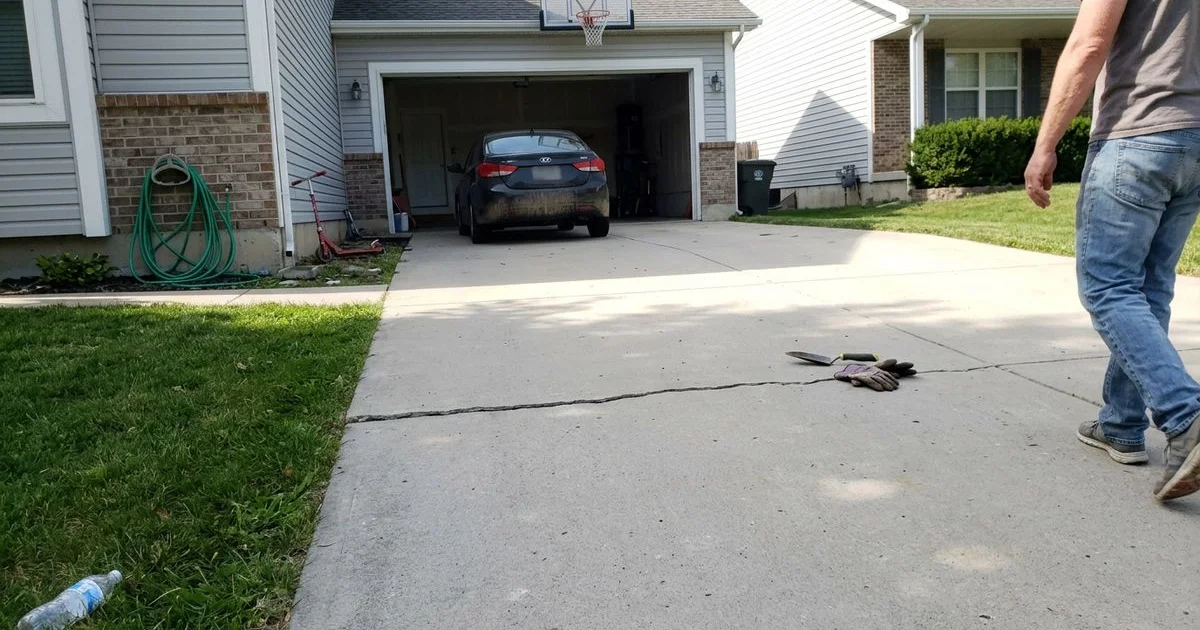
Our team understands the stress of looking at a broken slab and bracing for a massive replacement quote. Homeowners across the Hartford area frequently ask, can a cracked driveway be lifted, before spending an afternoon gathering estimates.
Booking a major driveway crack repair CT project or full replacement in 2026 is a significant expense.
We find that cracks are not the automatic disqualifier most people assume. The real deciding factor is the condition of the concrete on either side of the fracture.
This single distinction is what separates a total tear-out from a simple repair.
Our experience shows that Driveway leveling works perfectly well on plenty of damaged surfaces. Let’s look at the data, what it actually means for your property, and explore how to assess your driveway in about ten minutes.
What Lifts Well
Intact concrete slabs with clear, clean fractures are the best candidates for leveling. We look for sections that are solid, dense, and free of severe surface breakdown.
The lifting process raises these intact pieces as a single, unified block. Modern polyurethane foam provides the precise control needed for this type of stabilization.
Speed and Stability
Our preferred material reaches 90 percent compressive strength in about 15 minutes. You can safely park your vehicle on the freshly leveled driveway the very same day. Traditional mudjacking slurries typically require days to achieve that level of stability.
We evaluate specific structural factors before starting any repair job.
Even a slab broken into three or four substantial pieces can usually be lifted, because each piece is big enough to be raised in a controlled way and to sit stably afterwards.
Surface Conditions
Cracks without a vertical step show that the adjoining pieces are still moving together. Our technicians run a simple hand test across the surface to check for deterioration.
Solid concrete feels firm to the touch and does not shed loose grit. The aggregate stones remain tightly bound within the cement paste.
What Doesn’t
We cannot successfully lift concrete that has started to crumble into small, loose fragments. Injecting polyurethane foam under a shattered slab produces unpredictable movement in several directions.
The material needs a coherent structure to press against for a controlled, even raise.
The Impact of Winter Damage
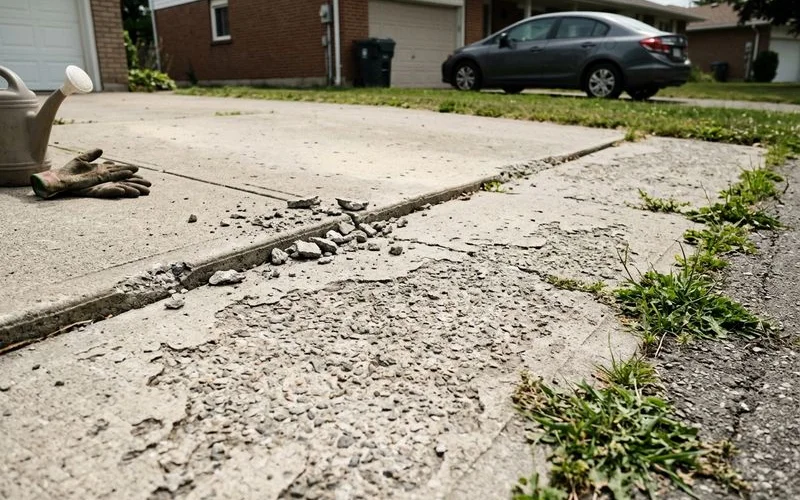
Our inspection process frequently uncovers severe spalling caused by harsh winter conditions. Road salts like calcium chloride attack the asphalt and concrete binder during the Connecticut freeze-thaw cycle.
The salt causes melted water to refreeze as a brine inside the concrete pores. We see this chemical breakdown manifest as a flaking surface with widespread exposed aggregate.
Adding support underneath the slab does not reverse this advanced top-layer deterioration. Edges that you can break off by hand indicate the concrete has reached the end of its service life.
Delamination Failures
Our equipment also detects delamination issues beneath the surface layer. A hollow sound that moves with the top surface rather than the whole section signals a material failure.
This specific problem requires replacement rather than a simple support repair.
Shrinkage Crack or Structural Separation?
We always teach homeowners how to distinguish between a harmless shrinkage crack and a structural separation. These two issues look identical to the untrained eye but mean completely different things for your property.
A shrinkage crack is narrow, often meandering, and features both sides sitting at the exact same level. Our research indicates that normal curing shrinkage creates cracks typically ranging from 0.1 to 0.3 millimeters wide.
Concrete naturally shrinks as the water evaporates during the curing process. This cosmetic fracturing is extremely common and tells you nothing about the stability of the soil underneath.
Identifying the Difference
We define a structural separation as a crack with a measurable vertical drop. Laying a straightedge across the gap will reveal if one side sits noticeably lower than the other.
This offset proves the two sections are moving independently over an underlying cavity. Our field teams consider any vertical drop greater than a quarter of an inch to be a prime lifting candidate.
- The test takes exactly thirty seconds to perform with basic household tools.
- Grab a standard straightedge, lay it across the fracture, and use a coin to measure the height difference.
The Self-Assessment
We designed this simple assessment matrix to help you answer, is my driveway too cracked to lift, in just minutes. The middle column outlines the ideal conditions for a successful foam injection repair. The right column highlights severe deterioration signs that point toward a full concrete replacement.
| Check | Good sign | Bad sign |
|---|---|---|
| Surface texture | Dense, solid, crisp edges | Flaking, exposed aggregate, sheds grit |
| Number of pieces | 1-4 large sections | Many small fragments |
| Crack behavior | Both sides level | Vertical step at the crack |
| Edges and corners | Intact | Crumbling by hand |
| Tap test | Hollow under whole sections | Hollow only in the top layer |
| Overall age condition | Weathered but sound | Coming apart |
Our advice is to tally up your results from the table above. Mostly checking boxes in the “Good sign” column makes your driveway a fantastic lifting candidate.
Landing heavily in the “Bad sign” column means your cracked concrete driveway repair or replace decision leans toward a full tear-out. We recommend reading our guide on lifting versus replacing a driveway to help finalize that decision.
This resource breaks down the exact cost differences and timeline expectations for the Hartford market.
Current local data shows replacement costs are frequently double the price of targeted leveling.
Partial Driveways Are Normal
We constantly remind callers that there is absolutely no requirement to treat the entire driveway. Most residential slabs do not settle uniformly across the entire poured surface.
Two or three individual sections might drop while the surrounding concrete holds perfectly level. Our sectional lifting process addresses only the specific areas that actually require support.
The final quote itemizes every single slab so you can see exactly where your money goes. This transparent pricing model allows you to stage the repairs over multiple seasons if needed.
Saving Targeted Sections
Our condition assessments follow this exact same localized logic. The apron near the street might be crumbling while the middle sections remain structurally sound.
A reputable contractor will lift the viable sections and honestly recommend replacing the ruined ones. We refuse to pretend that a perfectly good driveway needs a complete, expensive tear-out.
- Replacing only the severely damaged panels saves a tremendous amount of time and money.
- You get a safe, functional surface without paying for unnecessary demolition work.
What the Inspection Adds
Our comprehensive free inspection fills in the critical details that a visual self-assessment misses. The visual check cannot tell you how large the hidden cavity is underneath the slab.
The total volume of that empty space directly determines the final cost of the foam injection. We sound the concrete across its entire surface area to precisely map the hidden void.
- The technician measures the exact drop against fixed reference points to calculate the required material.
- This thorough evaluation also identifies the drainage issues or erosion feeding water under the structure.
Getting Your Honest Answer
Our office then provides a detailed, written quote based on those exact measurements. Sometimes the inspection confirms that the concrete has genuinely reached the end of its useful life.
You will receive a written recommendation to pursue a full replacement at no charge. We prefer to give you the honest truth rather than taking money for a temporary fix.
This straightforward approach is why homeowners trust our local repair services. Simply Book a free assessment to get a direct, professional answer about your property.