
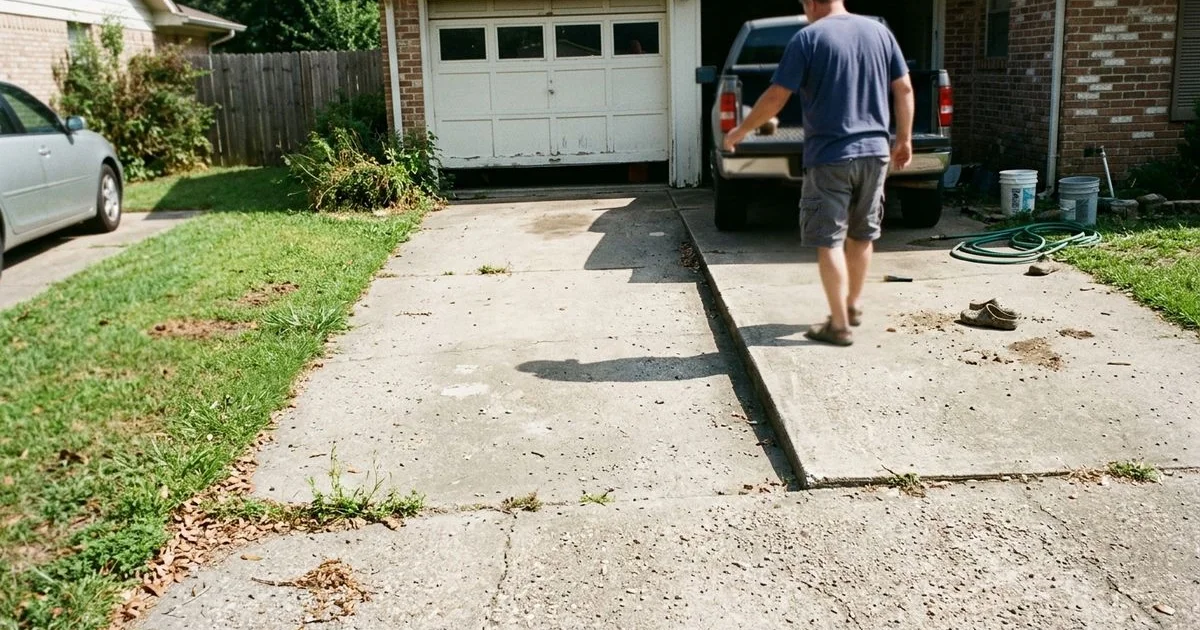
The Concrete Isn’t Failing. The Ground Is.
Our team constantly hears the question of why is my driveway sinking when the concrete itself still looks perfectly fine. You might assume the slab is failing, but the real issue actually lies beneath the surface. The ground supporting your driveway has simply vanished.
We consider this the most critical distinction to make when diagnosing a settling concrete driveway.
Over the past few decades, the soil holding up that heavy slab has consolidated, eroded, or washed away entirely. A hidden cavity has opened up underneath. The concrete easily bridged that gap for a while, but it eventually lost the battle against gravity.
Our our driveway leveling service is designed to solve this exact problem by addressing the three main culprits:
- Soil compaction issues from original construction.
- Harsh seasonal weather cycles.
- Poor drainage and surface water runoff.
The better approach is figuring out where the ground went and putting it back. We are going to walk through these sinking driveway causes and explain the exact steps needed to fix the problem. Once you know the cause, what happens during a driveway lift walks through the repair day itself.
Cause One: Uncompacted Fill From Day One
Builders dig out the ground around a new foundation and then push that dirt right back in. That backfill was graded and built upon without being compacted to the density of undisturbed soil. We see the effects of this every day when a driveway dropping at garage entrances creates a massive tripping hazard.
The soil underneath your concrete has been slowly consolidating since the day the house was finished. Decades of vehicle weight press it down even further. Our repair crews know this slow process is completely predictable.
This exact issue ruins the same sections of concrete on street after street of similar-age houses in Newington, Wethersfield, and Bloomfield. Heavy glacial till and clay soils in the Hartford basin hold moisture and settle dramatically over time. We always tell homeowners to look for these three warning signs of poor compaction:
- A noticeable lip or step where the driveway meets the garage floor.
- Sloping concrete that tilts back at the foundation.
- Hollow sounds when you tap a broom handle near the house.
Cause Two: Connecticut Freeze-Thaw
Connecticut building codes mandate that footings must reach below the 42-inch frost line. The 2022 Connecticut State Building Code strictly enforces this depth because frozen soil causes massive structural damage. We know that driveways only sit in the top few inches of dirt, leaving them completely vulnerable to winter weather.
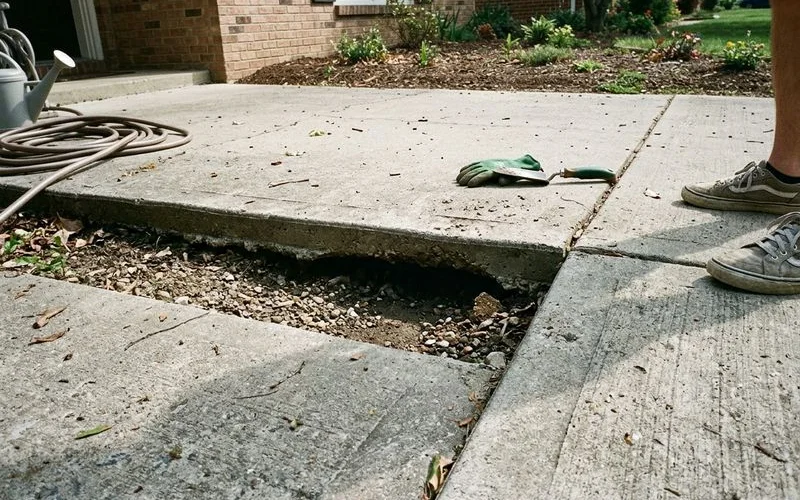
Water in the soil expands when it freezes, aggressively pushing the ground apart. The spring thaw lets it settle back down, but not to the exact same position. Our team often finds that meltwater carries the loosened dirt away during this process.
Next winter, the cycle attacks a base that is slightly emptier than before. Connecticut’s frost line explains this mechanism in full detail. We point to three specific phases of this cycle that destroy local driveways:
- The initial winter freeze that pushes the soil upward.
- The spring thaw that melts the ice and creates loose mud.
- The subsequent water drainage that washes the loose soil away.
Cause Three: Water Getting Underneath
Poor drainage acts as a massive accelerant for soil erosion. A typical one-inch rainstorm drops roughly 600 gallons of water onto a standard roof. We regularly see all that runoff dumping directly onto one small area of dirt beside a driveway.
Surface water running along the slab edge performs the same destructive work at a slightly slower pace. Every unsealed control joint serves as a direct channel from the surface straight into your base material. Our technicians constantly find that water washes precious soil away as it drains through these cracks.
Spotting the Water Path
An erosion channel at the edge of your slab is a clear warning sign. A section that severely ponds after rain means the original pitch is already ruined. We highly recommend checking out How voids form to understand the full mechanism at play.
Extending your downspouts at least five feet away from the concrete is a cheap, permanent fix for this specific issue. Catching the problem early prevents thousands of dollars in future damage. We always check for poor drainage during our initial property inspections.
Cause Four: Vehicle Loading on an Unsupported Section
Heavy loads do not actually create the hidden cavities beneath your driveway. A standard four-inch concrete slab already weighs around 80 pounds per square foot on its own. We know that the vehicle load simply decides the exact moment the slab finally gives up.
An unsupported section bridging a void can handle static weight and light cars for a long time. The structural margin eventually hits zero due to a few common triggers. We typically see slabs fail immediately after one of these events:
- A heavy 16,000-pound delivery truck pulling onto the driveway edge.
- A severe winter freeze that shifts the remaining soil.
- A period of heavy spring rain that washes out the final dirt supports.
The concrete suddenly snaps and drops into the empty space below. The damage looks incredibly sudden, but the erosion process actually took twenty years to reach a breaking point. We use advanced foam injection to restore that weight-bearing capacity before this failure happens.
Why the Crack Followed the Void
Homeowners frequently assume a surface crack caused the slab to settle. The exact opposite is true. We always explain that the crack is actually a symptom of the missing soil below.
An unsupported span develops immense tensile stress on its underside. While standard concrete can handle 4,000 PSI of downward compressive pressure, its tensile strength is only about 10% of that number. Our engineers know that the concrete will eventually snap along the exact line where the soil support ends.
The resulting fissure is simply a permanent record of where the hidden cavity begins. Filling that gap with caulk seals the evidence while leaving the root cause completely untouched. We use the visual clues left behind by the concrete to determine exactly what is happening underground.
| What you notice | What it means |
|---|---|
| Step at the garage apron | Foundation backfill has consolidated |
| Hollow sound when tapped | Cavity present, slab still bridging |
| Ponding water after rain | Pitch lost; slab has tilted |
| Crack running across a section | Support ends along that line |
| Erosion channel at the slab edge | Active water path feeding the void |
| Step growing each spring | Freeze-thaw enlarging the cavity |
Does It Stop on Its Own?
The short answer is no, and that harsh reality is the reason this page exists. The underground cavity grows a little larger with every single winter storm. We watch the heavy slab drop further into that void year after year.
The resulting drop changes the surface pitch, redirecting more rainwater straight into the problem area. That runoff removes even more base material in a destructive, endless loop. We always warn customers that nothing in this cycle is self-limiting.
The Cost of Waiting
Intervening early is dramatically cheaper than intervening late. A slab that is still level but sounds hollow requires basic void filling only. We can often save homeowners 50% to 75% compared to the $8,000 average cost of a full concrete replacement in Connecticut.
A driveway that has already dropped two inches demands a controlled lift and significantly more material. Delaying the repair will only guarantee a more expensive project next spring. Our free on-site inspections include a written quote and an honest assessment of whether your slab is worth lifting at all.
If you have read this far, your useful next step is getting the driveway sounded to measure the hidden cavity. Booking a free sounding inspection today is the best way to protect your property value.
We are ready to provide the exact answers you need to stop the sinking for good.