
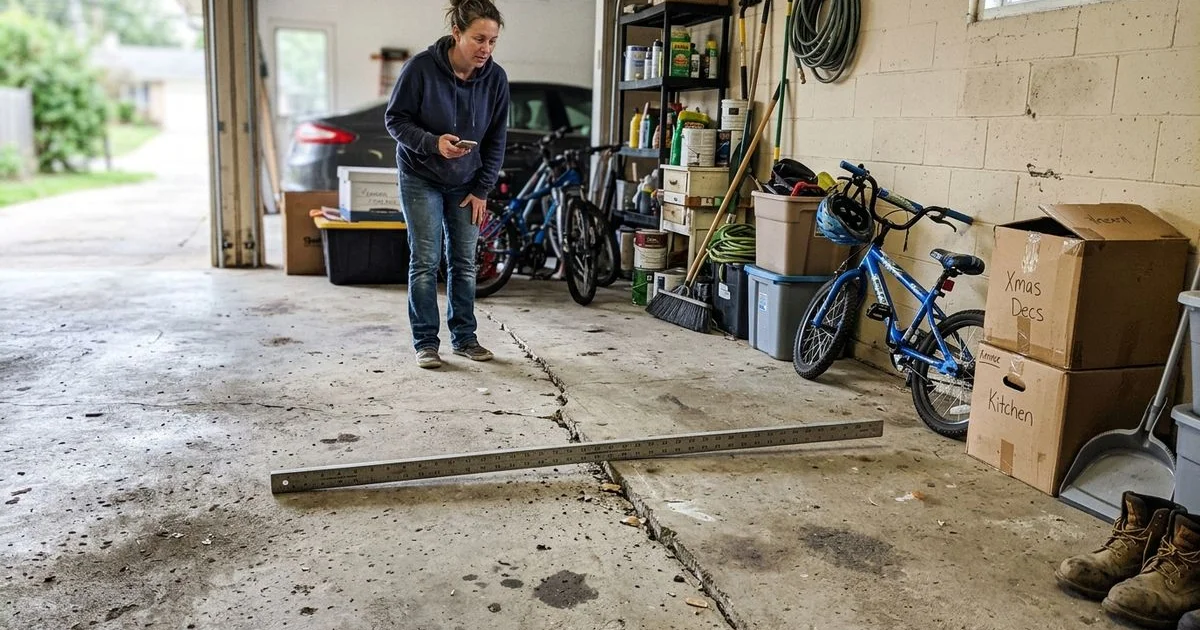
You know how almost every garage floor over five years old develops a few fractures. We answer the question “is my garage crack serious” daily while handling cracked garage floor repair jobs across the Hartford area. Most of those concrete lines are completely harmless, but a few indicate a hidden cavity underneath where the slab is actively pulling apart.
Telling the difference takes about a minute and a standard metal straightedge. Our team relies on this quick check to determine if a space needs garage floor leveling or just a bit of patience.
In this guide, you will learn:
- How to measure a crack using household items.
- What different gap sizes mean for your foundation.
- Practical ways to respond to active concrete settlement.
Let’s look at the concrete data and explore your best options.
Two Cracks That Look Similar and Mean Opposite Things
Concrete inevitably shrinks as it cures. Our experience shows that a typical slab shrinks about 1/8 of an inch for every 20 feet it spans. It loses water and gets smaller over those first few months. While the material is shrinking, it is restrained by friction against the dirt base and by any pipes embedded in it.
We know this creates tensile stress inside the material. Concrete is notoriously weak in tension. The resulting strain causes the slab to split.
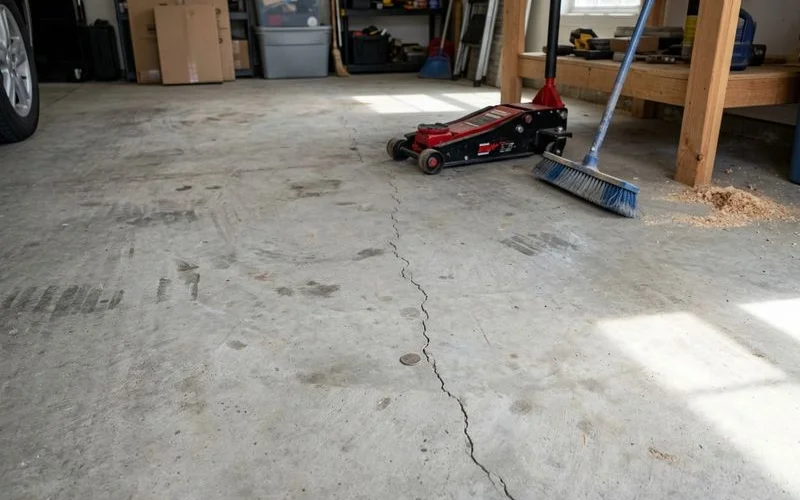
Here is what a cosmetic shrinkage crack looks like:
- A narrow opening that meanders instead of running in a straight line.
- Hairline width up to a couple of millimeters across.
- Both sides of the concrete sit at exactly the same level.
- Appearance within the first year or two of a slab’s life.
These cosmetic cracks tell you nothing about the soil underneath. We recommend addressing them eventually to prevent moisture issues. An open crack in a garage floor lets water down to the base, creating a real path for destruction when winter snowmelt drips off your vehicles.
Crack sealing is an inexpensive and preventive maintenance step. It definitely is not an urgent structural problem.
Stepped Cracking: A Void Below
A stepped crack garage slab has a clear vertical offset. We look for these structural warning signs immediately upon inspecting a property. Lay a straightedge across the fracture and you will see one side resting lower than the other.
That step means the concrete sections on either side are no longer moving together. One side is supported by the ground while the other side hangs in the air. The only way you get that vertical drop on a slab-on-grade foundation is when a cavity forms beneath the low side.
Our region creates the perfect storm for these voids. Connecticut winters bring severe freeze-thaw cycles that deeply impact local properties.
Common causes of these underground cavities include:
- Frost heave expanding and contracting the common sandy loam soils found in towns like Glastonbury.
- Erosion from poor drainage systems washing away the dirt base.
- Improperly compacted fill dirt settling over several decades.
This natural cycle leaves an empty pocket behind. We consider this the crack that truly matters. It indicates an active settlement issue that requires a lifting job rather than a simple sealing job.
The Straightedge Test
Take a straight length of timber or a metal rule that is at least three feet long. We advise laying it across the crack, perpendicular to the gap, and pressing it flat against the higher side.
Look closely at the space under the far end of the rule. Slide a coin under it to measure the clearance. A standard US quarter is 1.75 millimeters thick, while a penny measures roughly 1.52 millimeters.
Our technicians always check to see if a coin fits underneath the straightedge on the low side. Passing a coin through the gap confirms you have a measurable garage floor crack vertical offset.
| What you find | What it means | What it needs |
|---|---|---|
| No measurable step, hairline width | Shrinkage crack | Seal it eventually; no urgency |
| No step, wider crack, sound edges | Older shrinkage or joint | Seal it; monitor |
| Measurable step, sound concrete | Cavity below, slab still sound | Lifting |
| Step growing year to year | Active settlement | Lifting sooner rather than later |
| Crumbling edges either side of the crack | Concrete failing, not just support | Assess for replacement |
| Many small fragments | Slab past lifting | Replacement |
Do this test at several points along the line because offsets are rarely uniform. The variation tells you something highly specific about your floor. A step that grows toward one end usually points exactly at where the underground cavity is deepest.
Sound the Slab While You’re There
The straightedge test tells you everything about the surface. Tapping the concrete tells you exactly what is happening underneath.
Work systematically across the floor with a 16-ounce steel hammer or a heavy screwdriver handle and listen closely. We notice that a slab resting on solid ground rings with a dull, dead thud. A floor sitting over an empty cavity sounds noticeably hollow and loud.
The change in pitch between the two areas is usually much sharper than you might expect.
Mapping the Underground Void
Mapping out this hollow zone is a critical step for a proper repair. We use this sounding technique to determine exactly where to inject high-density polyurethane foam later on.
If the hollow area perfectly matches the low side of a stepped crack, you have confirmed a serious structural diagnosis without anyone visiting your home.
Why Filling the Crack Changes Nothing Structurally
This is the most frequent mistake observed on residential garage floors.
Filling a stepped crack with a surface epoxy or a standard repair mortar simply bonds the two top edges together. It does not put any supporting material under the low side. The concrete section is still bridging an empty cavity, still completely unsupported, and still carrying the massive weight of your vehicles.
Our repair crews see failed surface patches constantly. Many homeowners mistakenly spend hundreds of dollars on epoxy repair kits from big box stores like Home Depot, only to watch the repair crack again in the exact same spot.
Here is what happens when you only treat the surface:
- The repair mortar fractures under the weight of a car.
- The original crack holds, but a brand new fracture forms along the edge of the hidden void.
- Water continues to pool in the sunken area.
Sealing is genuinely useful work when used as prevention on a fully supported slab. We apply premium sealants as the final finishing step after a structural lift to keep seasonal moisture out of the dirt base. Using a sealant as a structural repair on a settled slab is just spending money on the symptom.
When It’s Past Lifting: Cracked Garage Floor Repair Options
Lifting raises concrete sections as solid units, so the process requires intact units to raise.
If the slab has already broken into dozens of small fragments, the material is failing. We cannot perform a lift if the edges on either side of the crack crumble easily when you press them. Severe surface spalling that constantly sheds gravel means the concrete has officially reached the end of its service life.
Adding support underneath a crumbling slab does not reverse a fundamental material failure. Lifting versus a new slab covers that difficult financial decision in detail. We always highlight the critical point that most property owners miss. A brand new slab poured over the exact same inadequate fill dirt will eventually settle again unless the base preparation is handled properly.
Weighing Replacement Costs
Full concrete replacement is a significant investment. Recent 2026 data shows the average cost to rip out and replace a standard two-car garage floor in Connecticut ranges from $4,800 to $6,000.
The process also leaves your driveway unusable for up to a week. We recommend high-density polyurethane leveling for structurally sound slabs because the specialized foam cures in just 15 minutes and costs a fraction of a full replacement.
If your crack has a vertical step and the concrete on either side is solid, you are dealing with a straightforward lifting case. Our free on-site inspection sounds the slab, measures the exact offset, and tells you what the underground cavity actually looks like. That precise measurement is the specific number that sets your price for professional cracked garage floor repair. Contact us today to schedule your evaluation.