
We hear the same question from homeowners every week when they notice a tripping hazard near the overhead doors. The garage floor leveling vs replacement comparison runs differently indoors than it does on an outdoor driveway. That changes the entire repair process.
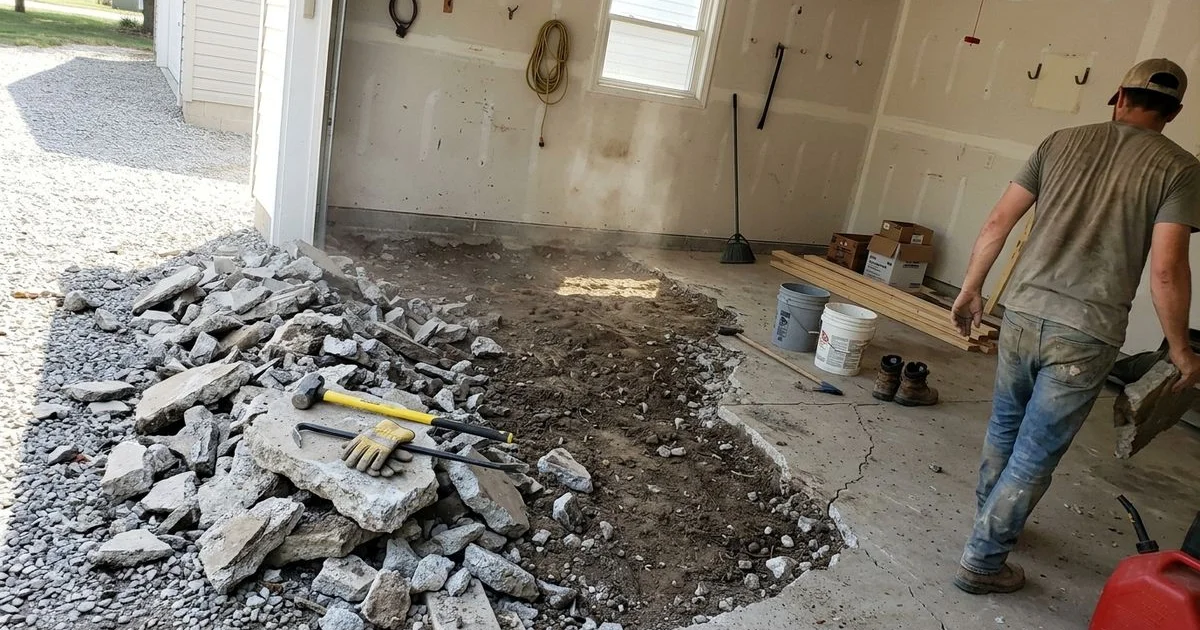
Our team knows an outdoor concrete repair is disruptive, but that demolition stays out in the yard. A garage slab repour happens inside a building with a single opening. Every ton of broken concrete leaves through that opening, and all your stored items need a temporary home.
We see how this enclosed space changes the math completely.
Garage floor leveling has a bigger practical advantage indoors than it does outside. Let’s examine the timeline, dust risks, and base preparations for both options to help you make the right call.
What a Repour Actually Involves
We tell clients upfront that choosing to repour a garage slab involves full-scale interior demolition, excavation, and a week-long curing process. A standard two-car garage floor weighs between 15,000 and 20,000 pounds. Contractors must break apart all ten tons of that heavy concrete and haul it out through a single door.
Our replacement process involves several highly disruptive steps. Workers must clear the entire space before the demolition crew arrives. A typical repour schedule looks like this:
- Breaking up the existing 4-inch thick concrete slab.
- Hauling debris out by hand or wheelbarrow.
- Excavating and regrading the compromised base soil.
- Setting new wooden forms and pouring the fresh concrete.
We always warn Hartford County homeowners about the strict curing timeline. You must wait at least seven days before driving a vehicle onto a fresh pour. Full curing takes up to 28 days.
What a Lift Involves
We complete a concrete lift by injecting expanding polyurethane foam beneath the sunken slab to raise it back into place in just a few hours. You only need to clear the immediate working area instead of emptying the entire garage. The crew will cover any nearby contents and set up direct dust extraction at the drill source.
Our technicians drill a precise pattern of 5/8-inch ports through the settled section. The fast and contained lifting process follows three clean steps:
- Drilling the small injection ports with attached dust vacuums.
- Injecting the high-density foam in carefully monitored increments.
- Patching the tiny ports and sweeping the floor clean.
We use a specialized polyurethane material that reaches load-bearing strength in 15 to 30 minutes. This foam provides a compressive strength of over 100 PSI, which easily supports heavy trucks and equipment. The bay is ready to take a vehicle the exact same day.
Our detailed guide on How long a lift takes breaks down the specific project timings. This resource explains exactly when you can park your cars inside again. You will not have to leave your vehicles on the street overnight.
Side by Side
We built this comparison table to show the exact differences between pouring a new slab and lifting your existing one. The data clearly highlights the timeline and disruption gaps. Breaking out old concrete creates a massive construction footprint, while leveling keeps the work highly contained.
| Factor | Break out and repour | Polyurethane Lifting |
|---|---|---|
| Garage out of service | A week or more | Same day |
| Contents to be moved | Everything, completely emptied | Working area only |
| Dust generated | Heavy demolition levels | Drilling only, vacuum extracted |
| Debris through the property | Hauled out by wheelbarrow | None |
| Threshold and door alignment | Reset to the new pour | Restored to original level |
| Base quality afterwards | Relies entirely on new compaction | Cavity filled with dense foam |
| Existing floor coating | Destroyed | Kept, small ports patched |
| Cost comparison | Full replacement pricing | A fraction of tear-out costs |
The Dust Question
We must highlight the severe dust issues associated with interior concrete demolition because homeowners constantly underestimate this risk. Breaking out a concrete slab in an enclosed space generates massive volumes of respirable crystalline silica dust. Current 2026 OSHA regulations (Standard 1926.1153) strictly control this hazardous material on residential construction sites.
Our experience shows that this fine dust gets into everything inside the attached building. An attached garage with a shared door means that silica dust will likely penetrate the main house. Standard plastic sheeting rarely stops these microscopic particles from circulating through your HVAC system.
Eliminating the Dust Hazard
We eliminate this hazard entirely by using a completely different repair method. Drilling a precise port pattern makes a tiny fraction of the dust created by heavy jackhammers. The HEPA extraction vacuum runs directly at the drill site to capture particles immediately.
Our modern leveling equipment keeps your home’s air quality safe and clean. You avoid the massive cleanup project that always follows a traditional interior demolition job. Your belongings stay dust-free throughout the short repair process.
The Base Is What Decides a Repour
We always remind property owners that a concrete slab is only as stable as the dirt beneath it. Your original floor settled because the soil underneath consolidated, washed out, or was poorly compacted during the initial home construction. Pouring new concrete over that exact same compromised fill simply resets the clock on another expensive failure.
Our team sees new slabs crack and settle even faster than the originals. The old soil already experienced decades of gradual shifting before finally giving way. A high-quality repour requires a very specific set of steps to succeed:
- Excavating all the compromised original fill.
- Hauling away the old dirt.
- Replacing it with properly graded aggregate material.
- Compacting the new base in structural lifts.
We know this deep excavation adds significant labor and increases your total replace garage floor cost. Cheap replacement quotes often quietly skip this crucial sub-base preparation to keep their prices looking attractive. The new heavy slab then sits on a weak foundation.
Our polyurethane lifting process sidesteps this entire problem by filling the existing underground voids directly. The expanding foam compacts against the surrounding ground and adds only about two to five pounds per cubic foot of weight. This lightweight stability prevents future settlement issues.
When a New Slab Is the Right Answer
We will be the first to tell you when lifting is the wrong solution for your property. There are three specific cases where pouring a new concrete slab is absolutely the correct choice over leveling. You should plan for a full replacement if your situation matches any of these conditions.
1. The Concrete Surface is Delaminating
Our technicians cannot raise a slab if the surface layer has completely separated from the main body of the concrete. Severe scaling and crumbling mean there is no structurally sound material left to lift. The expanding foam needs a solid, unified piece of concrete to push against.
2. The Floor is Fractured into Small Pieces
We can only lift sections of concrete that remain relatively intact as cohesive units. Fragments and shattered pieces do not lift coherently. Small broken chunks will move independently, making leveling impossible.
3. You Want a Complete Garage Redesign
Our leveling service restores your floor to its original position, but it does not change the core structure. A new layout, a custom stamped finish, or the addition of radiant floor heating all require a complete rebuild. You also need a full repour if you must install a new moisture vapor barrier beneath the concrete.
We explain this in more detail within the general lift-or-replace comparison guide, which covers the same decision across all flatwork types. Most garage floors in Hartford County simply consist of sound concrete sitting on dirt that gave way. This scenario is exactly what polyurethane lifting is designed to fix.
Our free on-site inspection helps you finalize the garage floor repair or replace decision. The visit tells you exactly which category your floor falls into before you commit to any construction work.
Schedule a call with the team today to get your concrete measured and evaluated.