
The Question That Decides Whether You Book
When looking into garage floor leveling, how long the repair actually takes is usually the primary question on a homeowner’s mind. People simply want to know how long the space will be completely out of action.
Downtime determines whether this critical maintenance happens right now or gets postponed indefinitely.
Our crews have found that the dread of a week-long driveway displacement is the biggest hurdle most people face. The short answer is that you will only have technicians on site for a few hours, and you can park your cars inside the very same afternoon.
Garage floor leveling covers the exact mechanical work itself, and why a garage floor sinks explains what put the slab down there to begin with. This guide will break down the precise timeline, explain the materials making it possible, and outline exactly what to expect on the day of the job.
Typical Job Duration
Most residential garage floors fall into a few predictable categories for repair times. We use precise 5/8-inch injection ports, which are roughly the size of a dime, to keep the drilling phase incredibly fast. This small port size protects the structural integrity of the concrete while speeding up the entire visit.
- Single bay with moderate settlement: Expect a total of two to three hours on site from start to finish. The crew handles setup, sounding the concrete, drilling, injecting the material, the final lift, patching, and cleanup.
- Double bay repairs: Treating a standard 400 to 600 square foot two-car garage typically requires three to five hours, giving you a clear baseline for how long garage floor repair takes. The total duration depends heavily on how much of the slab has actually dropped and the size of the hidden cavity underneath. Sectional work is very normal, so if only the front half near the driveway has settled, only that front half receives treatment.
- Garage plus exterior apron together: You should add an extra hour or two to the schedule. Tackling both areas at once is still a single visit, and it usually costs less than booking the apron and garage separately because it only requires one mobilization of the equipment.
Our estimates reflect actual working hours on site, not extended calendar days. You never have to schedule a return visit, wait out a long cure day, or worry about follow-up appointments.
The Cure Time That Makes It Possible
High-density polyurethane foam reaches up to 90% of its final strength within just 15 to 30 minutes of the initial injection. We utilize formulations engineered specifically for intense load-bearing applications, easily supporting the weight of modern trucks and heavy SUVs. These specialized polymers can achieve a compressive strength of up to 100 PSI, providing a rock-solid foundation that will not compress under heavy vehicle traffic.
In practical terms, the foam under the very first ports is already fully cured while technicians are still working on the final few holes. By the time the crew patches the ports and sweeps the floor, the material has been at a safe working strength for quite a while.
This rapid concrete lifting cure time highlights the single biggest practical difference against traditional mudjacking. A detailed look at how the process works goes into the specific material behavior and expansion science.
| Repair Method | Curing Time to Bear Vehicle Weight | Material Characteristic |
|---|---|---|
| High-Density Polyurethane | 15 to 30 minutes | Synthetic, hydrophobic, expands to fill voids |
| Traditional Mudjacking | 24 to 72 hours | Cement slurry, absorbs moisture, extremely heavy |
Cement slurry mixtures used in mudjacking typically require a full day to three days before they can safely carry a vehicle load without risking structural failure.
What You Need to Move Beforehand
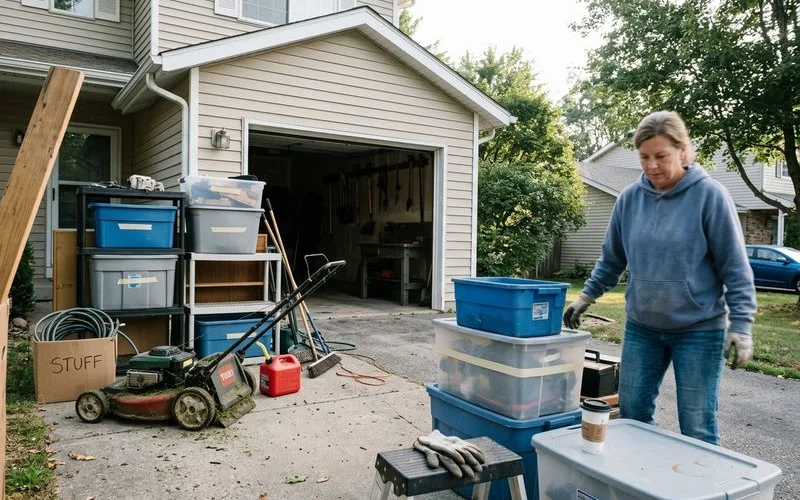
Preparing your space requires far less effort than you might initially think. Our team provides a very specific clearing list when the job is booked rather than leaving you to guess what needs to go.
- Definitely move: You must pull all vehicles out of the working bay. Relocate anything sitting directly on the specific section being lifted. Freestanding heavy items in the immediate working area, like large trash bins, bicycles, or a 400-pound riding lawnmower, must be moved to the driveway.
- Usually move: You should clear enough space around the working area so technicians can move safely with long hoses and a heavy-duty drill. Call it a solid two feet of comfortable clearance.
- Usually keep in place: Leave your shelving units along the walls alone. A heavy workbench that is not sitting directly over the settled area can stay put. Storage boxes at the back of a garage where only the front has dropped are completely fine. Wall-mounted track systems, like Gladiator or Rubbermaid FastTrack, do not need to be touched.
- Not at all: You never need to empty out the entire garage. Clearing the whole room is a requirement for a full concrete tear-out and repour, not a targeted lifting project.
If a particular item is extremely heavy, permanently fixed, or awkward to move, point it out at the initial inspection. We will plan the specific injection port pattern around that obstacle whenever possible.
The Sequence on the Day
Knowing exactly how the hours unfold helps set the right expectations for the morning. We follow a very strict, repeatable sequence to ensure the lift is accurate and the workspace remains tidy. The technicians bring specialized dust extraction equipment to keep the air clean during the preparation phase.
| Stage | Roughly | What is happening |
|---|---|---|
| Setup and protection | 15-20 min | Dust extraction rigged, nearby contents covered |
| Sounding and marking | 10-15 min | Underground cavity mapped, target level set |
| Drilling ports | 20-40 min | The brief, loud drilling phase |
| Injection and lift | 30-90 min | Quiet process; slow and controlled visible movement |
| Cure to load-bearing | 15-30 min | Polymer hardening already happening during the step above |
| Patching and cleanup | 20-30 min | 5/8-inch ports sealed flush, entire floor swept |
The two things you will actually notice are the drilling noise, which is brief, and the fact that very little is happening visibly during the lift itself. Watching a thick concrete slab come up an inch and a half over forty minutes does not look very dramatic in real-time.
Dust, Noise and Whether You Can Stay
You can absolutely stay in the house while the repair happens. The entire operation is fully contained to the garage, and there is zero heavy demolition involved.
Drilling produces fine concrete dust, and it is the only step in the process that does. Our crews attach a dedicated vacuum extraction system directly to the drill itself. This containment strategy means the dust volume is a tiny fraction of what breaking out an old slab generates, and the technicians cover nearby contents before starting.
The noise profile of a concrete lifting project is very predictable:
- The Drilling Phase: A heavy-duty rotary hammer drill piercing concrete hits about 120 decibels, which is comparable to a loud lawnmower.
- The Lifting Phase: Pumping the polyurethane foam into the void is practically silent.
If your garage is attached with an interior door leading into your living space, you just need to keep it closed during the brief 20 to 40 minutes of drilling. That single closed door is the only major noise precaution necessary for the whole day.
Weather and Scheduling
Interior concrete work is largely weather-independent, making garage floors much easier to schedule than exposed driveways and back patios. We run residential leveling routes all year long, even in the middle of January. The interior temperature of an attached garage usually stays just warm enough to allow the material to react perfectly.
Connecticut winters do create a few specific logistical challenges:
- Hidden Surfaces: A driveway apron buried under six inches of compacted snow is nearly impossible to assess accurately.
- Exterior Add-ons: If you are booking an exterior apron treatment along with the inside floor, deep snow will dictate the schedule.
- Soil Voids: Fierce freeze-thaw cycles cause water to freeze under the slab, expand, and melt, leaving the exact empty voids that require filling.
Our polyurethane foam is completely hydrophobic, meaning it actively repels water. The cured polymer ignores ground moisture and will not wash away during heavy spring thaws, ensuring the repair stands up to the New England climate year after year.
If severe winter conditions would genuinely affect the quality of your specific job, the office will tell you clearly during scheduling rather than turning up and finding out.
Same Day Means Same Day
The primary goal is to set your expectations precisely rather than generously, proving same day concrete leveling is a reality. On a normal residential garage bay featuring sound concrete and reasonable access, you will confidently park your car on it that exact afternoon.
There are a few rare scenarios where that swift timeline shifts. Unusually massive areas, badly fractured slabs needing multiple staged lifting passes, or commercial floors with heavy industrial loading requirements might take longer. In any of those complex cases, the estimator will tell you the exact timeline at the initial quoting stage, not as a surprise on the actual day.
Want to get this issue completely resolved and scheduled on the calendar? Book a slot online today, and the scheduling team will confirm the exact working area and send over the final clearing list when securing your date.