
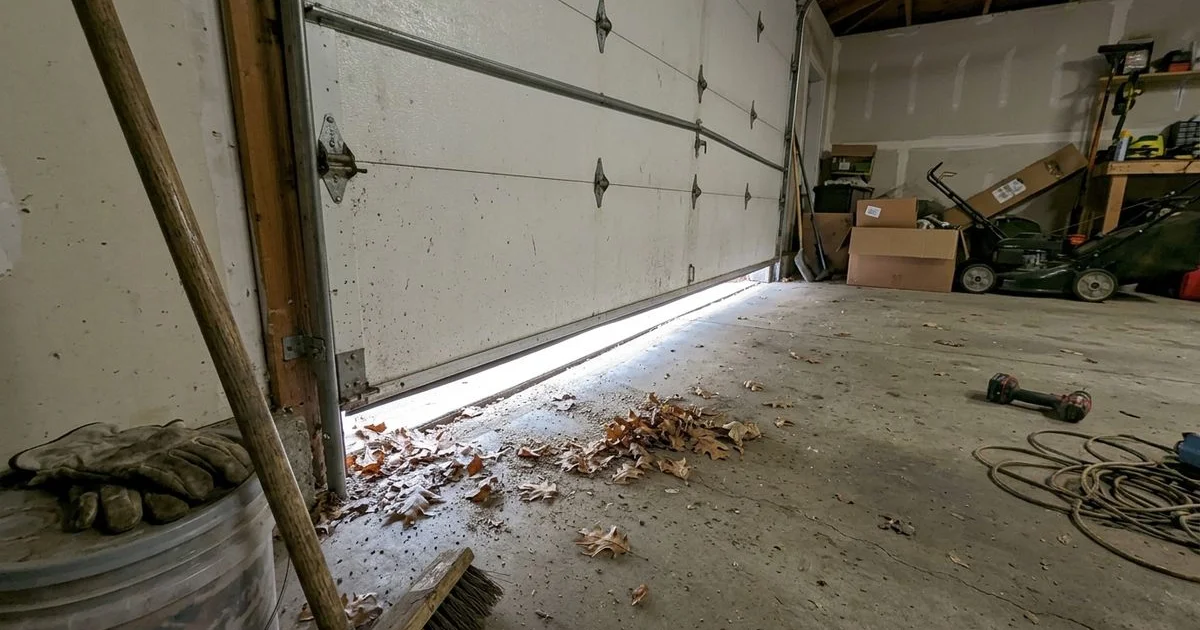
We frequently speak with local homeowners trying to fix a garage door gap uneven floor problem.
The immediate reaction is almost always to blame the weather stripping or the automatic opener. It makes perfect sense to diagnose the moving parts when a draft suddenly appears. Our team at CT Pro Concrete Leveling actually finds that the door itself is rarely the problem.
A concrete slab that has settled over time creates a void that no mechanical adjustment can permanently seal. This is why proper Garage floor leveling is the fix most properties actually need.
Let us look at the data behind why these gaps form, review a simple test to verify the cause, and explore the most effective repair methods.
You’re Troubleshooting the Wrong Component
You are likely troubleshooting the wrong component because the garage door runs on fixed tracks bolted to your framing. The hardware closes to the exact same height every single time.
We often get calls from homeowners who have spent hours tweaking tension springs. Almost everyone who searches for a solution is looking at the door because it is the thing that visibly fails. A much more likely explanation is that the floor it closes onto has physically dropped.
Our local Hartford housing stock sits on soil that goes through intense freeze-thaw cycles. Several common factors cause the subgrade beneath your concrete to erode:
- Poorly directed downspouts dumping rainwater near the foundation.
- Improper surface grading that traps moisture against the slab.
- Natural deterioration of original construction fill material.
We see this structural settlement leave behind widening voids every spring. The heavy concrete eventually sinks into those cavities and creates that drafty gap under garage door.
The Test That Settles It
The definitive test for a sunken slab involves closing the door completely during daylight hours and inspecting the bottom edge from the inside. A level floor will block out all exterior light, while a dropped slab will show a distinct pattern of daylight.
We recommend turning off the overhead interior lights to get the clearest view. You are looking for two specific shapes:
- An even gap across the whole width: This indicates a worn seal or a door adjustment issue. Seals compress and degrade uniformly along their length.
- An uneven gap tapering toward one end: This reveals a level problem. A rubber seal wearing out never produces a wedge shape.
Our inspections frequently uncover that second scenario. That wedge shape is the exact profile of a slab that has dropped heavily on one side.
We find that most of the gaps requested for service involve this uneven dropping. A majority of these properties have had a new seal fitted recently that completely failed to solve the underlying problem.
What Follows Once the Gap Is Open
A visible opening under your garage door immediately invites pests, weather damage, and accelerated concrete settlement. Leaving the garage door not sealing floor issue unaddressed turns a minor cosmetic annoyance into a costly structural repair.
We see a rapid cascade of secondary problems once the bottom seal breaks. The longer the concrete sits unevenly, the more extensive the resulting damage becomes.
Pest Infestations and Intrusions
Our local pest control data from 2026 shows that mice only need a gap the size of a dime to enter a building. An uneven threshold is an open invitation for rodents seeking winter shelter. These pests frequently nest in storage boxes and chew through expensive vehicle wiring.
Weather Seal Failure
We notice that factory weather stripping requires a solid surface to function correctly. The seal is designed to compress against a flat floor. Once a gap opens, the rubber compresses against empty space and degrades significantly faster from being completely unsupported.
Snowmelt and Water Damage
Our region experiences intense winter weather. Hartford averages over 50 inches of snow annually, and massive storms consistently drive snowmelt inside unsecured garages. Anything the wind moves along the ground ends up pooling on your dropped slab.
Accelerated Concrete Settlement
We consider this final stage the most destructive consequence. Water getting in over the threshold tracks aggressively under the concrete. This liquid carries fine soil particles away from underneath the slab, deepening the exact cavity that caused the gap in the first place.
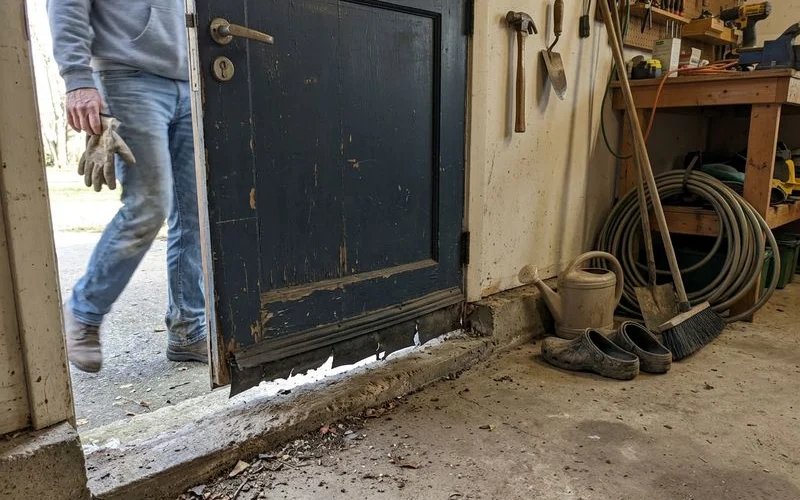
The Same Symptom Indoors
You will often find matching symptoms of concrete settlement on the interior doors leading into your house. A sinking slab pulls thresholds down and creates a visible garage threshold gap with adjacent frames.
We always recommend checking the service entrances after inspecting the main overhead door. The structural frame of the house remains stationary while the unattached garage floor sinks away from it. This drop creates several distinct warning signs:
- Interior doors catching or binding at one end of their swing.
- Daylight becoming visible under the corners of threshold strips.
- Washing machines and appliances no longer sitting flat.
- Heavy workbenches developing a noticeable rock.
Our team knows that all of these frustrations point to the exact same structural failure. The concrete floor is simply sitting lower than it originally did.
Why Adjusting the Door Doesn’t Work for a Garage Door Gap Uneven Floor
Adjusting a garage door to close lower fails because it forces the hardware to accommodate an uneven, actively sinking surface. This temporary fix creates dangerous load imbalances while ignoring the growing cavity underneath the concrete.
We frequently watch homeowners try to stretch their garage door limits to meet a sunken floor. Lowering the panels until they touch the lowest point means the high end is now taking all the structural load. The hardware will not seat evenly, and the motor will strain against the unnatural angle.
Our experience shows that the ground underneath is still settling while you make these adjustments. The subterranean cavity causing the drop is still growing, meaning whatever mechanical change you implement is purely temporary. Replacing the bottom seal presents the exact same issue. A thicker piece of rubber bridges the opening for a single season before wearing out against the uneven concrete.
We compiled this cost and longevity comparison to highlight why surface-level repairs fall short. Fixing the concrete is the only permanent solution.
| Fix | What it addresses | How long it lasts | Estimated Cost |
|---|---|---|---|
| New weather seal | The gap, cosmetically | A season, on a settling slab | $50 to $100 |
| Door adjustment | Closing height | Until the slab drops further | $100 to $200 |
| Threshold strip | The gap at floor level | Wears unevenly, hides the cause | $75 to $150 |
| Lifting the slab | The reason the gap exists | Holds permanently once void is filled | $500 to $1,500 |
What the Fix Involves
Professional concrete leveling involves injecting specialized polyurethane foam beneath the slab to fill the underlying voids. This modern polyjacking process gently raises the floor back to its original threshold height in a matter of minutes.
We utilize a highly controlled injection method to restore the surface permanently. The repair process follows a few predictable steps:
- Assessment: The technicians sound the garage floor and exterior apron to map hidden cavities, then measure the drop to establish a target level.
- Preparation: A pattern of tiny 5/8-inch ports is drilled through the settled concrete.
- Injection: High-density foam fills the cavity and raises the slab in monitored increments.
- Curing: The material reaches load-bearing strength in just 15 to 30 minutes.
Our crew ensures that only the immediate working area needs clearing, so you rarely have to empty the entire garage. You can safely park your car on the freshly leveled slab that exact same day.
We patch the small injection ports flush with the surrounding surface before leaving. The final cosmetic approach is always agreed upon before drilling any holes on a coated or painted floor. Once the concrete is fully restored, your existing weather seal usually turns out to be perfectly fine.
Check the Apron While You’re At It
You should always inspect the exterior concrete apron connecting your driveway to the garage when dealing with a dropped floor. An apron that has settled and pitched backward delivers destructive rainwater directly into your building.
We highly recommend addressing both slabs during a single service call. This exterior concrete serves as the primary route for bulk water to get underneath your interior floor. Treating both areas in one visit is normally much cheaper than paying for two separate mobilizations.
Our process deals with the root cause of the moisture intrusion rather than just putting a bandage on one of its effects. The detailed guide on Why garage floors sink explains exactly how these two concrete surfaces connect and impact each other.
We know that fixing a garage door gap uneven floor issue quickly is essential for protecting your property. Please Book a free inspection so the local experts can measure the void properly and provide a permanent, structural solution.